A curious guy. Becoming a better human?
QUOTE:
Tell me about despair, yours, and I will tell you mine.
Meanwhile the world goes on.
--Mary Oliver, Wild Geese
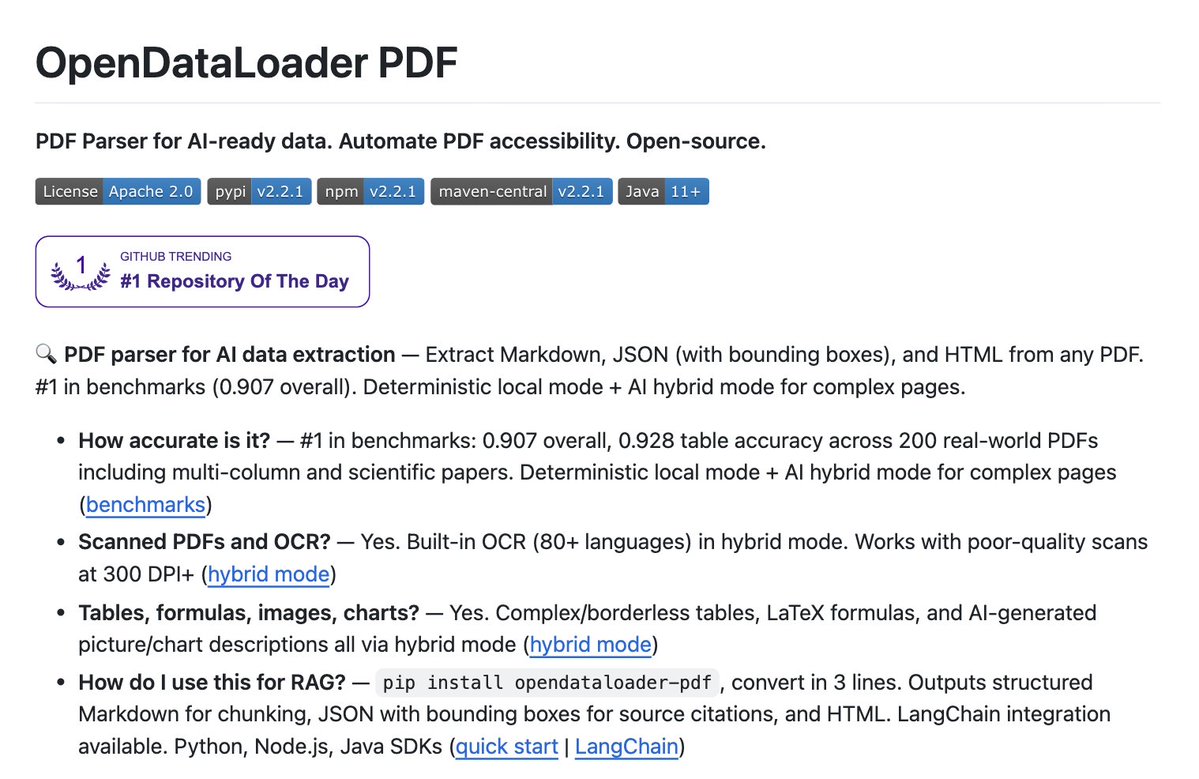
🚨 Someone just open-sourced a tool that converts pdfs to markdown at 100 pages per second.
It's called OpenDataLoader. It runs entirely on CPU and handles complex layouts, tables, and nested structures like a senior dev
100% Free.
The story of the man who got countless noise complaints for excessive screaming and loud music from neighbors and set up a nanny cam to find this.
https://t.co/eWyvrRlxd5
.@WCH_TECH is at it again with a 10-cent WCH CH570 RISC-V MCU. It features 2.4GHz wireless and USB 2.0 and is advertised as an update to the popular CH32V003 MCU.
https://t.co/Md3x8Y7nP8
The CH570 microcontroller also comes with 12KB SRAM, 256KB flash, up to 12 GPIOs, and more. CH572 has the same features, but adds Bluetooth LE support.
@patrick_riscv will be giving away 10,000 chips and 5,000 CH572 boards next week, so stay tuned. #semiconductors
Some people today are discouraging others from learning programming on the grounds AI will automate it. This advice will be seen as some of the worst career advice ever given. I disagree with the Turing Award and Nobel prize winner who wrote, “It is far more likely that the programming occupation will become extinct [...] than that it will become all-powerful. More and more, computers will program themselves.” Statements discouraging people from learning to code are harmful!
In the 1960s, when programming moved from punchcards (where a programmer had to laboriously make holes in physical cards to write code character by character) to keyboards with terminals, programming became easier. And that made it a better time than before to begin programming. Yet it was in this era that Nobel laureate Herb Simon wrote the words quoted in the first paragraph. Today’s arguments not to learn to code continue to echo his comment.
As coding becomes easier, more people should code, not fewer!
Over the past few decades, as programming has moved from assembly language to higher-level languages like C, from desktop to cloud, from raw text editors to IDEs to AI assisted coding where sometimes one barely even looks at the generated code (which some coders recently started to call vibe coding), it is getting easier with each step.
I wrote previously that I see tech-savvy people coordinating AI tools to move toward being 10x professionals — individuals who have 10 times the impact of the average person in their field. I am increasingly convinced that the best way for many people to accomplish this is not to be just consumers of AI applications, but to learn enough coding to use AI-assisted coding tools effectively.
One question I’m asked most often is what someone should do who is worried about job displacement by AI. My answer is: Learn about AI and take control of it, because one of the most important skills in the future will be the ability to tell a computer exactly what you want, so it can do that for you. Coding (or getting AI to code for you) is a great way to do that.
When I was working on the course Generative AI for Everyone and needed to generate AI artwork for the background images, I worked with a collaborator who had studied art history and knew the language of art. He prompted Midjourney with terminology based on the historical style, palette, artist inspiration and so on — using the language of art — to get the result he wanted. I didn’t know this language, and my paltry attempts at prompting could not deliver as effective a result.
Similarly, scientists, analysts, marketers, recruiters, and people of a wide range of professions who understand the language of software through their knowledge of coding can tell an LLM or an AI-enabled IDE what they want much more precisely, and get much better results. As these tools are continuing to make coding easier, this is the best time yet to learn to code, to learn the language of software, and learn to make computers do exactly what you want them to do.
[Original text: https://t.co/HdI3Jb9HmF ]
NO, HUMANS DON'T NEED TO WORK IN THE FUTURE
Sorry, we won't need 10x more programmers, customer support types, or lawyers in the future.
Once AI automates a job, it automates it! The job market for translators, transcribers, data entry, and audiobook creators HAS NOT EXPLODED because of AI.
It has categorically COLLAPSED!
The same will happen to other professions. Don't let anyone else tell you otherwise.
It's so 2024 to think that humans need to work 🙄🙄
The @stripe MCP Plugin for Cline is transforming how businesses handle payments through AI. Here's why it's a game-changer: 💳
Instead of wrestling with complex API calls or logging into Stripe's dashboard, you can now manage your entire payment infrastructure through natural language commands.
Want to add a new customer? Just say "Add John Doe with email [email protected]"
Need to set up a subscription? Simply tell your AI "Subscribe Jane to the Pro Plan at $29.99/month"
The magic happens when you realize you can handle everything from refunds to analytics without touching a line of code. Imagine checking your weekly revenue or managing customer disputes as easily as chatting with a colleague.
What makes this MCP Plugin special is how it bridges the gap between Stripe's powerful infrastructure and everyday business operations. Your AI assistant becomes your payment operations manager, handling tasks that would typically require technical expertise or manual dashboard navigation.
For Cline users, this means you can focus on growing your business while your AI handles the payment complexity. Whether you're creating invoices, processing refunds, or analyzing customer data, it's all accessible through natural conversation. 🚀
Think of it as having a 24/7 payment operations expert who speaks your language and knows Stripe's entire API by heart.
The best part? You don't need to understand the technical intricacies of payment processing. The MCP Plugin translates your everyday instructions into precise Stripe operations, making e-commerce management accessible to everyone in your organization. 💪
This is what the future of business operations looks like – where complex tasks become as simple as having a conversation.
If the people doing this, from
@elonmusk
on down, are honest about their intentions, they should have zero problem publishing EVERYTHING they are doing on a daily basis i absolutely want to see @Doge
reduce wasteful spending. But i want the process to be transparent..
I don't want to have to guess which media reports are accurate or not.
If this is the result of a detailed plan. I want to see the plan.
If this is legal. I want to see the law that supports it. If there are questions about whether it is, I want to see the opposition.
This isn't a shock and awe attack on foreign soil. This is a shock and awe attack on American Systems and Economics. That doesn't mean it shouldn't happen.
But if it should, then it should be 100 pct transparent. If they hide anything, they are doing it wrong. If they hide anything, that means the goals is not the interest of the American People. We were promised transparency. We should see everything
Here is the one aspect of DeepSeek R1 multiple languages (including its own on-demand language) that at times it <thinks> during reasoning,it is in:
SUMERIAN.
And most would not have caught it in these small parts of the <think> but I have studied this cuneiform.
More soon!




![cline's tweet photo. The @stripe MCP Plugin for Cline is transforming how businesses handle payments through AI. Here's why it's a game-changer: 💳
Instead of wrestling with complex API calls or logging into Stripe's dashboard, you can now manage your entire payment infrastructure through natural language commands.
Want to add a new customer? Just say "Add John Doe with email [email protected]"
Need to set up a subscription? Simply tell your AI "Subscribe Jane to the Pro Plan at $29.99/month"
The magic happens when you realize you can handle everything from refunds to analytics without touching a line of code. Imagine checking your weekly revenue or managing customer disputes as easily as chatting with a colleague.
What makes this MCP Plugin special is how it bridges the gap between Stripe's powerful infrastructure and everyday business operations. Your AI assistant becomes your payment operations manager, handling tasks that would typically require technical expertise or manual dashboard navigation.
For Cline users, this means you can focus on growing your business while your AI handles the payment complexity. Whether you're creating invoices, processing refunds, or analyzing customer data, it's all accessible through natural conversation. 🚀
Think of it as having a 24/7 payment operations expert who speaks your language and knows Stripe's entire API by heart.
The best part? You don't need to understand the technical intricacies of payment processing. The MCP Plugin translates your everyday instructions into precise Stripe operations, making e-commerce management accessible to everyone in your organization. 💪
This is what the future of business operations looks like – where complex tasks become as simple as having a conversation.](https://pbs.twimg.com/media/GkWnlMVa4AAdE_-.png)