Amazon Quick has Google Gemini beat!
HyperFRAME Research is homogeneous in our deployment of Google Workspace, we don't use Slack, Teams, or Zoom, we are 100% Google. You could say we are all-in on Google.
Stephanie Walter and I have been playing with Google Studio and the various Gemini features for weeks now, trying to do one simple thing:
"Go through all of my emails and find every email with the term "sow" or "statement of work" and then create a Google sheet with all of that info arranged into the following columns: name | email address | Company | short summary of the discussion | date of last interaction.
Google has spectacularly failed, after hours of trying, to perform what I think is a simple task. Especially since it has access to all of the data and has one of the best frontier models in Gemini. Epic fail, and even asking Gemini to help was an epic fail. Gave up...
Amazon Quick has gone from downloading, giving it permissions, to task completed in 25 minutes! And that is with me stumbling around with a new UI and not really knowing what I am doing.
The process was not one and done, and it took about 10 interactions to give permissions and review output, but 25 minutes later, the task was done.
Mind blown 🤯
Yesterday we launched Amazon Quick Desktop.
Today - Extensions for Word, Excel & Powerpoint. Quick just shipped a personal AI assistant that can do almost everything for you 🚀
Try it with your personal email → https://t.co/02xgeT6SAG
@amazonquick@awscloud@AmazonScience
Amazon Quick changes how you work. Today we're releasing it in desktop mode—a proactive AI assistant that connects to your apps, builds a personal knowledge graph from your work, and gets smarter every session. No AWS account needed. Quick finds the smarter way to get it done ➡️https://t.co/IKyc5ZWoTi
#WhatsNextwithAWS
NEW from @awscloud at #WhatsNextWithAWS: Amazon Quick just dropped its BIGGEST update since launch.
💻 Quick is now a personalized app on your desktop
🤖 Proactive AI that works in the background, surfacing what you need before you even ask
✅ Create live dashboards, apps, polished presentations, and engaging images
In other words: one AI platform that remembers you, builds for you, and connects to everything you already use.
The Quick desktop app is here, and it’s compelling.
Connects to your email, calendar, Slack, local files, and several other apps to flag important communications, retrieve and summarize info, make recommendations, send communications, and create agents that do work you used to have to do yourself. Gets smarter and more personalized the more you use it.
Been using it a lot recently and is changing how I work. It’s allowing me to use applications like my inbox more like an archive, and Quick as my personalized, prioritized, productivity hub that can multi-task various needs.
Still early days, and a lot more coming, but excited for folks to start using it to make the undifferentiated work so much less complicated. https://t.co/UtuGTDx4gT
Amazon Quick Desktop just launched, and I'm proud to have been one of the creators and science leaders behind it. 🚀
Amazing team. Amazing product. Go try it.
#AmazonQuick#AWS#AI
Amazon Quick is now available as a desktop app on your computer.
Quick connects the dots across tools and conversations, helping you stay ahead of meetings, follow-ups, and shifting priorities.
Your AI assistant sits beside your workday, learns the context of your projects, and works directly with your calendar, email, and local files, so you never start from zero.
Thrilled to share that our work has been accepted to the ACL 2025 main conference with a Strong Accept recommendation, placing in the top 15% of accepted papers! @AmazonScience@AWS
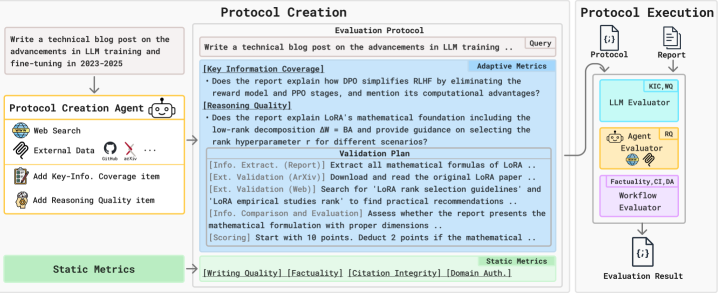
Excited to share our latest work—DREAM: Deep Research Evaluation with Agentic Metrics
TL;DR: How do you reliably evaluate Deep Research Agents (DRAs)? With another agent. We introduce a framework that makes evaluation itself agentic.
Preprint: https://t.co/ybNPAYu2fz
🧵
DREAM: Deep Research Evaluation with Agentic Metrics
Addresses the "Mirage of Synthesis" where static LLM judges fail to detect factual errors beneath fluent reports. DREAM makes evaluation agentic: tool-equipped agents create custom protocols with adaptive metrics, then route them to specialized evaluators. This establishes capability parity for more reliable assessment.
📜 New Paper:
We can't grade tomorrow's deep research agents with yesterday's static rubrics. As AI takes on complex tasks, establishing capability parity between an agent and its evaluator is a requirement for trust.
Check out how we're solving this in our latest paper. 👇
Evaluating agents with agents. The DREAM framework tackles one of the trickiest meta-problems in deep research right now. Check this out 👇 #AmazonScience
Excited to share our latest work—DREAM: Deep Research Evaluation with Agentic Metrics
TL;DR: How do you reliably evaluate Deep Research Agents (DRAs)? With another agent. We introduce a framework that makes evaluation itself agentic.
Preprint: https://t.co/ybNPAYu2fz
🧵
It's not every day I can share news that will completely transform your workday 🚀
Over the last couple of years, we’ve seen how AI can transform our personal lives, but this hasn’t been replicated at work—yet. That's all changing today with Amazon Quick Suite, a new agentic AI experience invented at @Amazon and tested by tens of thousands of our employees.
Amazon Quick Suite is your AI teammate that helps you cut through the noise of repetitive tasks and fragmented information. It can pull data from your documents (in SharePoint, Google Drive, OneDrive, etc.), emails (like Outlook), messages (like Slack), enterprise apps (like Salesforce and ServiceNow), data warehouses (like Redshift, Snowflake, Databricks, and many more) and the web so you can get work done faster. With support for MCP and partners like Workato and Zapier, you can connect data from 1000s of apps with Quick.
There’s a lot more to Quick than I can cover in this post alone—my latest blog has all the details. Give Quick a spin today and see why teams at Amazon are loving this! ➡️ https://t.co/qbS1U02VcR
Excited to share that our paper, "DocVLM: Make Your VLM an Efficient Reader," got accepted to CVPR! 🎉 Unlike general vision tasks, document understanding with Vision-Language Models demands high-resolution images, leading to a significant computational burden.
@CVPR#AI#LLM
Very excited to speak tomorrow at the NICE workshop
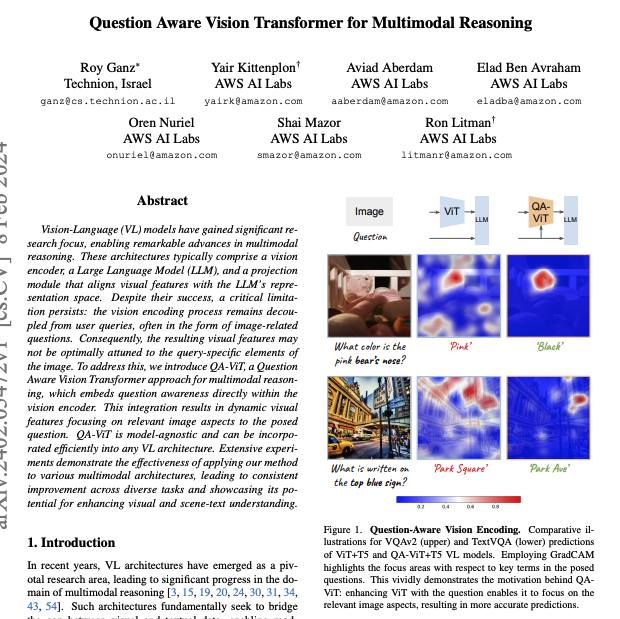
@CVPR, where I will be talking about our recent work: "Question Aware Vision Transformer for Multimodal Reasoning"
Talk details: https://t.co/Lofz4cYzZS
(15pm, Summit323)
I am thrilled to announce that our work was accepted as SPOTLIGHT to @CVPR!
The official code is available at https://t.co/qdk012iO2h (currently, code and checkpoints for inference. Training will be available soon).
@AmazonScience
עמית שלום,
התמונה צולמה בניר עוז ב8.10, לאחר 24 שעות לחימה. בזמן הזה ״אחים לנשק״ הקימו את החמ״ל האזרחי, פינו וחילצו בגופם את אנשי העוטף, איתרו ומיפו נעדרים וחטופים. היום אני אחרי 140 ימי מילואים, מה אתה עשית לטובת המדינה מאז?
במה אתה השתנת?
אותה רטוריקה ואותו פילוג.
אנחנו הבנו את גודל השעה.
לצערי אתה עדיין ממשיך לנסות ולהפריד ביננו.
Amazon presents Question Aware Vision Transformer for Multimodal Reasoning
paper page: https://t.co/jsgTITfmjJ
Vision-Language (VL) models have gained significant research focus, enabling remarkable advances in multimodal reasoning. These architectures typically comprise a vision encoder, a Large Language Model (LLM), and a projection module that aligns visual features with the LLM's representation space. Despite their success, a critical limitation persists: the vision encoding process remains decoupled from user queries, often in the form of image-related questions. Consequently, the resulting visual features may not be optimally attuned to the query-specific elements of the image. To address this, we introduce QA-ViT, a Question Aware Vision Transformer approach for multimodal reasoning, which embeds question awareness directly within the vision encoder. This integration results in dynamic visual features focusing on relevant image aspects to the posed question. QA-ViT is model-agnostic and can be incorporated efficiently into any VL architecture. Extensive experiments demonstrate the effectiveness of applying our method to various multimodal architectures, leading to consistent improvement across diverse tasks and showcasing its potential for enhancing visual and scene-text understanding.