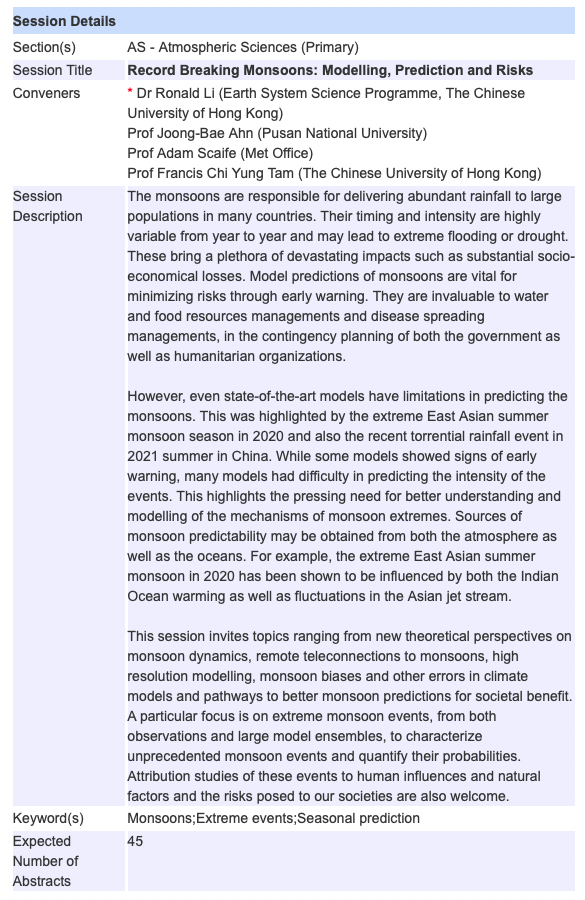
Calling for abstracts on "Record Breaking Monsoons: Modelling, Prediction and Risks", in our session AS26 at the AOGS 2022 virtual conference from 1-5 Aug 2022! Deadline 23 Feb 2022. Attached is our session description and submission link. https://t.co/VYMfjUAACH
Higher heights from the @ECMWF 2021 Summer forecast closely resemble the Circumglobal Teleconnection pattern (black circles). In our 2-min video, we show how the prediction skill of this over Eurasia - the Silk Road pattern - is reduced by Asian jet bias. https://t.co/qZq9TDQCSS
@Tess_J_Parker@zoegillett27@ClimateExtremes@MonashEAE Useful article Tess! May I also ask how far ahead in time was the extreme rainfall predicted? La Nina has a seasonal signal, what about the Rossby wave breaking?
Summer internship available in our group, looking at decadal climate variability. UK students from inside or outside Oxford welcome. Paid at £10.50 per hour plus possible access bursary to help with accommodation. Please spread the word! https://t.co/UDzzm7vTdA
3 more days left to submit abstracts on #monsoons 🌧️to promote your research at the international conference @AOGS_ 2022🌏! Our session is AS26 "Record Breaking Monsoons: Modelling, Prediction and Risks". Abstract submission deadline is 23 Feb 2022, more details below. Welcome!
Calling for abstracts on "Record Breaking Monsoons: Modelling, Prediction and Risks", in our session AS26 at the AOGS 2022 virtual conference from 1-5 Aug 2022! Deadline 23 Feb 2022. Attached is our session description and submission link. https://t.co/VYMfjUAACH
Call for undergraduate admission for 2022/23 in our newly merged Earth and Environmental Sciences Programme 🌏 at @CUHKScience in @CUHKofficial in Hong Kong 🇭🇰! English description on the slides but the audio is in Cantonese: https://t.co/xH73nDDuNe
After a successful #AOGS2021 at @AOGS_ our presentation on the Effects of ENSO diversity and cold tongue bias on seasonal prediction of South China late spring rainfall (Li et al. 2021 Climate Dynamics https://t.co/esETbB4G5t) is now available on YouTube https://t.co/rL4PZlRFPi
A new paper by Shirley Liu, Amos Tai, and I exploring the impact of agricultural emissions on ozone and the nitrogen cycle is out for discussion on ACPD.
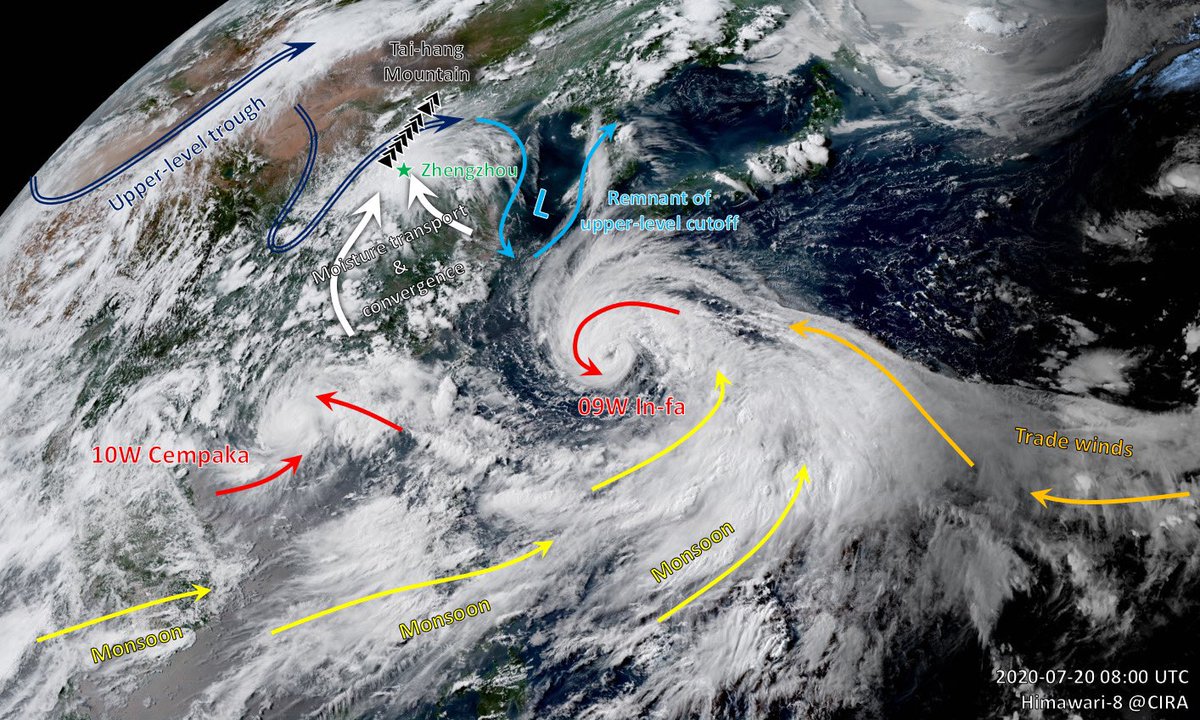
@Minghao_Zhou Great analysis of the observations and the short-range weather predictions! But may I ask why in the satellite photo, the bottom-right year reads 2020 instead of 2021? Thanks.
The wavy jet is indicative of the Silk Road pattern, which might have strengthened the high pressure to the north-east of #Zhengzhou and enhanced the moisture transport, leading up to the #HenanFlood. Prediction from June already hinted at this pattern: https://t.co/I1fN5GJZbS
Archived content: sketch of how extreme rainfall in Zhengzhou, China was related to (1) moisture transport enhanced by the monsoon gyre, (2) deepening upper-level trough, and (3) leeward inverted trough and upslope flow. 1/n
Leading up to the devastating #HenanFlood (black X), southerlies from the nearby high pressure - part of the Silk Road pattern - might have enhanced the moisture transport from the monsoon and set the stage. Forecast from June actually hinted at this, though not as extreme!
Higher heights from the @ECMWF 2021 Summer forecast closely resemble the Circumglobal Teleconnection pattern (black circles). In our 2-min video, we show how the prediction skill of this over Eurasia - the Silk Road pattern - is reduced by Asian jet bias. https://t.co/qZq9TDQCSS
Weather in Europe and Japan are connected through the Silk Road pattern. Our studies look at how we can better predict this important teleconnection: Li et al. (2020, https://t.co/od9hWod6FN) and Li et al. (2021, https://t.co/aKJuoxRPpW). And 2-min video https://t.co/qZq9TDQCSS
Waveguide teleconnections - such as the Silk Road pattern - strongly modulates Eurasian summer extremes. How does the Asian jet affect its prediction skill? Our studies Li et al. (2020, https://t.co/od9hWod6FN) and Li et al. (2021, https://t.co/aKJuoxRPpW) provide the answers!
Heat extremes aren't far from the news at the moment! Right on cue, we have a new paper out, led by @peiqiang_xu (+ @GeoffVallis @ruth_geen et al), showing that persistent anomalies in the jet stream favour summer temperature extremes over Northern Eurasia https://t.co/Pqq0Fs1Bxy
It's happening! How does the Indian summer monsoon force the Silk Road pattern - the Eurasian part of the CGT? How is the prediction skill affected by the Asian jet? We address both questions here https://t.co/aKJuoxRPpW
A strong manifestation of the Circumglobal Telecconnection (CGT) pattern is showing up just after mid-July, esp on the GEFS. This pattern is in large part forced by subseasonal enhancement of the Indian Summer Monsoon.
See Beverley et al (2021) for more:
https://t.co/lgtIG32tWL
@giodc3 Flooding is another mental image of mine for the monsoon! And if video is more convenient for you, I discussed how the Indian summer monsoon forces the Silk Road pattern, and its sensitivity to the mean state of the Asian jet, here at https://t.co/9xdIMFyACd
@JBeverley93@AntjeWeisheimer@horkesley@UniRdg_Met This reminds me of my paper on the forcing mechanism of the Silk Road pattern - the Eurasian part of the CGT (https://t.co/aKJuoxRPpW). While our experiment (Fig 4c) also shows slight westward wave propagation from ISM, ours is more suggestive of eastward wave affecting Europe.