Pleased to write for The Wire.
I have critiqued the gender stereotypes perpetuated by courts in several pronouncements. I have argued that the onus is on the judiciary to dismantle the barriers in accessing justice such that women can reaffirm their faith in the legal process.
Gender stereotyping dilutes the seriousness of gender-based violence and sends out a message to the wider public that the perpetration of such acts is condoned by the criminal justice system. | Rongeet Poddar writes
https://t.co/fAEdzLXiFW
Courage:
The half-submerged tribal women of MP who lay on pyres and stood beneath nooses,
just to save their rivers, their forests, and their land.
The thousands who marched yesterday in Delhi, asking for accountability.
The girl from Bihar who boarded a crowded general-compartment of a train with 20 rupees in her pocket because she thought showing up matters.
The journalist who ran, coughed, wiped the tear gas off her eyes, and kept reporting.
The young girl, under a rain of batons, asked the police, "Am I not like your child?”
The labourer who sat in solidarity, very aware of the day’s wages he is going to lose.
The young doctors who dressed wounds while being beaten up themselves.
The rickshaw driver who ferried students to the protest for free.
The blind man who couldn’t see the crowd but handed water bottles to everyone.
The strangers who anonymously sent food and the volunteers who served.
The boy from MP, who brought peanuts and an onion in a tiffin box
to a protest that met with batons and tear gas.
The brave student who after being struck on the shin with a baton, asked for another blow.
Those who stood, when standing came at a price.
When overcome by fear, courage was the only option.
History will remember those who looked at a nailed baton in the eye and did not flinch.
Te remind us that our nation was, is and will forever be, of the people.
Doing this online with the Wolfson College Research Networks:
'The Difficulties of ‘Doing’ Third World Approaches to International Law (TWAIL)'.
Date: 14 May 2026
Time: 3pm-4pm
Zoom link: https://t.co/bpQBGvNJTO
Do join!
Glad to share my new paper for JILS at WBNUJS. Have relied upon Miranda Fricker's lens of testimonial injustice to argue that the Supreme Court of India has entrenched a jurisdiction of suspicion against Rohingyas refugees.
The paper can be accessed at: https://t.co/ojrYz1EFpd
I have no idea what happened in Kolkata in the Messi event. But I couldn't help thinking that we Indians really do not like sport. We like stars.
What else could explain the millions, and I mean millions of dollars we spend to fly in superstars, when they will not even play a proper match.
I am ok with paying whatever it takes to bring in a top football team to play in India, like Messi did in 2011 or Tata Steel did for a long time in the 80s and 90s.
But getting them to come here just to shake hands and pose for pictures defies all reason. They will sell real estate, take pictures with every sponsor and go back with more money in two days than say the I League used to spend in a year.
I don't blame the organizers for getting into this, its a really profitable business, because the politicians are getting serious free mileage and the sponsor is spending his, or his company's money to fulfil his childhood fantasy. The journalists are overawed just to be there with a generational superstar, lots of folks are spending a reported Rs 10 lacs for a handshake and a photo op and the real estate guys are busy pushing deals.
That's millions of bucks spent on a footballer, whose closest attempt at action would be kicking a few footballs at the crowd or dribbling for a few minutes. Money that is desperately desperately needed elsewhere in actual football. Real camps, matches, ground level sponsorships. Or even to revive a football league.
And then we expect India to be better at sport!
Delhi High Court issued a dynamic injunction to block access to Sci Hub, Sci Net & its mirror websites on a complaint by Elsevier.
@Apoorvkc & @Rongeet18 argue that copyright protection has become a smokescreen for sustaining a skewed research ecosystem.
https://t.co/4ev6K1nNyB
My paper, 'Human Rights and Jurisdictional Trajectories: Shedding Light on the Colonial Genealogy,' has been published in the NLSIR Special Issue on 'TWAIL and the International Law of Jurisdiction.'
It represents a labour of love from the early phase of my PhD journey.
Our special Issue on 'TWAIL and the International Law of Jurisdiction' is finally out! https://t.co/oZ6FA4QnUM
Please do read these excellent contributions where senior and junior scholars come together to think critically with Prof. B.S Chimni about the concept Jurisdiction in International Law
@NLSIRev@Chimenekeitner
Here is my appraisal of Justice Chandrachud's Disability Jurisprudence. I thought of writing this counterintuitive piece for SCO to problematize the overwhelming consensus on his disability jurisprudence being 'progressive.'
https://t.co/Xx5WyJjCYk
Jobs-for-work scheme #MGNREGA guaranteeing 100 days a year of paid work stopped in #WestBengal since Dec 2021, amid #Modi govt-@AITCofficial govt row on corruption. Result: a wave of migration, as rural poor lose jobs. By Mrinalini Paul
https://t.co/iiDH0qQdZT
Today, the Supreme Court struck down provisions in various State Prison Manuals that mandated the assignment of work in prisons based on caste & the classification of denotified tribes as habitual offenders. The judgment was delivered in Sukanya Shantha v. UOI~1
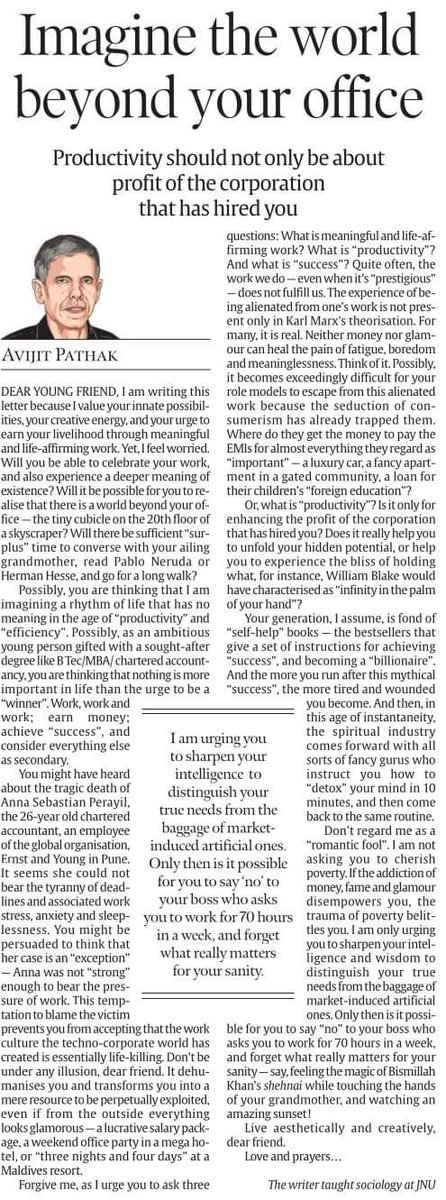
Never had the privilege of being taught by Prof Avijit Pathak, but his profound writing continues to offer a calm moment of introspection amidst all the cacophony.
Wrote this piece for The Leaflet, deeply affected by last week's tragic incident.
I make a case for pushing back against the ongoing valourization of long working hours, with the hope that we can cultivate empathy at the workplace alongside worker-friendly labour reforms.
India needs to forego valourisation of overwork and take workers’ well-being seriously, else there will be many more Anna Sebastian Perayils, writes Rongeet Poddar.
https://t.co/Bis3ZaPGul
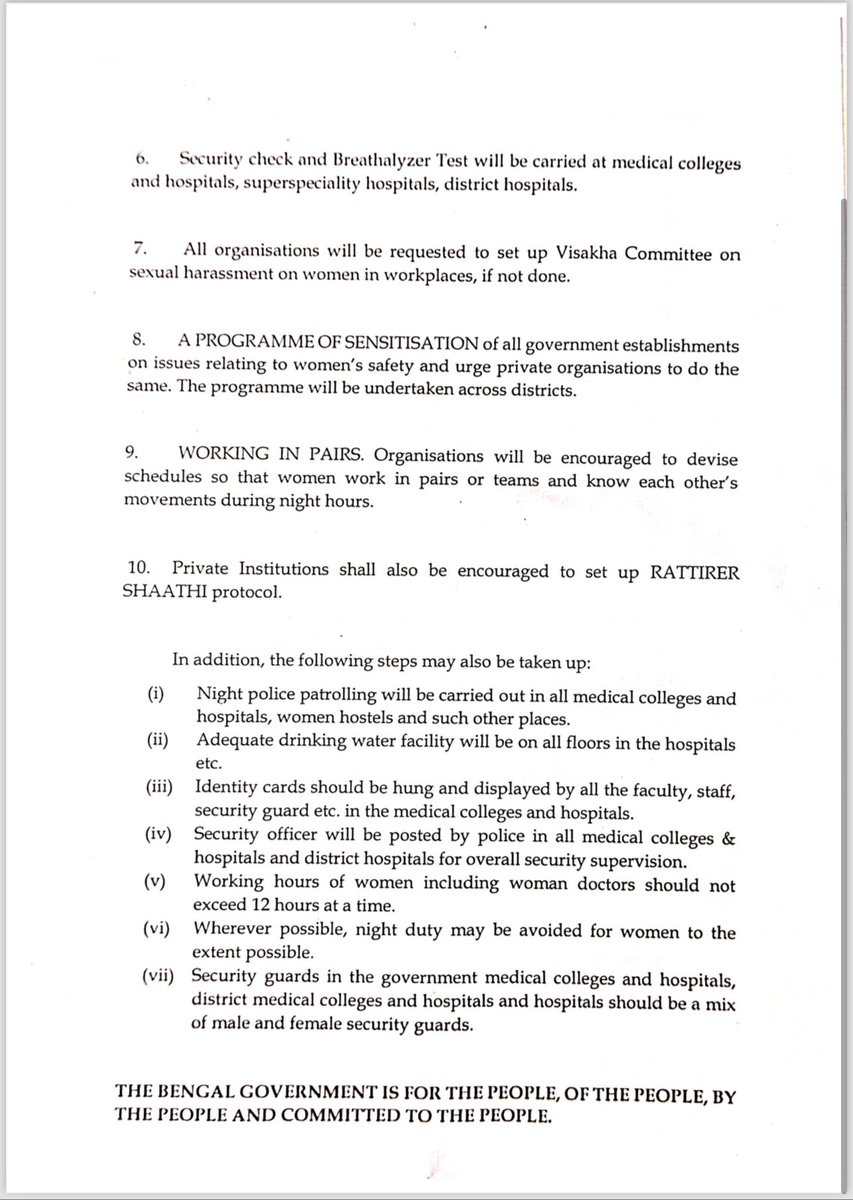
"Guideline 10 Para (vi) - Wherever possible, night duty 'may' be avoided for women to the extent possible."
After reclaiming the night of Independence Day on the streets, the last thing that women need is a patriarchal state's saviour complex.
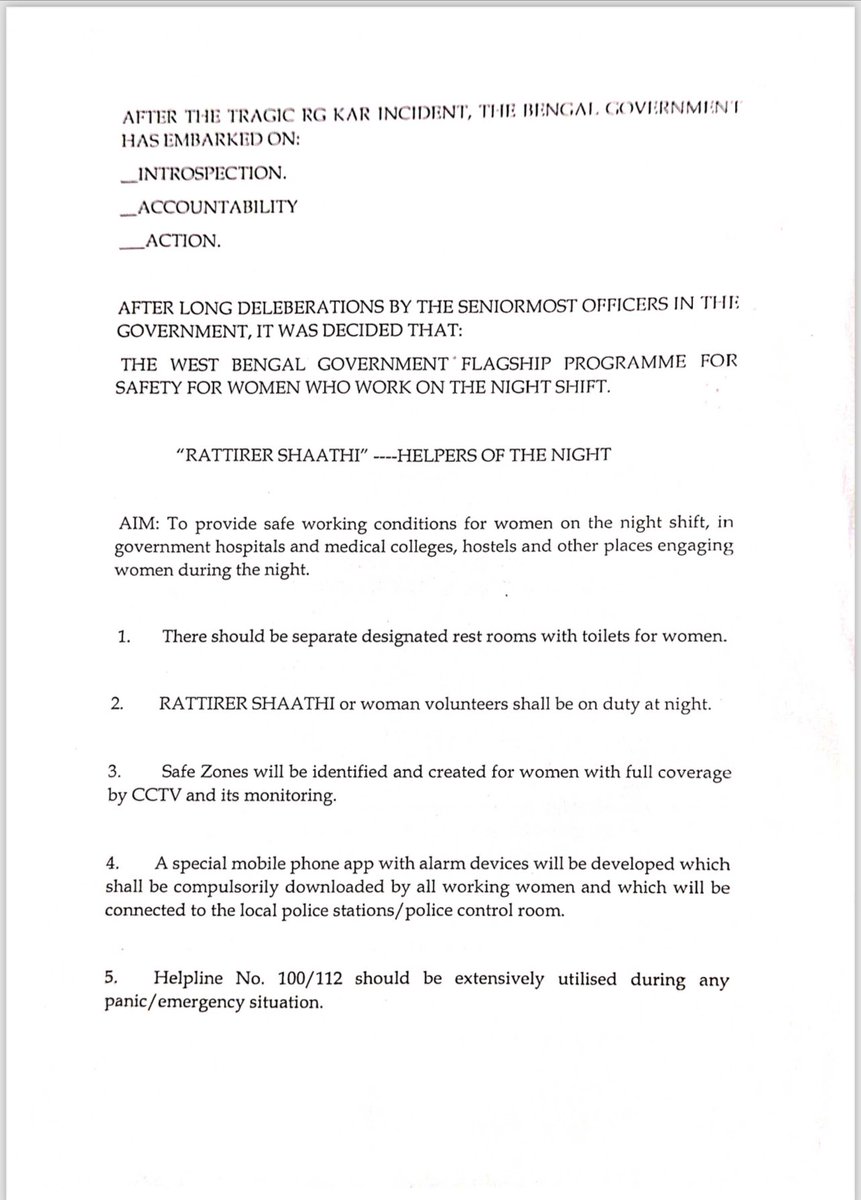
#Breaking: #WestBengal govt draws new measures for women’s safety across the stae in the backdrop of rape & murder of a doctor.
Some of the decisions for safe working conditions for women:
Working hours for women doctors should not exceed 12 hours and night duty to be avoided as much as possible.
Security check & Breathalyzer Test will be carried at medical colleges and hospitals, superspeciality hospitals, district hospitals.
There should be separate designated rest rooms with toilets for women.
Women volunteers will be deployed at night under the force named as ratirer sathi.
CCTV monitored of safe rooms.
Ratri sathi includes Special mobile phone app with alarm which will be connected to local PS.
112 should be established for Panic situation & Security check to be made mandatory.
All organisation to set up Vishaka committee for sexual harrasment if not done already.
Programme related to women safety to be organised across districts.
Night police patrolling in women colleges, hospitals & women hostel.
Identity Card wearing for staffs & Faculties to be made mandatory.
Security guard should be both male and female.
"Compulsory gender testing was instituted as result of Western athletes outperformed by Eastern bloc competitors during the Cold War.. Since collapse of USSR, all athletes restricted from competing internationally as women have been from the Global South."
https://t.co/NeIt7s5hc4
Wrote an editorial comment on @epw_in on the contractualisation/casualisation of academic labour. It is an issue close to me and I am glad that EPW has published the piece. It's high time we begin these conversations about gig work in indian academia.
https://t.co/HLzsqcu0DF
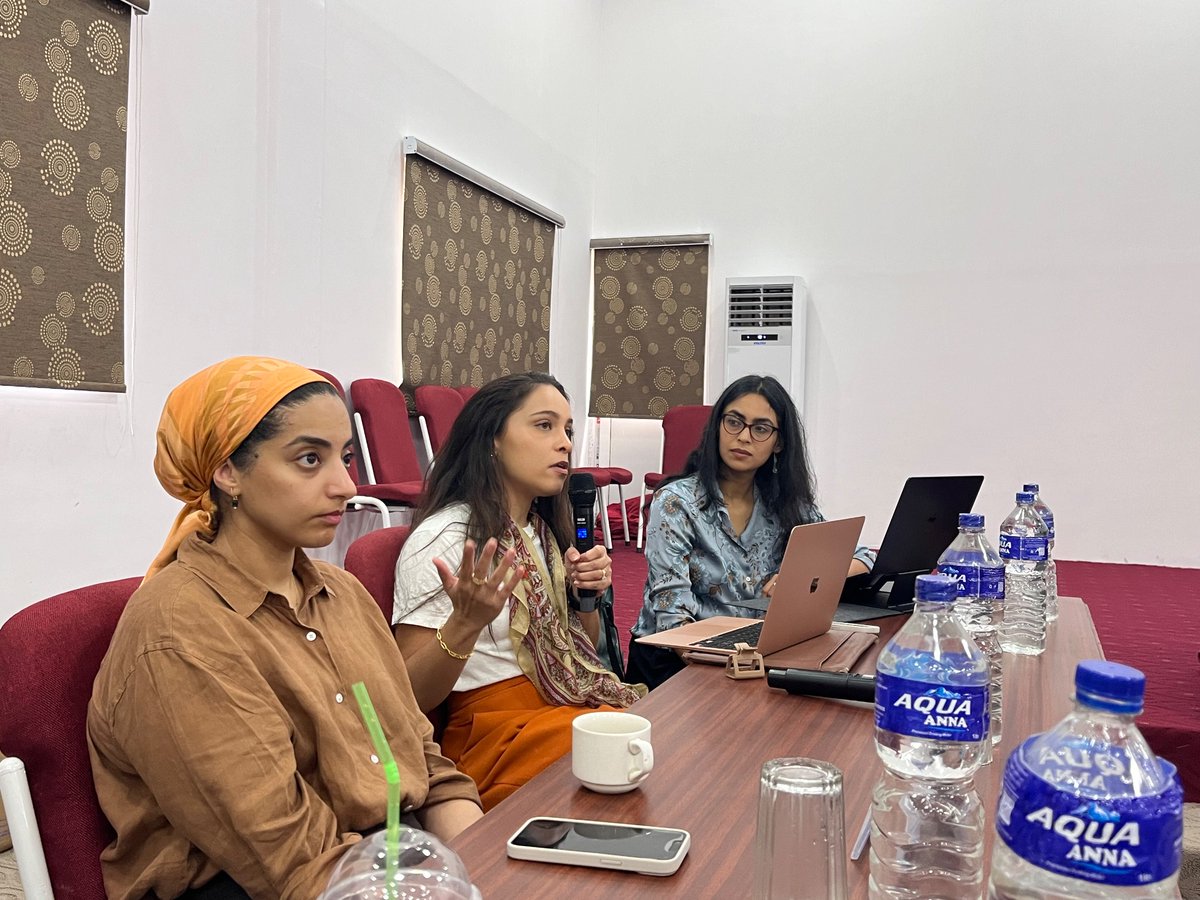
Immensely grateful to the Feminist TWAIL Collective's founding members for providing an inclusive platform at a Global South location. They made it possible for me to present the working draft of my co-authored paper and ideate on epistemological alternatives without inhibitions.
These 3 incredible women behind the Feminist TWAIL Collective organised their 2nd writing workshop in Kathmandu. They organised it in Nepal (without exoticising it), worked with a local university AND ensured almost all participants were academics based in the Third World.
"Private and public sector employers, including IIT-B, now often keep long-serving workers on short-term contracts, sometimes cyclically replacing labour contractors, to deny employment benefits or post-retirement benefits."
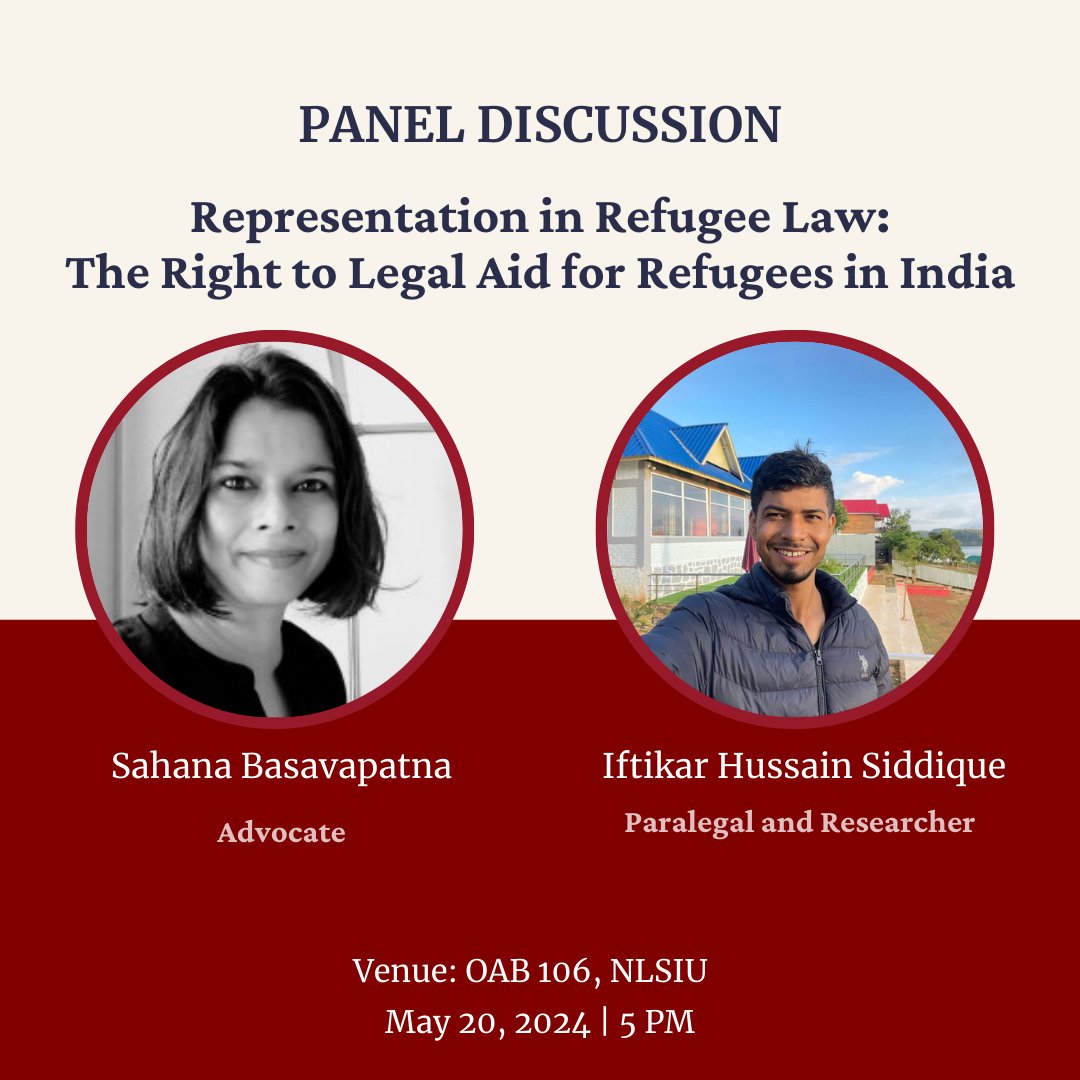
The UNHCR Chair on Refugee Law at NLSIU is organizing a panel discussion titled “Representation in Refugee Law: The Right to Legal Aid for Refugees in India”, on May 20, 2024.
Read more https://t.co/QmrOBoIu88
The roundtable videos for the TWAIL NLSIR Symposium are here.
If you were unable to join us for the rich discussions in the symposium, please check them out.
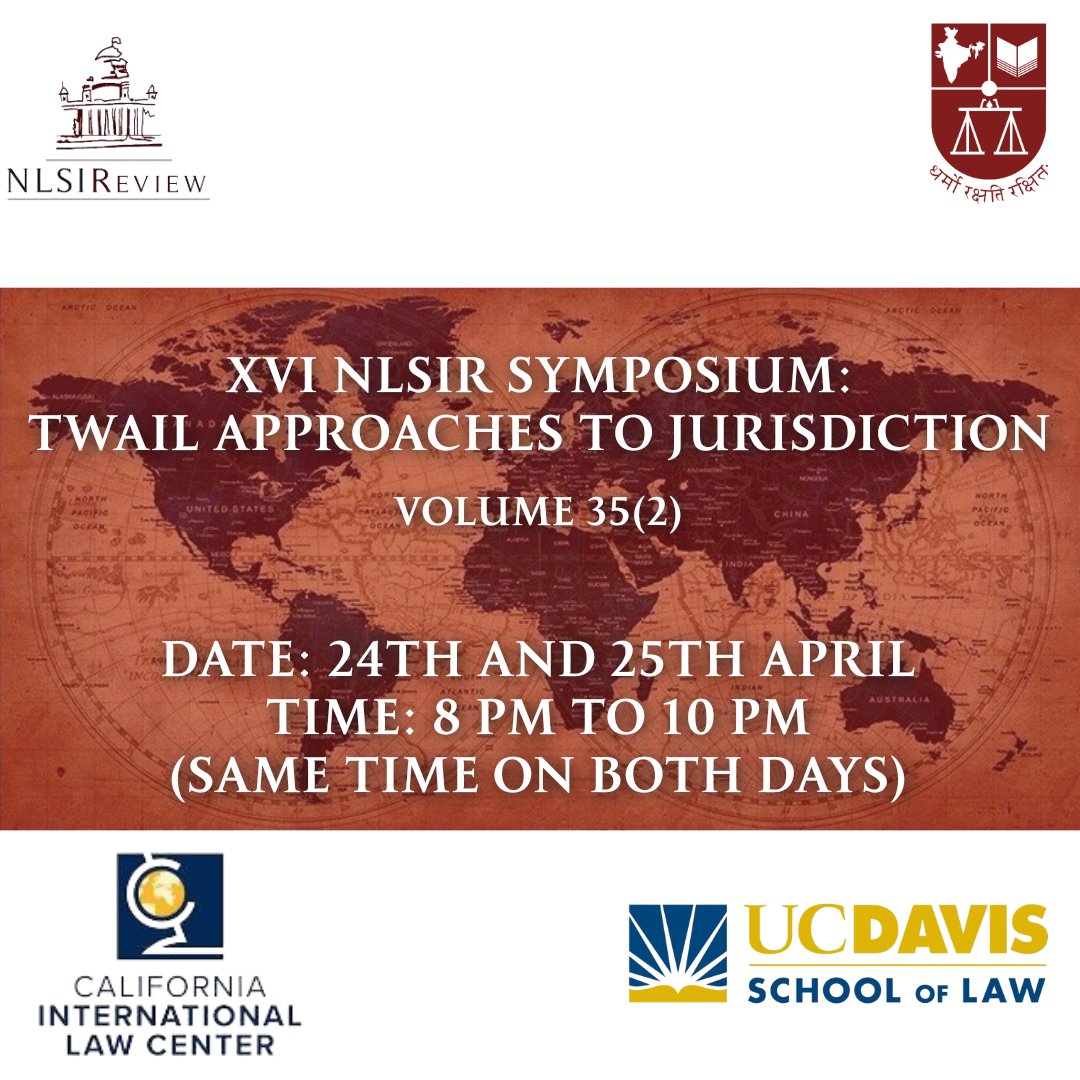
NLSIR, in collaboration with @CaliIntlLaw (@UCDavisLaw), is organising the XVI NLSIR Symposium on TWAIL Approaches to Jurisdiction on 24-25 April, 2024. Details available here - https://t.co/kV7B8tYt2l