VC @companyonvc | Former Capital Markets @OpenViewVenture| Former founding member of Cambridge Associates’ co-investment group | Food, wine, tennis, and tech
@deedydas In venture, you increasingly need to go early on valuations or be a later stage fund underwriting to a different risk profile. The middle is getting harder by the day.
At the $100M valuation mark, you need more and more true outliers at $5B-$10B+ to do the heavy lifting.
@endowment_eddie I always assumed it was an LP “bucket” term on portfolio fit.
In reality, it shouldn’t matter when you’re trying to select the best pickers in the field.
@PeterJ_Walker Young but promising! We invested early in @FlexSuperApp and @zaidrmn has been lighting the world on fire building an AI native private bank for business owners. Raised a big Series B last year and more to come in 2026 👀.
Miami will see more tech growth in the next few years.
Most founders lose VC deals before the first slide. Before they even enter the room.
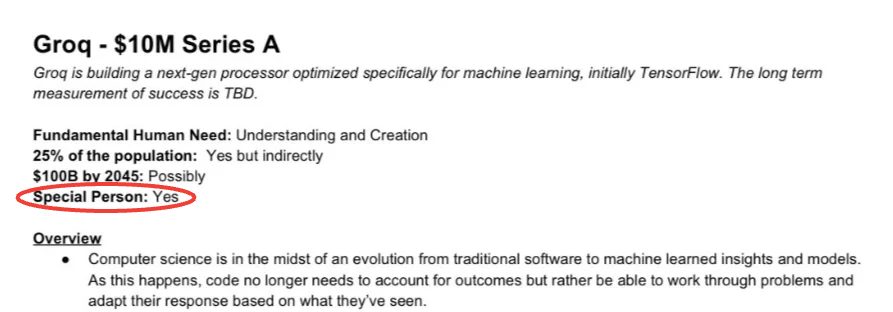
Here’s the single line from Chamath’s Groq memo that explains why.
The $10M check into Groq’s $25M valuation Series A — an investment that will return billions through the Nvidia deal.
Most people will stare at the returns.
But the most important line in the memo isn’t financial at all:
“Special Person: Yes”
I’ve been on both sides of the table.
As a founder, I pitched hundreds of VCs.
Now I’ve sat in partner-level investment committee meetings, listening to how real decisions actually get made.
And here’s something that surprised me early on:
A shocking number of IC discussions are not about product, models, or decks.
They boil down to one question:
“Is this founder special?”
I used to press investors on this.
What does special mean?
Pattern match? IQ? Grit? Vision?
No one could give a clean answer.
Not because they were hand-waving — but because “special” isn’t a checklist.
It’s a conviction.
It’s that feeling where, after seeing hundreds of founders a quarter, one person creates a pause in the room, an inevitability.
The partner leans back.
The conversation slows down.
Someone says: “I don’t know how big this gets… but this person will figure something out.”
That’s what “Special Person: Yes” really encodes.
At the earliest stages, most deals are 80–90% team.
And that judgment is formed before the spreadsheet is opened, often before the person even enters the room.
Founders should internalize this:
You don’t need to be special at everything.
But you do need to be world-class at something that matters.
Technical depth others can’t touch.
Insight from living the problem for years.
An execution engine that makes normal timelines look slow.
Or scar tissue from doing the impossible once already.
Investors see hundreds of founders a quarter.
They’re subconsciously asking:
Why you?
Why now?
Why should I bet my reputation on this person?
Sometimes the answer becomes a single quiet line in a memo.
“Special Person: Yes.”
And that one line can be worth billions.