Decoding hair loss papers into actionable data. 🧬 📉 Self-Experimenting: Minox + 1.5mm Needling. 🧪 Goal: Regrowth via Science, not Hype. Not medical advice.
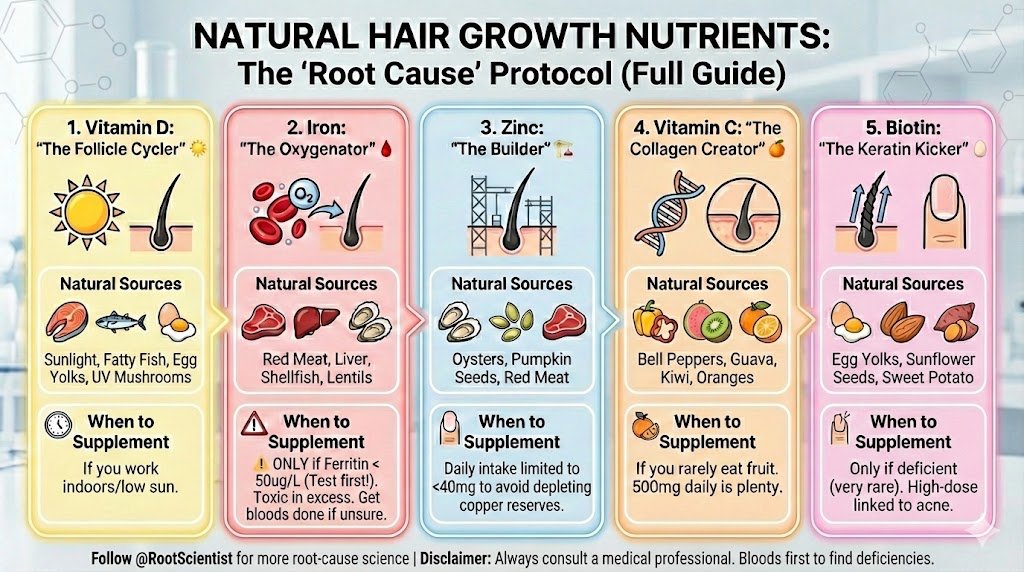
Many hair growth supplements pass right through your system unabsorbed.
Your body absorbs nutrients from real food 10x better than from a pill.
Here are my Top 5 vitamins and minerals for hair density, where to find them, and the when you should supplement.
Enjoy the read 👇
@questmoosa Solid find, and the biology’s real: androgen-driven TGF-β1 does ride on ROS, and Shin et al. (2013) switched it off with an antioxidant. One snag though: that antioxidant was NAC, on rat cells in a dish. Not vitamin E. Promising lead, but the dish isn’t your scalp yet.
@questmoosa Good instinct, stress can absolutely trigger shedding (telogen effluvium), a 2021 Harvard mouse study (Choi, Nature) showed cortisol keeps follicles in rest. BUT that’s reversible shedding, not genetic pattern baldness. Calm won’t regrow a DHT-driven hairline.
@XScienceCraft A lot of BS to flog a batana oil affiliate link. Coconut oil does cut breakage (Rele, 2003), but no oil grows hair “3x faster”, that rate (~1cm/mo) is set by genes + DHT. Lemon juice irritates the scalp and for reference- conditioning isn’t regrowth.
Bottom line:
No cure was announced, nothing changes your routine tomorrow. But the through-line was clear: the field is shifting from slowing hair loss to regenerating follicles, with Korea driving it. Pipeline’s the healthiest in 30 years.
Follow @RootScientist for more.
The biggest event in hair science just wrapped.
The 14th World Congress for Hair Research (Seoul, May 28-31) drew a record 1,700+ researchers from across the globe. Theme: “Awakening the Soul of Hair Science.”
Here’s a roundup of what actually mattered 👇
On the natural side:
A Korean team (Aekyung) unveiled L-THP, a compound from corydalis, as a hair-loss-relief candidate. Historically studied for anti-inflammatory effects, now explored for follicles. Early-stage and industry-led, so file under “watch,” not “proven.”
The pattern across all 5: hair grows at the follicle, 3-4mm below the skin. To reach it you need molecules that penetrate (minoxidil) or controlled injury (microneedling). Eggs, rice water, and ACV do neither.
Follow @RootScientist for more science.
5 food-based hair growth remedies you’ve seen on X. None of them regrow a single follicle, and the biology for why each one fails is genuinely simple. Quick rundown 👇
Myth #5: Green or black tea rinses block DHT and regrow hair. Mechanism is real. EGCG (in tea) inhibits 5α-reductase in lab dishes. The problem is delivery. A 2-3 minute rinse can’t get enough EGCG through the scalp to reach follicles meaningfully. Lab petri dish ≠ human scalp.
Bottom line: NAFL is legit. New device class, FDA-cleared, real mechanism. ASLMS data is promising but thin on detail. Treat as emerging adjunct, not breakthrough. Fundamentals (finasteride, minoxidil) still do the heavy lifting.
Follow @RootScientist for more science.
A new device class for hair loss just got fresh clinical data at ASLMS this week. It’s not LLLT. It’s not microneedling. It’s NAFL: non-ablative fractional laser. Here’s what it is, what the science says, and whether it’s worth the money 👇
Practical reality: 4-6 monthly clinic sessions to start, then 2-3 maintenance sessions yearly. Not a DIY treatment. Side effects include redness, temporary shedding, and possible pigmentation change. Best framed as an adjunct, not a replacement for finasteride or minoxidil.