$BTC crashed 12% intraweek to $61,300, its lowest since February, as $1.75 billion was liquidated in a single session. Meanwhile, US spot Bitcoin ETFs posted a record 13-day outflow streak totaling $4.4 billion, the heaviest selling since the products launched in 2024.
↳ $BTC hit $61,300 on June 4 as geopolitical tensions, leverage unwind, and @strategy's first BTC sale since 2022 combined to push markets into Extreme Fear territory.
↳ US spot $BTC ETFs saw 13 consecutive days of net outflows totaling $4.4B. The 20-day trailing window hit $5.42B and 73,080 BTC, both all-time records
↳ CFTC cleared @coinbase to offer perpetual futures via DeribitExchange, making it the first US-regulated exchange for perps. Own US product launches July 21.
↳ @RobinhoodApp completed its $180M acquisition of @WonderFi, entering the Canadian market with Bitbuy and Coinsquare, covering C$2.1B in assets and 1.6M users.
@Strategy sold Bitcoin for the first time since 2022. Only 32 $BTC for $2.5 million, but the signal matters more than the size.
The company holds 843,738 $BTC worth $64 billion, yet its growing preferred stock dividend obligations of $887 million per year forced the move.
$MSTR dropped nearly 6% on the news as investors question whether this is a one-off or the beginning of a structural shift in how the world's largest corporate Bitcoin holder manages its treasury.
Our latest research breaks down the capital structure behind the sale, why the market reacted the way it did, and what it means for $BTC holders.
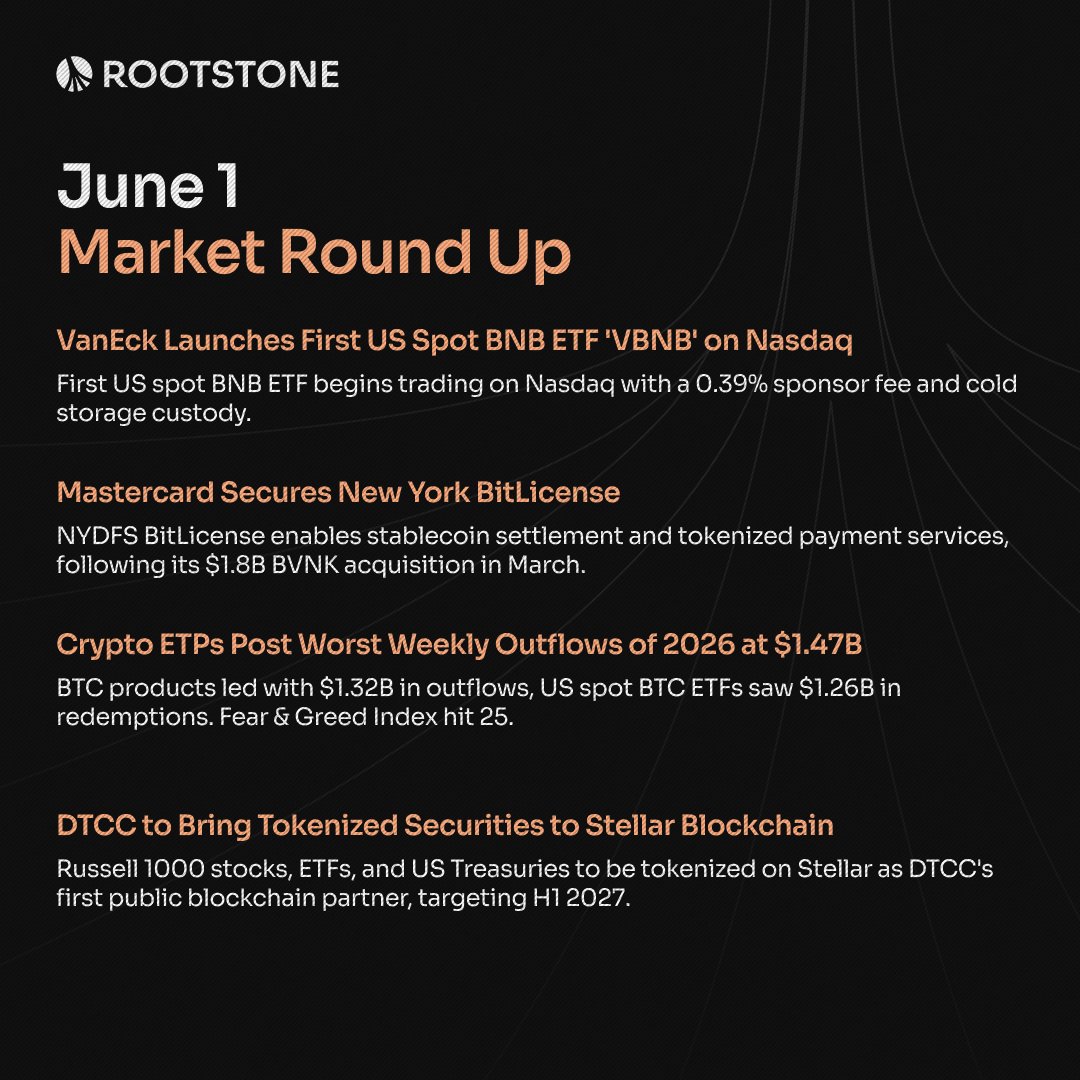
$BNB gets its first US spot ETF, @Mastercard goes deeper into crypto with a New York BitLicense, and DTCC maps out tokenized securities on @StellarOrg — all while the market posts its worst ETF outflows of the year at $1.47 billion.
↳ @vaneck_us launches VBNB on Nasdaq — the first US spot BNB ETF with a 0.39% fee and cold storage custody
↳ @Mastercard secures NYDFS BitLicense for stablecoin settlement and tokenized payments, following its $1.8B BVNK acquisition
↳ Crypto ETPs see $1.47B in weekly outflows — the worst of 2026. $BTC products led with $1.32B as Fear & Greed hit 25
↳ DTCC to bring Russell 1000 stocks, ETFs, and US Treasuries onto Stellar as its first public blockchain partner, targeting H1 2027
The total crypto market cap sits at $2.55T today, up 0.29% over the past 24 hours.
$BTC is trading at $73,332, down 1.03% on the day. $ETH holds at $2,003.94, down 0.35%. $BNB is at $635.63, $XRP at $1.31, and $SOL at $81.79.
A relatively quiet session across the board with most majors seeing minor pullbacks while $XRP edges slightly higher.
Cross-chain bridges move billions between blockchains every month, but they remain the most exploited infrastructure in crypto.
Over $4 billion has been lost to bridge hacks since 2021, with the $292 million @KelpDAO exploit in April triggering a $13 billion DeFi TVL wipeout.
How do bridges actually work? Lock-and-mint, burn-and-mint, multi-oracle verification, intent-based relayers. Each model handles security differently, and bridge selection is one of the most consequential decisions in crypto.
Our latest research breaks down how bridges work, why they keep getting exploited, and how the industry is responding.
Regulatory caution, infrastructure shifts, and Europe's stablecoin push define this week's crypto headlines.
↳ The SEC delayed its tokenized stock exemption plan after pushback from traditional exchanges, sending $BTC to $75,253 and triggering $320M in leveraged long liquidations within hours.
↳ Seven protocols moved over $4B to @chainlink CCIP as bridge security concerns intensified. Lombard, KelpDAO, Solv, and Kraboraken led the post-LayerZero exodus.
↳ 37 European banks across 15 countries joined the Qivalis consortium to launch a MiCA-compliant euro stablecoin in H2 2026, backed 1:1 by euros and powered by @FireblocksHQ.
↳ SEC Chair Atkins ordered public comment on 24 prediction market ETFs from @Bitwise, Roundhill, and GraniteShares, pausing approval of funds covering elections, recessions, and labor data.
A red week across the board as all five majors posted declines.
Total #crypto market cap dipped to $2.68T with $XRP leading losses at -7.96%. $ETH fell 6.13% to $2,136, $SOL dropped 5.42%, and $BTC pulled back 4.39% to $77,717. $BNB held up relatively best at -2.97%.
Bitcoin dominance remains steady at 58.1% while ETH dominance slipped to 9.6%, its lowest level this year.
Prediction markets let participants trade on real-world event outcomes using crypto infrastructure. The sector has exploded from $1.2B to over $21B in monthly volume in just one year.
@Polymarket hit $25.7B in March with 1.29M active wallets, while @Kalshi controls 89% of the U.S. regulated market at a $22B valuation.
Now both platforms are launching perpetual futures, blurring the line between event trading and traditional derivatives.
Our latest research breaks down how it all works and what risks to watch.
Regulatory milestones, institutional derivatives, and the battle between on-chain and traditional infrastructure define this week's #crypto headlines.
↳ The U.S. Senate Banking Committee passed the CLARITY Act, establishing clear jurisdictional boundaries between the SEC and CFTC for digital assets. The bill now moves to a full Senate vote.
↳ @CMEGroup and @Nasdaq launched joint crypto index futures covering $BTC, $ETH, and $SOL, expanding regulated multi-asset derivatives access for institutional investors.
↳ SBI and @Rakuten securities began developing crypto investment trusts as Japan's financial sector positions ahead of JPX's planned 2027 ETF listings.
↳ @HyperliquidX pushed back against @CMEGroup and ICE, arguing that its fully on-chain order book delivers superior transparency compared to traditional exchange infrastructure.
Total crypto market cap climbed to $2.77T this week as $BNB surged 7.37% to lead the majors at $683.
$XRP followed with a 5.61% gain while $SOL posted +3.49% to reclaim $91. $BTC edged past $80,500 with a modest +1.15%, pushing dominance to 58.4%. $ETH was the lone decliner at -1.00%, slipping below $2,260 as ETH dominance dipped to 9.9%.
Tokenization converts real-world assets like U.S. Treasuries, real estate, and bonds into digital tokens on a blockchain.
The sector has surpassed $21B in TVL in 2026, led by @BlackRock's BUIDL fund at $2.5B+ and @OndoFinance at $2.75B+. Tokenized Treasuries alone account for $9.7B as institutions from @jpmorgan to BNY Mellon build on-chain infrastructure.
Our latest research covers how tokenization works, what is being tokenized, and why Wall Street is accelerating its adoption.
Wall Street's crypto push deepens with major custody, trading, and leadership moves shaping this week's headlines.
↳ @MorganStanley launched spot crypto trading on @etrade at a flat 0.5% fee for $BTC, $ETH, and $SOL, undercutting Coinbase and Robinhood. All 8.6M E*Trade clients expected by year-end.
↳ BNYMellon, the world's largest custodian with $55T+ in assets, launched institutional crypto custody in Abu Dhabi for Bitcoin and Ethereum with plans to expand into stablecoins and tokenization.
↳ Japan's Progmat began migrating over $2B in tokenized real estate and corporate bonds to @avax, the largest institutional RWA deployment on a public blockchain.
↳ Kevin Warsh's Fed Chair confirmation vote approaches with disclosed investments in Bitwise, Compound, and $SOL, signaling a crypto-aware Federal Reserve leadership.
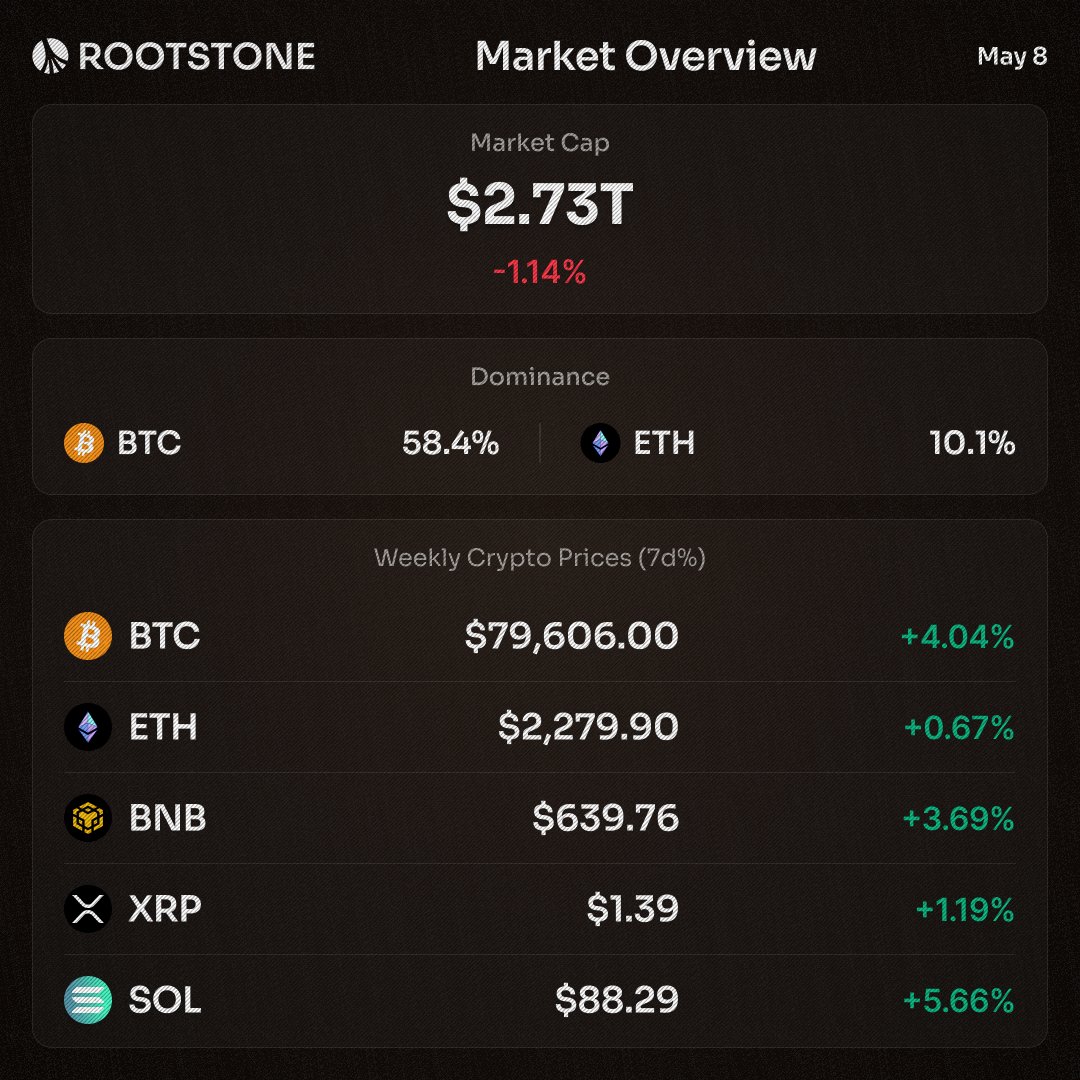
$BTC broke through $79,600 this week with a 4.04% gain, pushing total crypto market cap to $2.73T. $SOL led the majors at +5.66%, followed by $BNB at +3.69% and $XRP at +1.19%. $ETH posted a modest +0.67% as Bitcoin dominance held firm at 58.4%.
All five tracked assets closed the week in the green despite a 1.14% dip in the 24-hour market cap.
Layer 2 networks process transactions off Ethereum's main chain to cut fees and boost speed while inheriting its security.
In 2026, L2s collectively hold over $34B in TVL, with @base, @arbitrum, and @Optimism processing roughly 90% of all L2 transactions. Base alone handles over 10M daily transactions at costs under $0.01 each.
Our latest research covers how rollups work, what separates optimistic from ZK architectures, and the risks users should weigh when moving across chains.