The real AI divide won’t be who has the best models, but who has access to meaningful compute. As Pukar Hamal @pchamal argues, “compute equality” is becoming infrastructure: without it, human agency, entrepreneurship, and security become structurally constrained.
#AI | Artificial intelligence Vs Humanity
"Every organisation will be a mix of humans and AI by 2030. Every successful organisation will have to bring both together and become structurally fluid: @rossdawson, Australian Author
#AI#ArtificialIntelligence#RossDawson #AIvsHumanity #FutureOfAI #TheRightStand | @AnchorAnandN
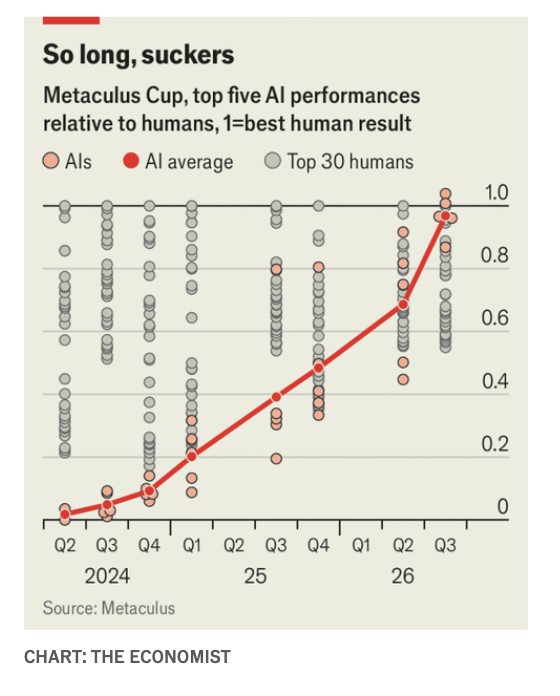
AIs cracking short-term superforecasting is such an important (and, still, under-discussed) trend.
Via a new piece from @nikostro https://t.co/EuVP7FyfbD
Wonderful to see deeply grounded research on what economic policies may work best in various AGI scenarios. As the authors note, we need more data and research to inform this stream of work. It is clear that we will need new policies. As the economy evolves, likely very rapidly, we need to uncover how best to respond.
Today we are announcing the new DeepMind Institute, a forum dedicated to interdisciplinary, evidence-led debate on the societal and economic questions surrounding AGI.
As part of the launch, @JulianDJacobs and I have a new essay and working paper: “Economic Policy for AGI.”
https://t.co/cCSdKMZneH 🧵1/n
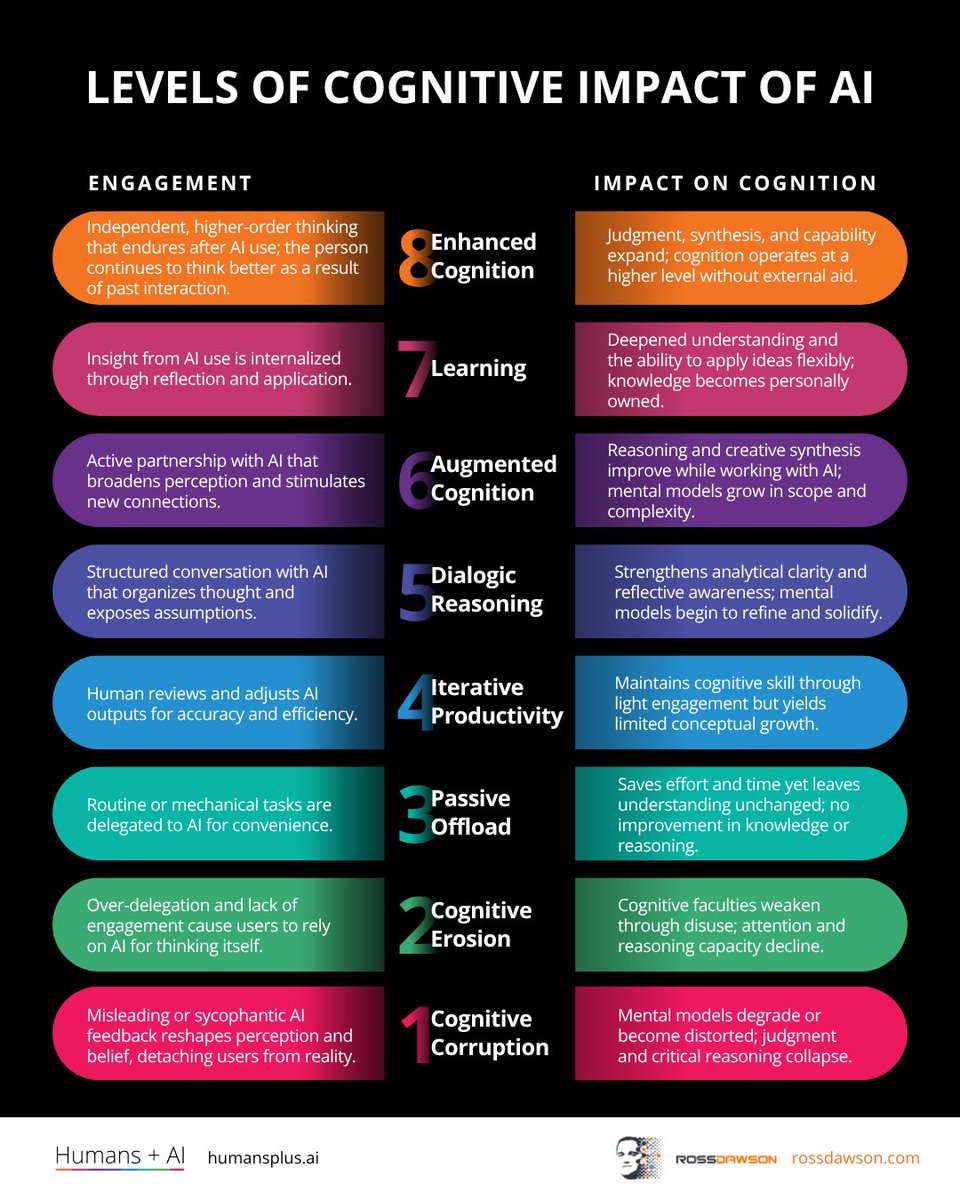
Details on the 8 levels of cognitive impact of AI as a tool to help us be aware of our current level, and how we can move to higher levels.
https://t.co/CLNlCtktSh
There is plenty of evidence that most people's default use of AI negatively impacts them, including cognitive erosion and even corruption.
We can choose to use AI in ways that enhance our cognition. This requires the right mindset and metacognition to be aware of our use.
👇
There is a strong analogue to information behaviors, as I laid out in my book Thriving on Overload.
The human brain is drawn to novelty and infinite scroll.
But as many people demonstrate, we can choose information use that makes us smarter.
👇
On a new benchmark ApprenticeBench, the latest frontier models leap up to outperform humans. But the token cost is almost triple what the human would cost. There are a number of things to unpack here.
The benchmark from NeoCognition is on processing accounts payable in a full simulation of an actual company. It is a defined fairly low-level task, so not readily generalizable to other categories of work.
This is of course far more relevant than the isolated tasks of most benchmarks. But it still doesn't emulate the real-world social setting of work, with the implicit multi-party negotiation and sense-making.
There is undoubtedly still exception handling required, so the additional costs of the human interruption and routing would need to be factored in.
It tests the AI and humans separately, ignoring the far more more interesting question of whether there is improvement or degradation with a Humans + AI system. While the article expresses the intent to create human–AI teams that are 10–100 times as productive as individuals, it is still framed around either/or human or AI work.
Emulating real-world organizations - to the degree possible - is an important step forward in benchmarks, but it is a long road for these to be very close to real work and workflows.
Yes frontier models will start to beat humans in specific tasks, sometimes with high token costs, and then the costs will come down.
The intent has to be always on building Humans + AI systems, and the benchmarks and framing that will support that.
Introducing ApprenticeBench: computer use + continual learning on a real job.
We show Fable 5.1 and GPT-6 Astra can now continually learn on a job and surpass human professionals. A decisive step change in AI's job readiness.
No FDEs. Agents deploy themselves into the job. 🧵
Single task focus or multitasking?
The answer used to be crystal clear. The cognitive cost of task switching is very high, so far better to work on one project for extended periods.
Now that our cognition is in Humans + AI systems with high latency for frontier models, the answer changes.
Do you flip between projects, putting in your human guidance episodically as LLMs surface for input?
Or stick to single projects, using LLMs however best assists?
Despite being the author of 'Thriving on Overload', which advocated for cognitive task consistency in the chapter on Attention, I now find myself flitting across multiple projects as LLMs work on substantive projects simultaneously.
I'm considering whether this is the best approach. I currently think it is, despite the cognitive load, which @simonw has noted makes him mentally exhausted by 11am.
Where do you stand on this?
How have your cognitive focus habits evolving with substantial LLM use?
Working with companies globally I see:
Those focusing on AI as tech and its link to ROI are flailing.
Those soaring ahead are laser-focused on building better Humans + AI org operating systems.
This is hard work. Work redesign, decision architectures, learning loops. It pays.
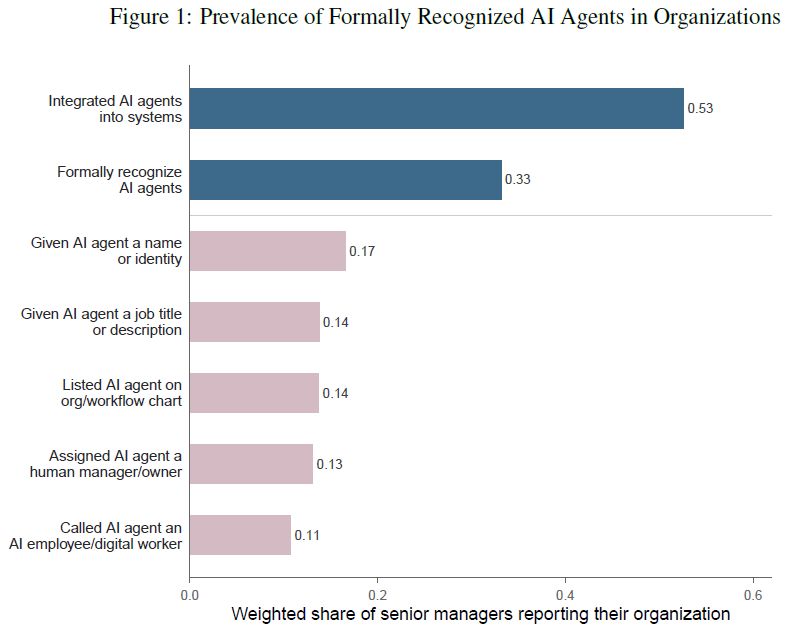
Agents are rapidly embedding themselves throughout organizations. They are not equivalents of humans, not least because managers treat them differently.
Successful Humans + AI organizations will build delegation and supervision that recognizes those differences.
23% of organizations in a Boston University/BCG study have AI agents formalized on the org chart.
The research shows one of the biggest challenges of delegating to agents: managers supervise agents differently from humans, increasing risk. 👇
Formalizing AI agents as employees is often not the best approach. Whatever the label, every agent needs a named human owner, defined review standards, and escalation that adds checking rather than replacing it.
→ https://t.co/NAwWYfAABR