i recommend anybody that has high ambition & agency in life to watch the saban documentary. pure old skool mad man with a strong philosophy applicable to success in biz or any endeavor. what a legend 10/10
We've just signed Electron's largest commercial launch contract ever: 20x new launches with Earth-observation constellation operator @synspective 🚀🦉
That brings the total number of Synspective launches on Electron to 47 - the most of any Rocket Lab launch customer. We're proud to continue building out their low Earth orbit constellation through to 2031.
🚨 $RKLB just landed its largest-ever commercial Electron deal.
The company will launch 20 new Electron missions for Synspective.
The agreement pushes Rocket Lab’s launch backlog to more than 100 missions.
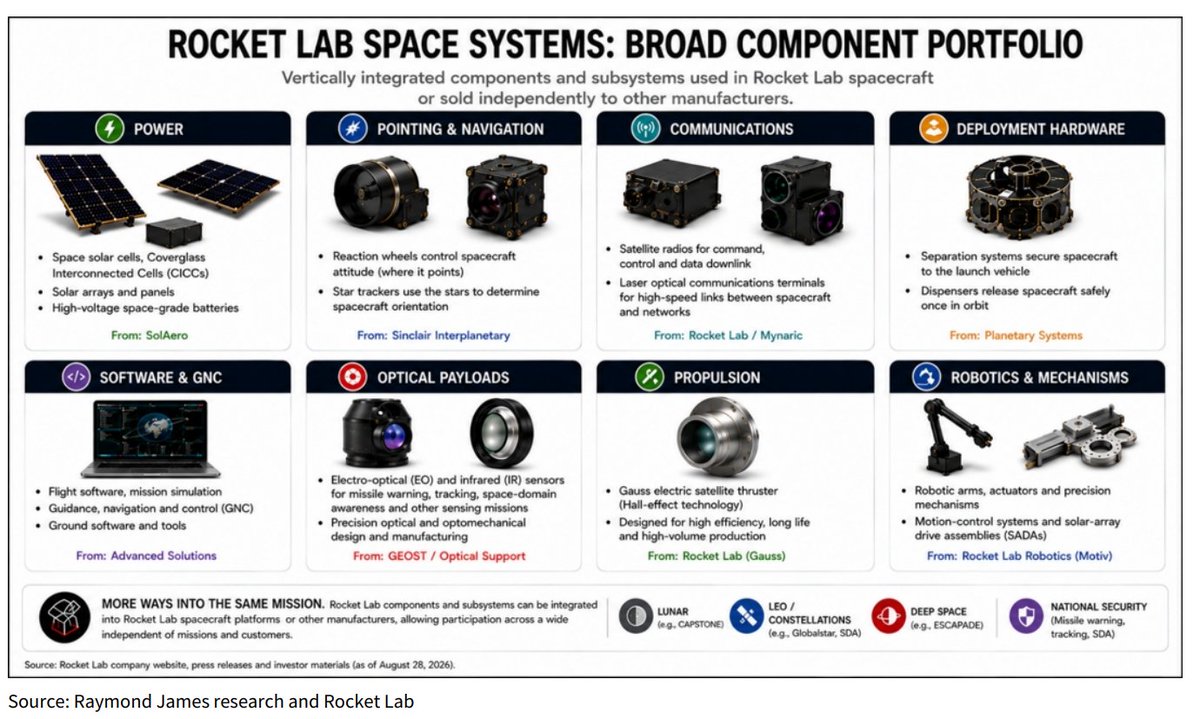
$RKLB IS BUILDING THE FULL SPACE STACK
• Power through SolAero solar cells, arrays and batteries
• Pointing & Navigation through Sinclair reaction wheels & star trackers
• Communications through Rocket Lab radios & Mynaric laser links
• Deployment Hardware through Planetary Systems separation systems & dispensers
• Software & GNC through Advanced Solutions flight software and guidance
• Optical Payloads through GEOST & Optical Support sensors and precision optics
• Propulsion through Gauss electric satellite thrusters
• Robotics & Mechanisms through Motiv robotic arms, actuators & motion systems
Rocket Lab can monetize same mission whether it wins full program or supplies components to whoever does.
One of the biggest challenges in investing is controlling emotion. When SpaceX was preparing to go public, everyone wanted in because excitement and optimism were at their peak. Now that the stock has pulled back, many of those same people are hesitant or even fearful. Yet the underlying business may not have changed nearly as much as investor sentiment has.
This is a pattern we see repeatedly in the market. Investors tend to feel the most confident after prices have already risen and the most fearful after they’ve fallen. That’s why removing emotion from the decision-making process is so important.
The same concept applies to UWM. Short-term price movements and headlines can create uncertainty, but our job is to help clients stay focused on the long-term fundamentals rather than daily market swings. Volatility often creates opportunity, not just risk. By taking emotion off the table and making disciplined, fundamentals-based decisions, clients are better positioned to benefit when sentiment eventually catches up to the company’s underlying value.
Successful investing isn’t about chasing what’s popular or avoiding what’s temporarily out of favor. It’s about remaining disciplined, focusing on quality businesses, and maintaining a long-term perspective, even when emotions are telling you to do the opposite.
I speak with a lot of prospects that think they are doing the right thing just because they have the accounts set up. 401(k) from the old job. IRA from a rollover three years ago. Brokerage account they opened during the pandemic.
The right account but zero coordination.
Here’s the problem: each one gets its own login, its own strategy (or lack of one), its own set of assumptions. Nobody’s looking at the whole picture.
So you end up with:
Overlapping holdings you didn’t know you had.
A 401(k) still sitting in target-date funds from 2019.
An IRA that hasn’t been touched since the day it was opened.
A brokerage account taking all the risk while your retirement accounts sit too conservative, or vice versa.
None of these accounts are wrong on their own. But together, uncoordinated, they’re working against each other instead of for you.
The fix isn’t consolidating everything into one account. It’s making sure every account has a job.
Your 401(k), your IRA, your brokerage, each should play a specific role in your tax strategy, your risk exposure, your liquidity needs, your timeline.
That only happens when someone is looking at all of it together. Not quarterly. Not once a year at tax time. Continuously.
That’s the difference between having accounts and having a strategy.
At UWM, this is where we start with every client, not “what should I buy,” but “how does everything you own work together.” Because a strong portfolio isn’t a collection of good accounts. It’s a coordinated one.
I want to share a real example of what we do at UWM because many people believe that once they reach retirement, or “distribution years”, they have to move everything into fixed income, buy expensive annuities, or slowly deplete their savings while hoping they don’t outlive their nest egg.
When UWM was founded nearly 17 years ago, one of the very first accounts we managed was a client’s IRA. At the time, he was 70 years old, which back then was the age Required Minimum Distributions (RMDs) began.
His IRA balance was approximately $600,000.
From year one, he has taken an RMD every single year.
Over the past 17 years, those distributions have averaged roughly $40,000 annually, smaller in the early years and larger today as IRS life expectancy tables changed.
Conservatively, that means nearly $700,000 has been distributed from the account over that time, which is actually more than the original starting balance.
Today, despite all of those withdrawals, his IRA is worth $2,015,907 as of 5/19/2026.
Think about that.
He has systematically taken income for 17 straight years while still more than tripling the value of the account. That’s the best of both worlds, income when needed and long-term growth.
So please excuse me when an insurance salesman tells me the “only” way to retire successfully is by locking money into an expensive annuity. That’s simply not true.
And the same goes for the outdated mindset that says once you hit a certain age, you should move the majority of your portfolio into fixed income, lock in 3–4% bond yields, and sacrifice growth while barely keeping up with inflation.
That approach is not one-size-fits-all either.
In this client’s case, and many others we’ve worked with over the years, they were able to generate income, preserve flexibility, continue growing their wealth, and ultimately strengthen the legacy they’ll leave to their families.
The key is not starting with a product.
The key is starting with the individual.
Every client’s goals, needs, risk tolerance, and situation are different. The right approach is building a personalized plan designed to achieve those goals with the least amount of unnecessary risk and volatility possible.
That’s what we’ve focused on for decades, and through every conceivable market cycle.
Message me or send me an email ([email protected]) if you want to discuss how UWM can be a positive force in your growing financial future.
Here’s the one thing I tell every new client: your financial plan should make you sleep better at night, not keep you up checking your phone.
If your portfolio gives you anxiety, something is wrong. Not necessarily with the market. With the plan.
A good financial strategy isn’t just about maximizing returns; it’s about building something you can actually stick with.
Through bull markets and bear markets. Through rate hikes and recessions. Through the noise and the headlines that make everyone feel like they should be doing something different.
That only happens when you truly understand what you own, why you own it, and what it’s working toward. And it’s almost impossible to get there alone.
The advisor you work with matters more than most people realize. Not just their credentials or their track record, but whether they take the time to understand your life, your goals, and what risk actually feels like to you personally. Risk tolerance isn’t just a number on a questionnaire. It’s deeply personal. It’s the difference between checking your portfolio once a quarter with confidence and panic-selling at the worst possible moment.
Find someone who listens before they advise. Someone who builds a plan around your life, not a template. Someone whose job is to keep you calm, focused, and on track no matter what the market is doing.
That’s what real financial planning looks like. And when you find the right person, you’ll feel it, because for the first time, you’ll actually be able to sleep at night.
Message me or send me an email ([email protected]) if you want to discuss how UWM can be a positive force in your growing financial future.
Just left a job?
There’s probably an old 401(k) sitting there. Still invested in whatever your old employer’s plan offered. Still capped by whatever limited fund menu they gave you. Still on autopilot.
Most people mean to deal with it. Then six months pass. Then two years.
Here’s the thing about a workplace 401(k): you never really had control to begin with. A handful of pre-picked funds. No say in strategy. No one watching it day to day.
A rollover into an IRA changes that. It’s not just paperwork, it’s taking the wheel and controlling how your retirement funds get invested.
At UWM, control is the whole philosophy. Every position gets daily oversight, not a quarterly glance. We hold 30-40 high-conviction names we actually believe in, not a basket of whatever the index says to own. We keep dry powder on hand so we’re never forced into a bad sale. Stop-losses on every position, because protecting what you’ve built matters as much as growing it.
Your money, your access, on your terms, always.
If you’ve changed jobs recently, that old 401(k) deserves a second look. It’s still your money. Time to actually run it like it is.
Investing isn’t just about how much you make when everything is going up, it’s about how much you keep when the market tests you.
Real wealth is built through discipline, risk management, and protecting your downside when things get turbulent.
Anyone can feel confident during a bull run. The real difference shows up when markets pull back.
That’s where thoughtful planning and a long-term strategy matter most.
At UWM, our goal is to capitalize on the strength of bull markets while building portfolios that are built to grow and compound over the next 5, 10, and 20 years.
But just as important as offense is playing Hall of Fame–level defense. That means managing risk intentionally, protecting the foundation of the portfolio, and making sure our clients stay in the game through every cycle.
It’s this balance, capturing long-term growth while defending against the unexpected, that ultimately drives real, lasting wealth and is part of our focus every single day at UWM.
Message me or send me an email ([email protected]) if you want to discuss how UWM can be a positive force in your growing financial future.
$RKLB
ROCKET LAB WINS A $266 MILLION U.S. AIR FORCE CONTRACT.
- Launches will take place in Alaska
- Expected to be completed by end of 2028
- Adds to the streak of winning more defense contracts
Rocketlab has always traded at a premium but this company continues to seriously execute and quite frankly they diluted at $130 which was a VERY smart move, but I do think the decline from $150 to $60 is a bit aggressive and hopefully we've seen the worst of it as the stock bottomed around the $58 range back in March as well.
Neutron and the Golden Dome are still future catalysts that are very important for this company. Iridium acquisition also helps them seriously compete in the connectivity business long term.
$RKLB +4%
A few weeks ago I talked about young investors and financial planning. Now let’s talk about what should be happening a few years later.
Your 40s and 50s are the most important decade for your finances. Most people don’t treat them that way.
You’re earning more than ever.
But the pressure is stacking up too.
Kids. Mortgage. Aging parents. Maybe a business. And somewhere in the back of your mind, retirement, creeping closer every year.
This is the season where financial mistakes are the most expensive.
Not because the stakes are higher.
Because time stops being on your side.
Here’s what I see too often with people in this stage:
❌ Still in the same set-it-and-forget-it portfolio from their 30s
❌ No real plan for when to shift from growth to protection
❌ Overexposed to risk they don’t even know they’re carrying
❌ No one reviewing the full picture, investments, taxes, income needs
The game changes in midlife.
You’re no longer just accumulating. You’re starting to think about protecting what you’ve built, and making sure it actually gets you where you want to go.
That balance between offense and defense matters more now than it ever has.
At Udine Wealth Management, this is exactly what we do.
Actively managed portfolios. Real downside protection. Stop-losses, strategic cash, and daily oversight, not a quarterly glance and a generic rebalance.
And a portfolio manager with 30+ years of experience who’s seen every kind of market.
These can be your peak earning years and they are too valuable to leave on autopilot.
Message me or send me an email ([email protected]) if you want to discuss how UWM can be a positive force in your growing financial future.
Nick Martinelli could end up being the biggest steal of the second round.
• 26 MIN
• 19 PTS
• 5 REB
• 2 AST
• 2 STL
• 0 TO
• 8-9 FG
• 3-3 3PT
• +13 +/-
About as efficient as it gets.
His unorthodox game continues to translate at the next level.
A lot of people ask us, why aren’t you always fully invested?
Shouldn’t you be? It’s a fair question.
But bull markets make everyone look smart. It’s the drawdowns that separate real advisors from order-takers.
Anyone can stay fully invested and hope.
The hard part is knowing when to hold cash, when to cut losses, and when to get aggressive.
At UWM, that’s exactly what we’re built for.
Stop-losses on every position. Strategic cash reserves ready to deploy. A portfolio manager with 30+ years of experience who has seen every kind of market, and managed through all of them.
Hope isn’t a strategy. Active management is.
Message me or send me an email ([email protected]) if you want to discuss how UWM can be a positive force in your growing financial future.
Everyone wants the “sexy” investment.
Private equity. Hedge funds. Venture capital. Real estate syndications.
They hear the pitch, uncorrelated returns, exclusive access, sophisticated strategies, and they’re in.
What they don’t hear is the fine print.
Your money is locked up.
Five, seven, sometimes 10+ years before you see a dollar back. No exit. No liquidity. No changing your mind.
And life doesn’t care about your lock-up period.
Job loss. Health issues. Divorce. Or even a market opportunity you actually want to act on.
When that moment comes, and it will, illiquid money is no money.
Here’s what doesn’t get talked about enough in the alternatives world:
Public equities offer something most of these strategies can’t, optionality.
Every day the market is open, you have the ability to act.
Trim a winner. Cut a loser. Raise cash. Rotate into new opportunities. Adapt to what’s happening now, not what was happening when you signed paperwork years ago.
That’s not a flaw in equities. That’s the advantage.
At UWM, we’re not chasing exotic strategies.
We run focused, actively managed portfolios, typically 30 to 40 holdings, with daily oversight from a portfolio manager with 30+ years of experience.
We hold strategic cash. We use stop-losses. We move when the data tells us to move.
No lock-ups. No “wait and see.” No hoping for a future liquidity event.
Just a disciplined strategy you can actually act on, in real time, in real markets, with real flexibility.
Boring? Maybe to some.
But when a client needs access, they’re not filling out redemption paperwork and waiting years.
They’re making a phone call.
The best investment isn’t always the most sophisticated.
It’s the one that works when you need it to.
Message me or send me an email ([email protected]) if you want to discuss how UWM can be a positive force in your growing financial future.