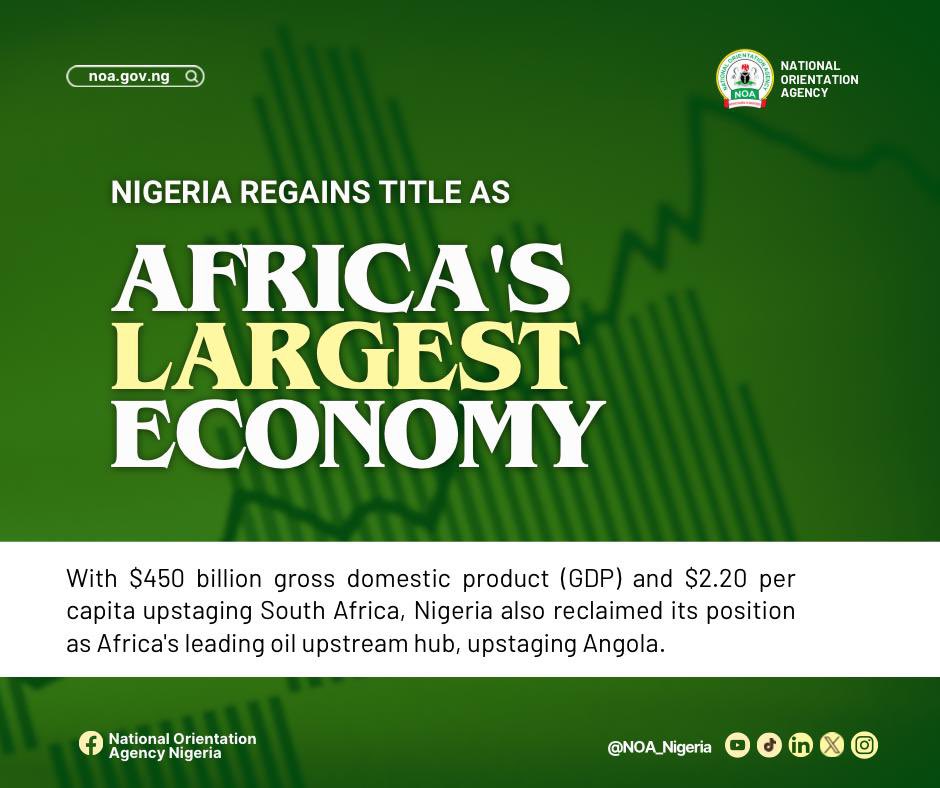
Nigeria Reclaims Position as Africa’s Largest Economy
Less than a year after falling to fourth place, Nigeria has regained its status as Africa’s largest economy, just two weeks after reclaiming its position as the continent’s top oil upstream hub.
With a GDP of $450 billion and a per capita income of $2.20, Nigeria has surpassed South Africa ($360 billion), followed by Egypt ($300 billion) and Algeria ($170 billion). Other major African economies include Morocco ($120 billion), Kenya ($99 billion), Angola ($92 billion), Ethiopia ($91 billion), Ghana ($67 billion), and Tanzania ($62 billion).
World Bank Country Director for Nigeria, Dr Ndiamé Diop, credited the rebound to macroeconomic reforms, including exchange rate adjustments and improved foreign exchange access, which have bolstered growth.
🚨 Heads Up! In-Person Registration Closes Soon! 🚨
Don’t miss your chance to attend OLxDCon'24 in person! ✨ The deadline to secure your spot is October 25. ⏳
Nigeria’s Orientation Agency Releases Standardised Version Of New National Anthem Amid Confusion Over Correct Lyrics | Sahara Reporters https://t.co/eykiYQiYRo
PRESS RELEASE
GRID SHUT DOWN : UNION DELIBERATELY SHUT DOWN THE NATIONAL GRID.
The Transmission Company of Nigeria hereby informs the general public that the Labour Union has shut down the national grid, resulting in black out nationwide. The national grid shut down occured at about 2.19am this morning, 3rd June 2024.
At about 1:15am this morning, the Benin Transmission Operator under the Independent System Operations unit of TCN reported that all operators were driven away from the control room and that staff that resisted were beaten while some were wounded in the course of forcing them out of the control room and without any form of control or supervision, the Benin Area Control Center was brought to zero.
Other transmission substations that were shut down, by the Labour Union include the Ganmo, Benin, Ayede, Olorunsogo, Akangba and Osogbo Transmission Substations. Some transmission lines were equally opened due to the ongoing activities of the labour union.
On the power generating side, power generating units from different generating stations were forced to shut down some units of their generating plants, the Jebba Generating Station was forced to shut down one of its generating units while three others in the same substation subsequently shut down on very high frequency. The sudden forced load cuts led to high frequency and system instability, which eventually shut down the national grid at 2:19am.
At about 3.23am, however, TCN commenced grid recovery, using the Shiroro Substation to attempt to feed the transmission lines supplying bulk electricity to the Katampe Transmission Substation. The situation is such that the Labour Union is still obstructing grid recovery nationwide.
We will continue to make effort to recover and stabilize the grid to enable the restoration of normal bulk transmission of electricity to distribution load centres nationwide.
Ndidi Mbah
GM, Public Affairs
3/5/24
#tcnnigeria
There’s no way this thing should actually be increasing everyday. My theory is that there are some forces deliberately manipulating the demand market. MTOs or not. Some people are actually deliberately sabotaging it.