I’m recruiting 2~3 funded PhD students for Fall 2027 to join the Symbiotic Interfaces Lab at UT Austin CS (@UTCompSci)!
Check out our research:
https://t.co/UlVoBhav5s
Apply by Dec 15, mentioning my name:
https://t.co/QgP06LdbB0
Reposts appreciated!
(1/2)
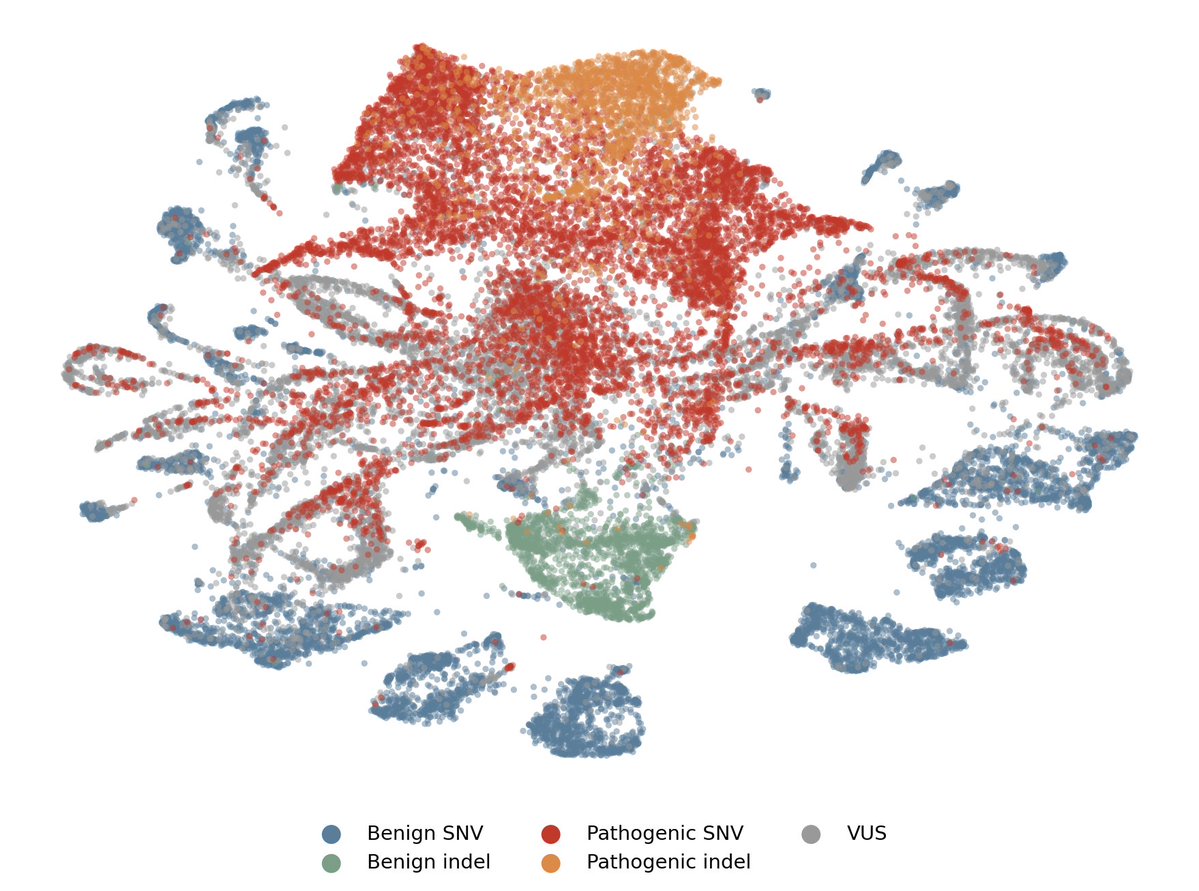
We achieved state-of-the-art performance in predicting which of 4.2 million genetic variants cause diseases by interpreting a genomics model, in a new preprint with @MayoClinic.
We're now releasing an open source database for all variants in the NIH's clinvar database. 🧵(1/8)
Two funded AI opportunities closing this month:
ERA AI Fellowship: 10 weeks, Cambridge, fully funded. Deadline April 12.
https://t.co/UU40uQ2lz5
Neuromatch AI Sentience Scholars: 6 months, remote. Deadline April 28.
https://t.co/3H8tOZ5xde
#BlackInAI#AISafety
Prospective PhD students in AI, apply to UMD @umdcs!
Aside from existing faculty, you should definitely check out our new and incoming faculty!
Don't miss the opportunity to work with rising stars in the field. 👇
Excited to share that I will be starting as an Assistant Professor in CSE at UCSD (@ucsd_cse) in Fall 2026! I am currently recruiting PhD students who want to bridge theory and practice in deep learning - see here: https://t.co/cHN0Tdr5QQ
Had an interview on 10 Sept for Junior Backend role I and an engineer from the their team pair coded
A multi tenant Key value store which stores and retrieves json data
100 MB storage quotas per tenant with LRU eviction when limits are exceeded
📑 SOP vs Research Proposal: The Hidden Divide in PhD Applications
DM me “PhD structure” if you want to work with me!
🇺🇸 United States – Statement of Purpose (SOP)
•Length: 2–3 pages (800–1,000 words).
•Purpose: Demonstrate potential, motivation, and program fit. Not a full project plan.
•Structure (typical breakdown):
1.Introduction – research interests & motivation (10–15%)
2.Academic preparation – courses, projects, skills (25–30%)
3.Research experience – prior labs, methods, publications (25–30%)
https://t.co/YKZVBkPtpg with program – faculty, resources, collaborations (20%)
5.Future goals – academic/industry pathways (10%)
•Why?: US PhDs last 5–7 years, with coursework, lab rotations, and qualifying exams. Programs admit students with research potential and then train them to refine topics.
🇬🇧 United Kingdom – Research Proposal
•Length: 1,500–3,000 words (some allow 5,000).
•Purpose: Present a specific, feasible project from day one.
•Structure (commonly expected):
1.Title & Abstract – concise overview (200–300 words)
2.Research question & aims – precise objectives
3.Literature review – demonstrate awareness of debates & gaps
4.Theoretical framework – underpinning concepts
5.Methodology – methods, data sources, ethical considerations
6.Proposed timeline – 3–4 years broken into stages (data collection, analysis, writing)
7.References – 20–40 citations minimum
•Why?: UK PhDs are 3–4 years with minimal coursework. Supervisors expect candidates to arrive with a defined project aligned with their expertise.
🇩🇪 Germany / 🇪🇺 EU
•Length: Usually 2,000–4,000 words proposals.
•Unique feature: You often need to secure a supervisor before applying (“Doktorvater/Doktormutter” system). Some programs require a formal “doctoral agreement.”
•Funding: DAAD scholarships, structured programs, or direct supervisor funding.
🇦🇺 Australia
•Process: Applications are often tied to scholarships (Research Training Program – RTP).
•Proposal: ~2,000–3,000 words, with emphasis on originality, feasibility, and alignment with university “research priorities.”
•Funding: Competitive, but most PhDs are fully funded once admitted.
🇨🇦 Canada
•Hybrid model:
•Some universities follow the US SOP format.
•Others (especially in the humanities/social sciences) require UK-style proposals.
•Pro tip: Always check department-specific requirements — it can differ within the same university.
📝 Other Common Documents (side by side)
•CV/Resume: US = 2–3 pages; UK/EU = no strict limit, but academic CVs often run 4–6 pages.
•Recommendation Letters: US = typically 3 (with strong emphasis on research potential); UK/EU = 2–3 (often from prior supervisors).
•Writing Samples: US humanities/social sciences = 15–25 pages; UK often optional unless applying for competitive programs.
•Language Tests: TOEFL/IELTS almost always required for non-native English speakers. GRE is being dropped by many US programs post-2020.
While learning various algorithms, the visualization plays a significant role in grasping the concepts easily.
The https://t.co/uby1YJwoap is an excellent resource with amazing collections of algorithms.
I'm recruiting PhD students for Fall 2025! CS PhD Deadline: Dec. 15th.
I work on safe/reliable ML and causal inference, motivated by healthcare applications.
Beyond myself, Johns Hopkins has a rich community of folks doing similar work! Come join us!
🚀 Introducing BLIP3-o: A Family of Fully Open Unified Multimodal Models https://t.co/Gk6X5uEbzl
🔓 Attempting to unlock GPT-4o’s image generation.
Open source everything!
Including 25 million pre-training data!
Extremely excited to announce that I will be joining @UTAustin@UTCompSci in August 2025 as an Assistant Professor! 🎉
I’m looking forward to continuing to develop AI agents that interact/communicate with people, each other, and the multimodal world. I’ll be recruiting PhD students for Fall 2026 across a range of connected topics (details: https://t.co/Jh7VvrT4i7) and plan on recruiting interns for Fall 2025 as well.
A huge shoutout to my mentors who have supported and shaped my research! Especially grateful to my postdoc advisor @mohitban47 for helping me grow along the whole spectrum of PI skills, and my PhD advisor @ben_vandurme for shaping my trajectory as a researcher, and of course the amazing students/collaborators from @uncnlp and @jhuclsp 🙏
How can you calculate a Convolutional Neural Network (CNN) by hand? ✍️ I posted two lecture videos at to show you Forward pass and Backward pass. Link below. 👇
A 256M open-source vision LM for complete document OCR just beat models 27× bigger.
SmolDocling converts full documents into structured metadata using <500MB VRAM on consumer GPUs.