Russian Journal of Economics is an OA, peer-reviewed journal for all fields of economics related to policy issues.
Published by Voprosy Ekonomiki
@ARPHAplatform
The multicountry model considers the effect of a 10% world #TradeShock on macroeconomic indicators of the #EAEU countries. The figure shows the effect on real #GDPgrowth, inflation, #HouseholdConsumption, investment, exports, imports, #RealWages, #REER.
https://t.co/1yu06zBEh5
/1
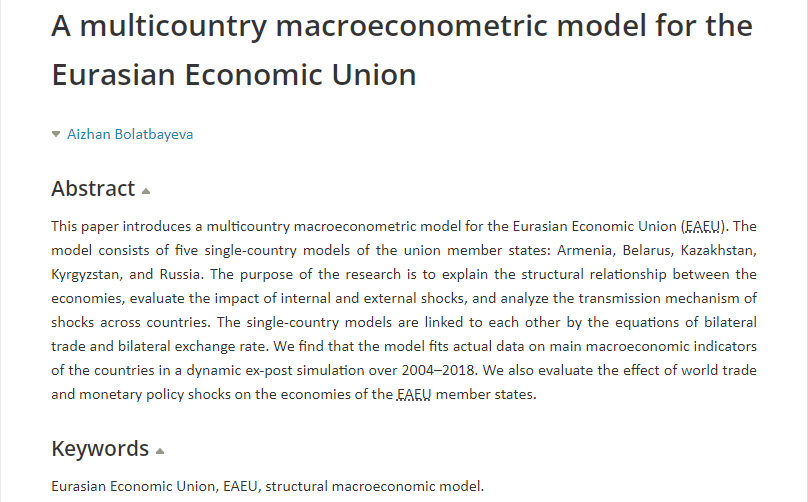
This paper introduces a multicountry #macroeconometric model for the Eurasian Economic Union (#EAEU). The simulation results demonstrate that the model is able to match the observed data on the main macroeconomic indicators in #Kazakhstan and #Russia.
https://t.co/1yu06zk2Sv
Russia’s more sophisticated exports are more successful in the markets of its poorer geographic neighbors than at richer locations. Redesigning industrial policy by making it more conditioned on export outcomes can help solve the problem.
https://t.co/y5EYRX0q6n
#Competitiveness
The main personal #HealthSpending item in #Russia is medication because compulsory health insurance does not reimburse these expenditure in most cases. Poor households could spend nearly 15% of their income on medication in case of health problems.
Study: https://t.co/EUnwBpMUwj
Despite the modern #protectionism trends in the world economy, effective R&D still cannot be achieved by each of the #BRICS countries alone, and require shifting to developed country’s investment patterns with reconsidering the patterns of state ownership.
https://t.co/unPVMvIuNj
"The paper contributes to the literature by offering a conceptual framework for analysis of the role of different types of #SocialCapital in group lending, conditional on the strength of formal institutions."
Study: https://t.co/ex2dowdFX0
#microfinance#EconomicBehavior
This paper introduces a multicountry #macroeconometric model for the Eurasian Economic Union (#EAEU). The simulation results demonstrate that the model is able to match the observed data on the main macroeconomic indicators in #Kazakhstan and #Russia.
https://t.co/1yu06zk2Sv
In Russia,the proportion of out-of-pocket payments in current #HealthExpenditure has risen from 30.2% in 2000 to 36.6% in 2019. It is higher compared with high-income countries and comparable to the BRICS countries.
Study on #HealthcareSpending in #Russia: https://t.co/EUnwBpMUwj
The paper finds that richer economies export more complex products & supply them to wealthier destinations.
The case of Russia is discussed, which pursues the goal of gaining economic sovereignty & tries to make its economy more complex
https://t.co/y5EYRX0q6n
#EconomicComplexity
The paper by @UniversityRudn researchers analyzes relationships between #IFDI, #OFDI, R&D expenditure, & #CO2emissions in the #BRICS. The study shows a positive relationship between environmental pollution & national growth-oriented economic strategies.
https://t.co/unPVMvIuNj
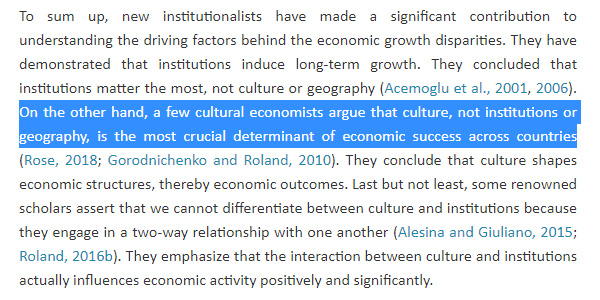
Is #culture the most significant determinant of economic performance across countries, rather than #institutions or #geography?
This paper reports that an increasing number of studies have investigated the role of culture for economic outcomes: https://t.co/RFL83gBtSF
The aim of this paper is to consider the problems of transformation of socio-economic institutions in #Brazil in the face of external shocks at the stage of development, which is very similar to that of #Russia.
https://t.co/VWCqRyU3WC
#MiddleIncome#economicreforms#BRICS