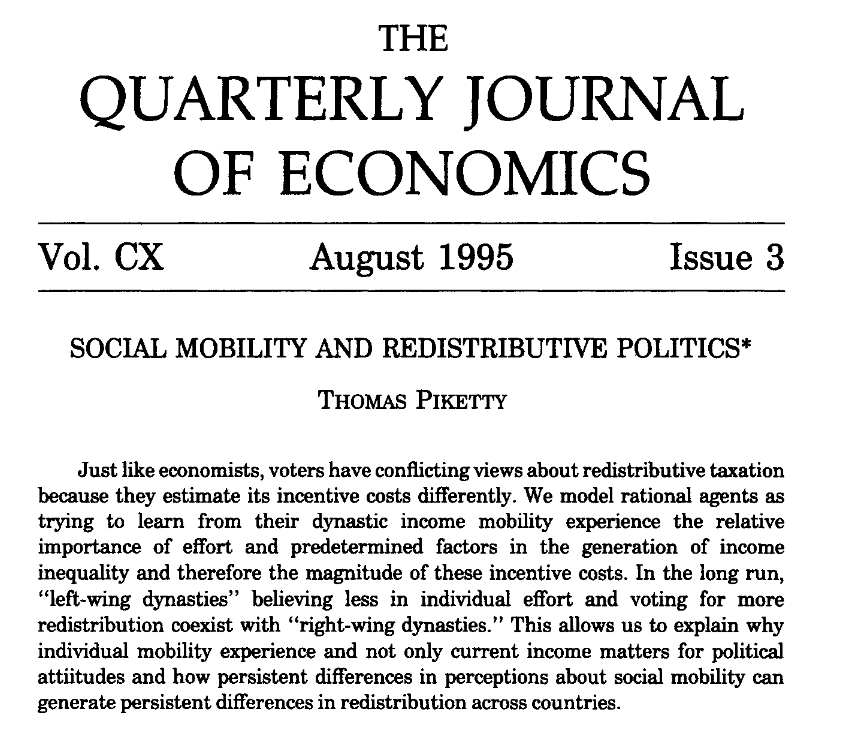
Some Piketty (et al.) bangers to explain why he is so respected, even before Das Capital 2.0, and whatever AI-generated stuff he publishes in the newspaper today
In the 1990s, he formalised theories of self-fulfilling preferences and redistribution. He showed us (1/4)
I've really been enjoying @DavidBeckworth@Macro_Musings podcast lately (we are in a golden age of econ podcasts!). A recent episode with former CEA chair Tyler Goodspeed takes on a fascinating question: Are recessions driven by random shocks (bad luck) or the product of inherently cyclical boom-bust phenomena? Goodspeed's new book argues it's the former. The episode is good fun and very interesting.
https://t.co/cUN5cHFl4L
Two thoughts I wanted to share in reaction, given that this is a topic close to my heart:
1) Somewhat ironically, even though we call short-run fluctuations business *cycles*, the random shocks view is close to the mainstream approach in academic macro. A long tradition in time series macro going back to Granger's work in the 60s looks at the properties of macroeconomic time series (spectral densities!) and finds that there is not much evidence of stable, regular cycles in macro series. Modern DSGE macro models expansions/recessions as the product of relatively persistent shocks, rather than endogenous cycles. The view that business cycles are the product of endogenous boom-bust dynamics is slightly more on the periphery of macro than people might think!
2) That said, I would push back a bit on the strongest version of the random shocks view. I agree that a lot of variation at business cycle frequencies comes from random shocks. But there is quite a bit of evidence that the endogenous boom-bust story has some truth, at least during specific episodes featuring credit and financial booms preceding financial crisis recession. There is quite a bit of evidence that rapid expansions in credit, especially to certain risky sectors like real estate, coupled with booming prices of real estate and other assets, are a strong predictor of future downturns and financial crises. Financial crises are not unpredictable "bolts from the blue." While the exact timing of a crisis is very hard to predict, there are certain vulnerabilities that make financial crises and deep recessions more likely. These dynamics don't hold mechanically during every business cycle, but they do matter for understanding major downturns involving financial instability.
A few examples off the top of my head include: 2008 in the US, Spain, Ireland, etc; the Japanese financial crisis after the 1980s boom; the crises and deep recessions in the Nordic economies of late 1980s; emerging market crises like Mexico 1994 and Thailand 1997; or historical crises like Australia’s housing boom and bust in the late 1880s, the panic of 1893, and perhaps the US Great Depression.
Food for thought!
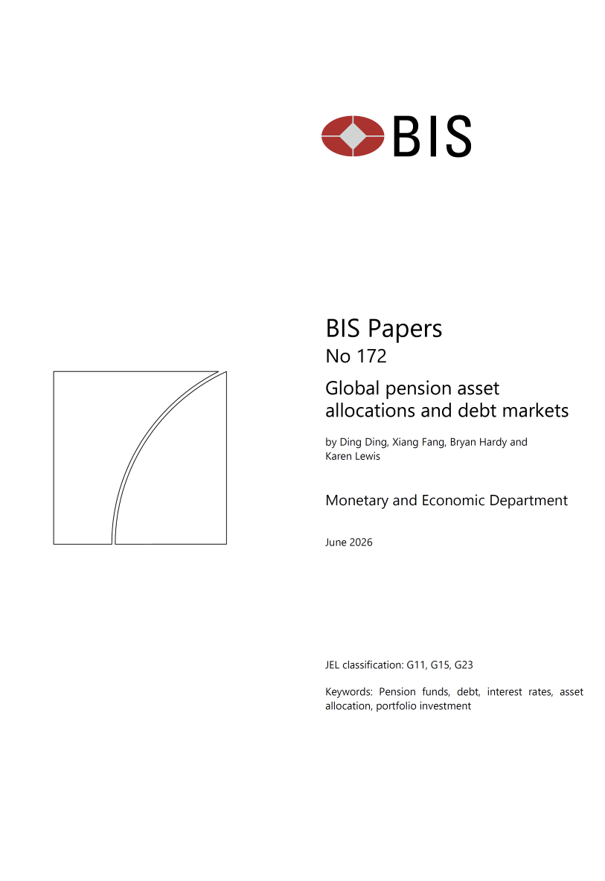
"Global pension asset allocations and debt markets" by Ding Ding, Xiang Fang, Bryan Hardy, and Karen Lewis.
"The pensions sector is an important investor group in global financial markets and a key holder of government and corporate debt. This paper examines the evolution of pension fund asset allocations around the globe and documents important structural changes. Over time, pension investors have shifted from fixed income securities to mutual fund shares. In the meantime, they have also reallocated from traditional investments into alternative investments. Evidence from US pensions suggests that the decline in the fixed income share is due to both private and public debt. We hypothesise that a global decline in interest rates is one potential driver of this change. Using a global sample, we document that declining local currency government bond yields are associated with lower bond shares in pension portfolios and higher shares of mutual fund and foreign assets. We discuss the potential implications of these trends for borrowing costs."
https://t.co/UUnoKdra20
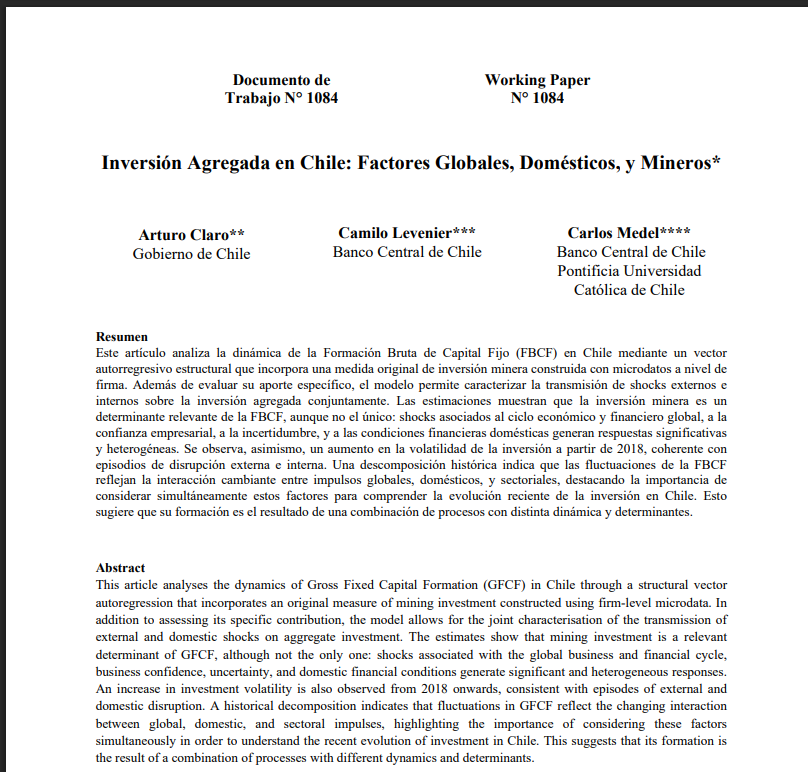
1/6 Cuando estaba en el Banco Central, me tocó intentar responder la pregunta: ¿Qué mueve la inversión en Chile?
Para responder parte de ella, hicimos el Documento Trabajo N°1084 (https://t.co/8Q1mgLZxBu), junto a Camilo Levenier y Carlos Medel
Lo más clave acá. Doble clic👇👇
Short post on the two traditions in the history of economic ideas. The central divide is between classical political economy, reproduction, surplus, accumulation, and the Benthamite/marginalist tradition of utility, exchange, scarcity, and individual choice /1
IT’S OUT
IT’S ONLINE
AND FOR JUST ONE MONTH…
IT’S FREE at https://t.co/9E1Wt8oIm6
And: ok it may be called CAPITALISM but… don’t be selfish… please r/t 🙏🏻🙏🏻🙏🏻🙏🏻🙏🏻
@flandreaumarc@damianclavel
Excited to FINALLY release toughest+most rewarding paper I've worked on...
….we attack a 150 year old Walras question that's gone unanswered, not for lack of trying (Hicks, Samuelson, Arrow; our chances?😱)...
Q: Is the market equilibrium stable or unstable?¯\_(ツ)_/¯
🧵
Schumpeter in a nut shell:
— Capitalism forces “rationalization” and the rationalist worldview, which just ends in an almost nihilistic skepticism that corrodes everything traditional that it touches: in particular “family life” and the aristocracy.
— The traditional bourgeoisie aren’t utilitarian individualists, they’re glory-seeking lineage-makers; the only reason they accumulate so much property is so their dynasties will outcompete other bourgeois dynasties in their preferred measure of prestige (money). Once women realize that traditional family values are bullshit (thanks to the rationalist individualism capitalism disperses) the lineage-making stops, and therefore so too does the most powerful reason for endless excess accumulation.
— The dispersion of capital ownership via the new corporate form will dim the bourgeoisie’s passionate defense of private property; corporate managers takeover the old heroic entrepreneur’s functions so it’s no longer that fun or glorious anyway. Bourgeoisie “can’t say boo to a goose.”
— The aristocracy was the necessary bulwark against rising socialist tide because they had the “habit of command” required to put down the street ruffians back in their place. Rationalist skepticism gets rid of that bulwark too.
— Enlightenment and mass education over produces “intellectuals” as a class, who are habitually disgruntled and instinctively attracted to the idea of rational planning. The bigger this group gets, and the more resentful they get about their lack of proper recognition in a world where money is the metric of prestige, the more they’ll go for capitalism’s throat.
In schematic form:
Capitalism —> rationalism/individualism
—> decline of family values + (rise of corporate form —> dispersion and devaluation of property + automation of entrepreneurship) —> bourgeoisie gives up
—> aristocracy gets axed and removed as a private property defender
—> overproduction of intellectuals, who are structurally predisposed to be socialists, take over the all the available ideological space and overwhelm state actors, bending their instincts towards socialism too
Capitalism doesn’t fail for economic reasons—economically, it could go on forever; the Marxists and radical Keynesians are wrong about that—it fails because capitalism produces a culture and sociology inimical to itself.
Really cool!
"FRED Adds Data from the Treasury International Capital System: FRED has added 4260 data series about cross-border portfolio investment flows and positions between U.S. residents (including U.S.-based branches of firms headquartered in other countries) and foreign residents (including offshore branches of U.S. firms), reported by the U.S. Department of the Treasury, the Board of Governors of the Federal Reserve System, and the Federal Reserve Bank of New York."
https://t.co/iLyxa1IJyG
¿Puede una suba de tasas generar una depreciación? Sí.
Si te interesa macro abierta, política monetaria o entender por qué los mercados emergentes se comportan "al revés"… este paper de nuestro profesor @JavierGC14 y @juanpdiiorio (maestría 2022) es para vos.
👉https://t.co/3uGshvIawn
Milei disertó en San Andrés sobre neutralidad del dinero y la curva de Phillips. Presentó una versión “canónica” con la lectura liberal-monetarista, según la cual la curva de Phillips es un error “Keynesiano”, corregido por Friedman, Phelps y Lucas
Hilo 👇
A lot of discussions on the Fed and its role in the economy. It's high time to have another look at interesting books like this one!
"The Federal Reserve: A New History" by Robert L. Hetzel.
"In The Federal Reserve: A New History, Robert L. Hetzel draws on more than forty years of experience as an economist in the central bank to trace the influences of the Fed on the American economy. Comparing periods in which the Fed stabilized the economy to those when it did the opposite, Hetzel tells the story of a century-long pursuit of monetary rules capable of providing for economic stability."
https://t.co/aYjiGYJX3b
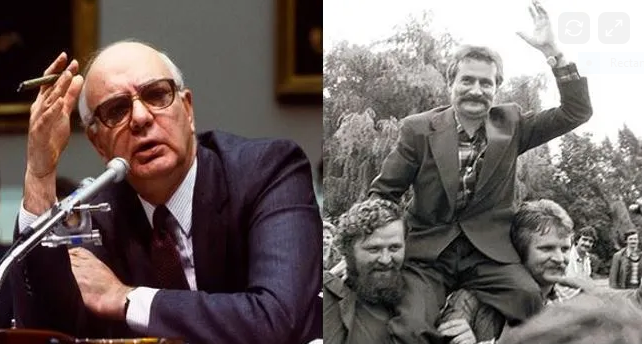
An excellent book (by Frirz Bartel)
Western money and Eastern promises
How the oil shock revived capitalism and ended communism
https://t.co/AJEotRFSsr