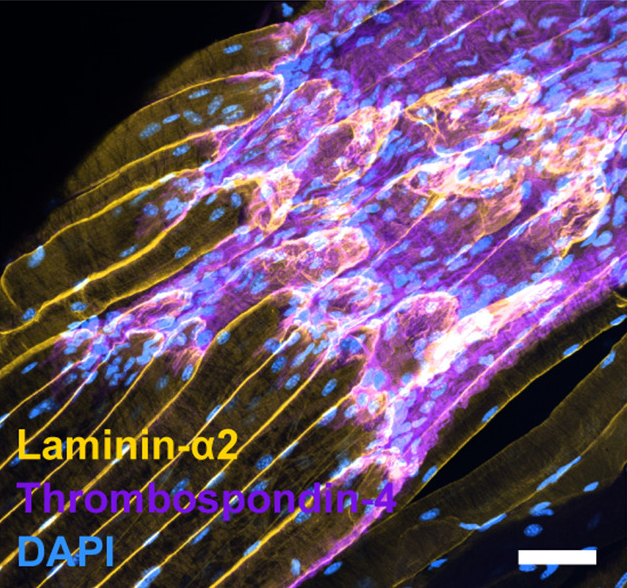
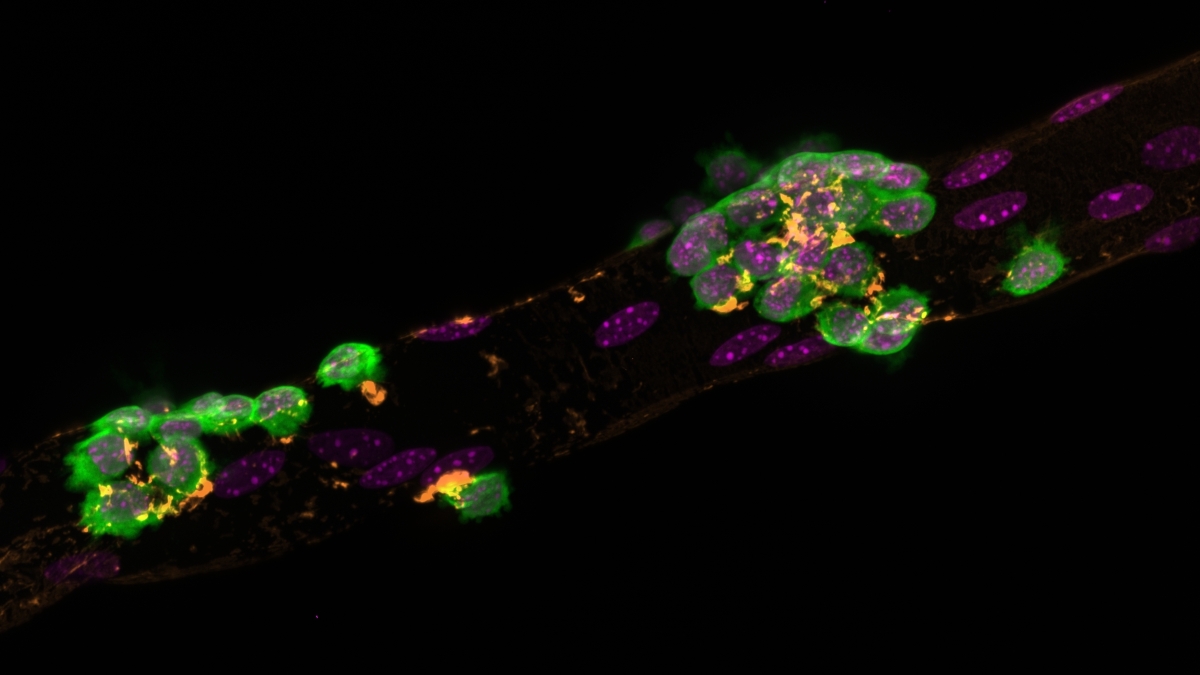
Thank you for highlighting our study as Editor's choice, @MatrixBiology! We hope this work helps advance understanding of MTJ stability and its role in LAMA2-MD.
https://t.co/fst9Qapovx
We are pleased to announce the first selection for the @MatrixBiology Editor’s Choice feature.
“Laminin-α2 is required for the maintenance of the myotendinous junction in vivo”
@JuliaSchedel, Shuo Lin, Thomas Bock, Dominik Burri, and Markus rüegg
https://t.co/VQRVUTXSBx
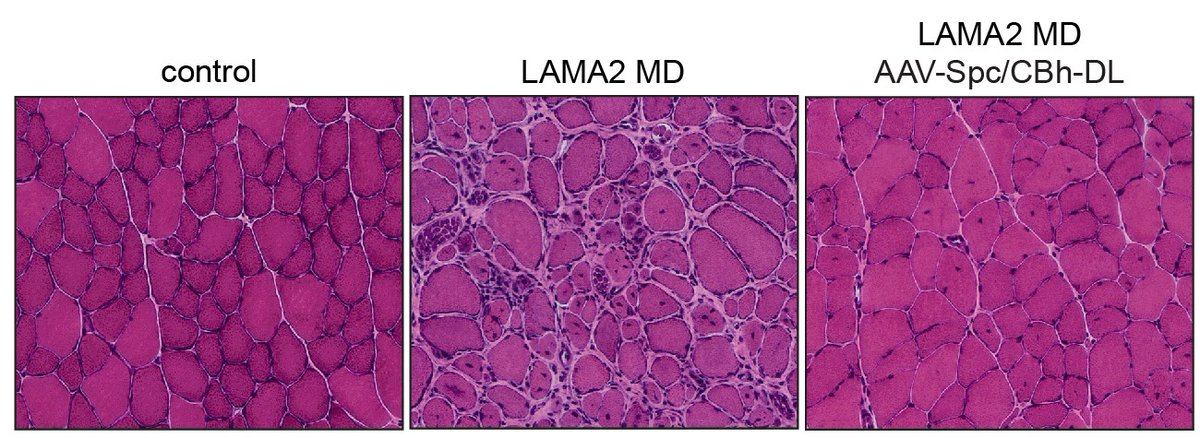
LAMA2-related muscular dystrophy is a rare genetic disease for which there is currently no treatment available.
We are happy to share our recent publication in Molecular Therapy, where we describe a unique linker-mediated gene therapy approach . https://t.co/RrmEXtpSEo
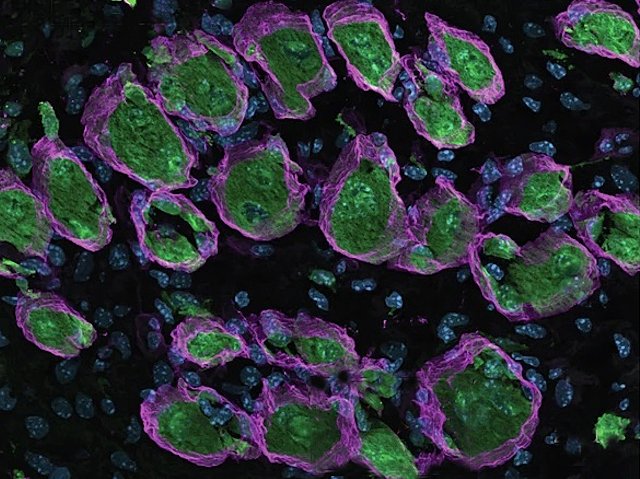
Stem cell-derived laminin-α2 is crucial for muscle regeneration & reveals impaired stem cell function underlies LAMA2 muscular dystrophy
📷 Timothy J. McGowan et al @RueggLab@biozentrum in @NatureComms
➡️ https://t.co/cJTBzqaEL7 with @AntDLewis
We're delighted that two of our publications have been shortlisted among these great papers. If you enjoyed our work, you can vote with the link below:
It is that time again, time to vote for the 12th Annual Matt's Totally Biased (but less so) Top 10 Muscle Papers of the Year. Due to prohibitive shipping costs, this year’s winner will receive an e-gift card in lieu of a plaque. Voting will end Dec. 20. https://t.co/nE7mIyKOIa
Check out our latest publication in @NatureComms, where we show that activated muscle stem cells remodel their niche with laminin-α2, and that the loss of this process intrinsically impairs their regenerative capacity in LAMA2-related muscular dystrophy:
https://t.co/dOX5fWvZb8
We’re excited to launch our Research Highlight Series! First up: an in-depth Q&A with Dr. Daniel Ham from @RueggLab on his latest @NatureComms paper, and insight into muscle biology, research, and more. #myotwitter
Interview
https://t.co/Km6H7iAgrI
Paper
https://t.co/87p3615I4z
In our latest preprint, we show that activated muscle stem cells secrete laminin-α2 into their niche — and that the loss of this process intrinsically impairs their regenerative capacity in LAMA2-related muscular dystrophy:
https://t.co/3uDahI9bo7
New study by @RueggLab challenges previous view about the muscle growth factor #Myc! This protein is dispensable for #musclegrowth. High Myc levels disrupt muscle fiber structure and function. @UniBasel_en@snsf_ch@NatureComms
https://t.co/Kq1WQwVUqc
Myc and muscle growth: necessary in muscle stem cells, dispensable in muscle fibers and harmful if overexpressed. Check out our latest work https://t.co/ACbr55RXuz in @NatureComms, where we explore the role of Myc in muscle growth and more.
If you're using AAVs to develop a gene therapy or to study gene function in skeletal muscle, then this may be of interest to you. In our latest work, we show that AAVs commonly used to deliver transgenes to muscle fibers also target mononuclear cells:
https://t.co/XHVtO8ouFw
Check out our latest publication where we use single-nuclei RNA-seq to study gene expression at the neuromuscular junction: https://t.co/GU9mPiMaMw
The paper also characterizes three novel NMJ proteins including the transcription factor ETV4 and the MuSK-binding protein PDZRN4.
It was great to host @TelethonSuisse in our lab and share insights into our research on LAMA2 muscular dystrophy (in French) @swiss_muscle@SEAL_Tx
Reportage sur deux laboratoires de recherche à Bâle https://t.co/OXbie7ASup via @YouTube#LAMA2#MDC1A
Really happy to share our study on Myotonic Dystrophy Type 1 now in #SkeletalMuscle. Very proud of the work performed by Denis Falcetta, @sandrinequirim, Florent Chabry, and all other group members and collaborators @unige@biozentrum. Thanks to all !
https://t.co/Ckpa8kasIw
Check out our latest preprint where we use single-nuclei RNA-seq to study gene expression at the neuromuscular junction: https://t.co/g6akExmN50
The paper also characterizes three novel NMJ proteins including the Golgi-associated and MuSK-binding protein PDZRN4.
On #RareDiseaseDay, we are putting the spotlight on LAMA2 muscular dystrophy. As yet, there are no effective therapies for this genetic disease. @SEAL_Tx, a @unibasel_en start-up, is now pursuing a promising approach.
🧵 1/7
https://t.co/Y8ExwbGa21
Zum #TagDerSeltenenKrankheiten rücken wir die LAMA2-Muskeldystrophie in den Fokus. Bislang gibt es keine Therapie für die genetisch bedingte Erkrankung. @SEAL_Tx, ein Start-up der @unibasel, verfolgt nun einen vielversprechenden Ansatz.
🧵 1/6
https://t.co/oMOy6lDtUv
Be part of our pioneering efforts towards #bioxolography and join our new SNF Sinergia consortium with the research groups of Robert Katzschmann @srl_ethz (@ETH_en), Markus Rüegg @RueggLab (@UniBasel), and Matteo Moretti (@EnteOspedaliero). Revolutionize bioprinting with us!
@RueggLab has developed a new method using #CRISPR/Cas9 to study the function of genes in muscle fibers. It is efficient and reduces the number of experimental animals. The method implements the #3R principles. @biozentrum@UniBasel_en@NatureComms
https://t.co/WWjPhDKuN2
Win-Win in der Muskelforschung: Forschende @biozentrum haben eine Methode entwickelt, die die Zahl der benötigten Versuchstiere stark reduziert.
#Forschungsethik#CRISPR#3R
https://t.co/Q9yHSwtHgw
Congratulations to @MThurkauf for successfully defending his PhD thesis „Decipering the function of candidate genes in skeletal muscle aging using AAV-CRISPR/Cas9“. @biozentrum@UniBasel#phdone
All the best for your future! 🎓🎉