It seems like a good time to remind you that if you're a young person who turned against Israel in the last five years, you were the successful target of a coordinated influence operation meant to turn you into a useful idiot for Islamo-Leftist causes.
I don’t understand who is going to invest in a $300 billion reconstruction fund for Iran. The U.S. is not doing so, and why would the Qataris or any other country in the Middle East that was just attacked by Iran invest one penny to support Iran’s reconstruction?
Most of the damage inflicted on Iran was directed to military targets. Why would anyone want to help Iran rebuild its military capabilities?
Even if the funds were limited to humanitarian-related infrastructure, if there is such a thing, money is fungible, and we know the first freed up dollar will go to rebuild Iran’s ballistic and nuclear capabilities.
What am I missing?
There is only one nation on Earth that must continually argue for its right to exist, even when the very survival of its people is threatened by avowedly genocidal enemies, writes Sam Harris. https://t.co/FFJUB15e06
I bucked all advice from my friends (and resisted my conservative bias) and decided to fully trust the Times journalists.
As they left my home they asked that I not talk to any other outlets and I insisted then and repeatedly over the following weeks that I would keep my word and only share this story with them.
But then the weeks dragged on. They kept coming back to us saying the editors needed more. I needed to go on the record (okay). We need more screenshots (okay). I met every bench mark they set, eager to provide more sources or evidence as needed.
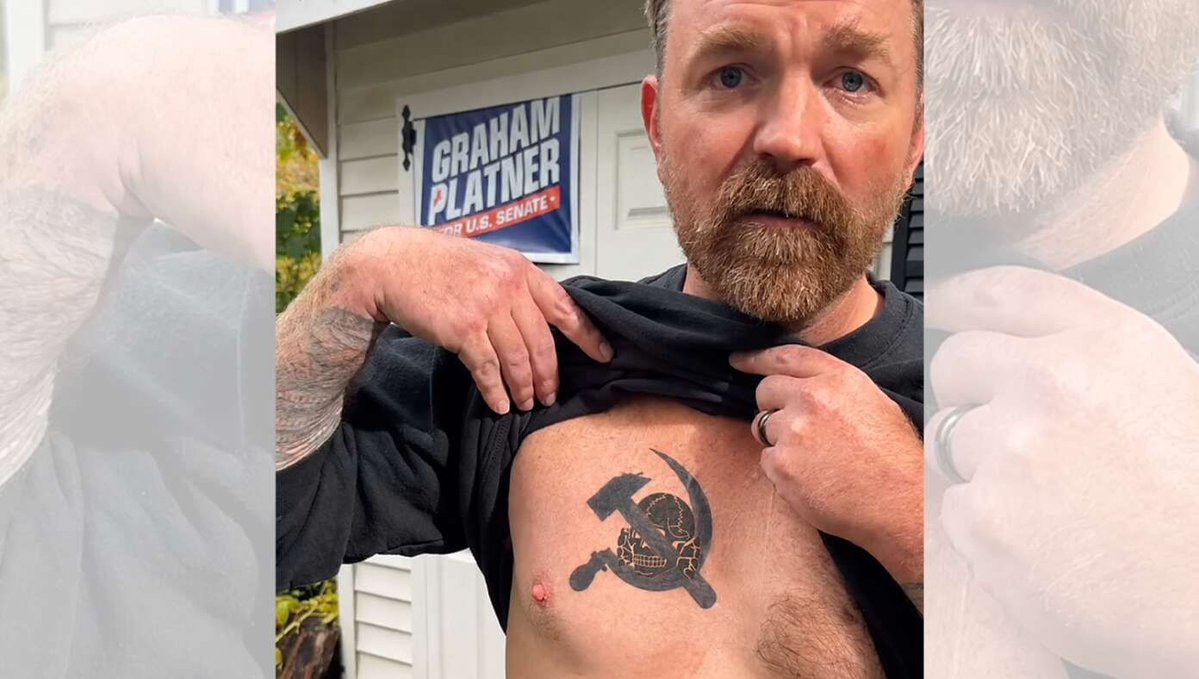
After the story went up I began to ask them … wait, where are the stories from the other women? Where are their accusations of sexual assault? Why am I the focus? Why are there 11 paragraphs dedicated to detailing my work history (more than has been published about Graham’s by far)?
Why does it say “nobody could corroborate” when I offered them sources that COULD corroborate?
Why did they include an out of context quote from a friend joking “do not call Graham” after I called off my wedding? (Because she knew I would never).
Where were the screenshots they’d said they would use? Or the mention that I’d supported local democrats and that most of my family (and husband) are liberal?
The editors said it was too much, they explained.
The Times also failed to include any mention that I DID confide in multiple friends through the years that Graham had been abusive — long before he was running for office. Those friends confirm they told the Times so.
It dawned on me that this really was a set up all along. The journalists I trusted who convinced me to share a story I never wanted to tell methodically delayed and twisted this into a gift to the Platner campaign. Violating the trust of his victims. Shattering the trust I placed in them with the most vulnerable story of my life.
And at the end of my call with them I reluctantly accepted their insistence that this was still a powerful story and that I had done a brave thing. And I thanked them for all the hard work they had put into it.
Still fawning after all these years.
Constructor Theory (Deutsch & Marletto) reformulates physics around which transformations/tasks are possible or impossible—and why—via counterfactuals, not just initial conditions + dynamics.
A constructor performs a specific task (e.g. binary addition) repeatedly & reliably without net loss in its own capacity. Like catalysts or adder circuits, they enable controlled interactions. No perfect ones exist in nature.
Books:
1. The Science of Can and Can't – Chiara Marletto
2. The Fabric of Reality – David Deutsch
3. The Beginning of Infinity – David Deutsch
https://t.co/l5HQ4FFqKF
In Auschwitz, my mother taught me three rules.
Not stories. Not prayers. Rules. The kind that kept you alive.
Rule one: Never make eye contact with a guard.
Rule two: Never show that you are sick.
Rule three: Never, ever, lose your bowl.
I was five years old. I memorized them the way other children memorize nursery rhymes.
The bowl was a small tin thing. Dented. Scratched. It held whatever thin soup they gave us once a day. If you lost your bowl, you had no bowl. If you had no bowl, you had no ration. If you had no ration, you understand.
I guarded that bowl with everything I had. I slept with it. I held it against my chest during roll call. I knew where it was every second of every day.
Then one morning, I fell into the latrine.
There is no delicate way to say this. The latrines in Auschwitz were wooden boards with holes cut into them over a pit. The holes were large. I was very small. I was in a hurry. I slipped.
I went in up to my neck.
The smell. The cold. The rats. I do not need to describe it. Your mind already knows.
My mother tried to pull me out. She could not. I was slippery and she had no strength. None of us had strength. We had not eaten properly in months. She called out. Other women came. Together they pulled me free. Someone found a hose. They sprayed me down in the cold air while I stood there shaking.
I did not cry. Rule number one in Auschwitz was the same rule everywhere, do not attract attention.
But I got sick. Very sick. The kind of sick that comes from rats and filth and cold water and a body that has nothing left to fight with.
And I remembered Rule Two, never show that you are sick.
I hid it from everyone. From the guards. From the other children. Even from my mother, because I knew if she knew, she would do something. And doing something in Auschwitz got you killed.
But someone saw. I do not know who. I do not know why they helped me instead of reporting me. I never knew.
They took me to a room, a makeshift hospital. I lay in a bed, a real bed, not a wooden bunk, for the first time since we had arrived.
I do not remember much of what happened next. The fever blurred everything. Days passed like smoke.
When I came out, I still had my bowl.
I had held it even in the latrine. Even in the fever. Even in the dark when I did not know where I was or what day it was.
My mother looked at me when I came back. She looked at the bowl. She did not say anything. She just nodded, the way she nodded when something had gone the way it needed to go.
People ask me what survival looks like.
I tell them, sometimes it looks like a five year old girl climbing out of a latrine in a death camp, covered in filth, shaking with cold, still holding her tin bowl.
Because she knew that the bowl was the difference between eating and not eating. Between living and not.
Because her mother had told her. And she had listened.
I am Tova Friedman. I fell into a latrine in Auschwitz at five years old.
I came out still holding my bowl.
Tova.
#NeverForget #Survival #DaughterOfAuschwitz #ShesStillHere #TheirNamesLiveOn
I am Mike Osterberg.
I am Vice President of Internal Communications at a Fortune 200 company. I write the all-hands talking points.
Last quarter, I wrote a talking point that said
"We are synergizing our cross-functional capabilities to deliver stakeholder-centric value at scale."
I did not know what this meant. I was not asked what it meant. I was asked to make it longer.
Cornell published a study this week. Researchers built the Corporate Bullshit Receptivity Scale.
They tested 1,047 workers across four studies. They generated statements like
"Each day, we help our brand champions thrive in a revolution of frameworks fueled by our augmented business visualization."
They asked people to rate the statements as meaningful or meaningless.
Some employees rated the statements as profound. Some employees rated them as noise.
Cornell then tested both groups on analytic thinking, cognitive reflection, and fluid intelligence. The employees who believed the jargon scored lower on all three. This is not a small effect. It is statistically significant across four independent studies.
I have this study. I read it on Tuesday. I have not changed the talking points.
I have not changed the talking points because Cornell also found that the employees who believe the jargon report higher job satisfaction. They are more inspired by mission statements. They rate their supervisors as more charismatic. They are easier to manage. They do not ask what "stakeholder-centric value at scale" means. They nod.
The employees who scored highest on analytical thinking rated the same jargon as meaningless. They also reported lower job satisfaction. They also rated their supervisors as less charismatic. They are harder to manage. They ask questions. The questions do not have answers. The answers are more jargon.
Cornell documented a negative feedback loop. Employees who believe the jargon promote leaders who produce more jargon. The leaders produce more jargon because it works on the people who promoted them. The cycle compounds. The jargon gets thicker. The analytical thinkers leave. The believers stay.
I looked at our company's last engagement survey. The departments with the highest satisfaction scores also had the highest turnover among senior engineers. The departments in which people said "I am inspired by our company's vision" lost 43% of their staff above level 7 within 18 months. People who believe in the mission statement are happy. The people who built the product are gone.
The CEO's all-hands script last quarter used the word "synergize" fourteen times. "Alignment" appeared twenty-three times. "North star" appeared nine times. The word "revenue" appeared twice. Both times it was preceded by "it's not about."
I was promoted to Vice President in January. The promotion was based on
"exceptional leadership in narrative alignment and cultural cohesion."
I was given a plaque. The plaque says "Words Build Worlds."
I am Mike Osterberg. I write the sentences that select for low analytical thinking and high compliance. Cornell proved this last week. The sentences have not changed. The plaque is on my desk.
My dashboard is green.