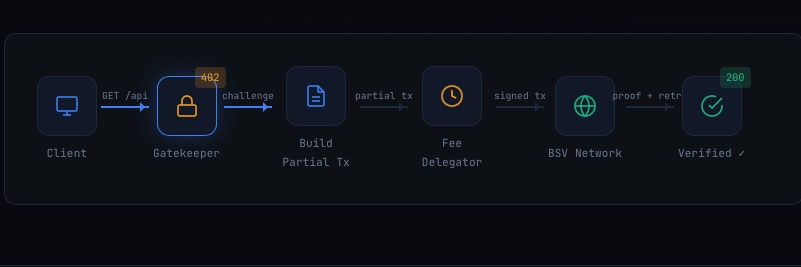
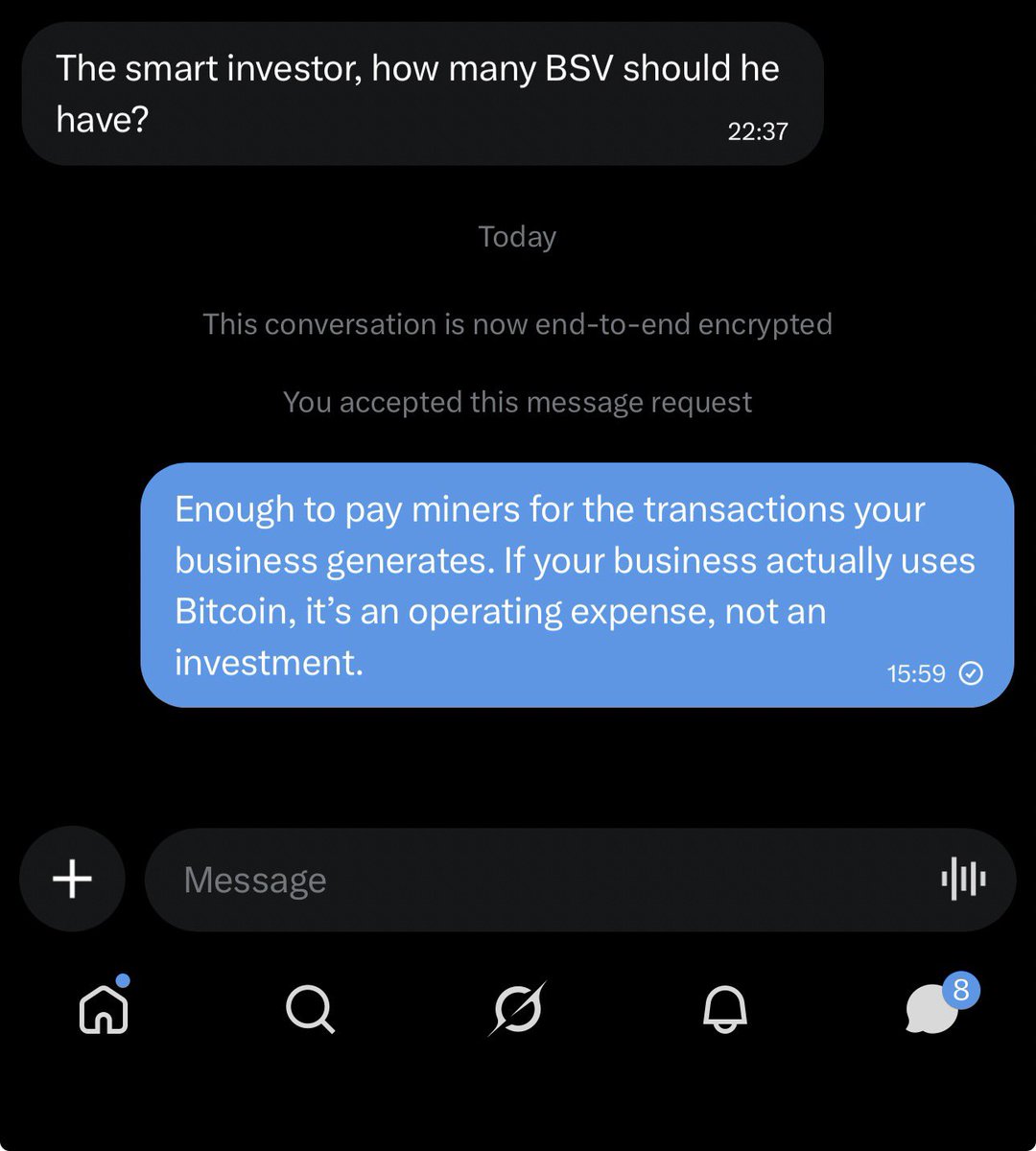
@patrickdusman@Dr_CSWright If your thesis were correct, every business using commodities would spend its cash hoarding inventory instead of growing the business. That’s simply not how firms allocate capital.
The biggest misunderstanding in Bitcoin is thinking like an investor instead of an operator.
If your business genuinely uses Bitcoin, the coins you hold are working capital to pay miners for the economic activity you create.
They’re not the business.
They’re an operating expense.
Real adoption begins when people stop asking, “How much Bitcoin should I own?” and start asking, “How much value can my business create using Bitcoin?”
@patrickdusman@Dr_CSWright In commerce, assets are held as working capital. Businesses forecast cash flow, liquidity requirements, settlement delays and counterparty risk. Bitcoin is no different. Larger balances reflect larger operational requirements, not an expectation of capital gains.
@jack Dorsey warns about five CEOs controlling AI while having spent years running a platform that decided what millions were allowed to say. He also co-founded @opencryptoorg with the only purpose of taking legal action against Dr Craig Wright to stop his claims to be Satoshi Nakamoto and prevent the world of using Bitcoin without middlemen. The irony is that he now presents himself as a champion against centralised control.
Yes, yes, ...
The classic crypto argument: “people who build on BSV keep failing and leaving.” And what do you think happens on BTC or Ethereum? Projects rot mid-development. Developers rage-quit after running into protocol spaghetti. Entire “Layer 2” ecosystems are born just to duct-tape over the broken base layer, and no one bats an eye—because failure on those chains is called “pivoting,” “iterating,” or the best one yet, “innovation.”
Meanwhile, BSV delivers a scalable platform and people whine that builders fail—when half the time, it’s because of the peanut gallery’s screeching or because they were chasing hype instead of substance. You want success? Build something useful. Otherwise, maybe go back to cheering for your favourite rug pull and calling it “DeFi.”
@BSVAssociation@VotariApp Much respect for the work you do in stewarding the protocol. Providing long-term stability, certainty, and confidence gives builders like us the foundation to innovate.
The problem with BSV is not the protocol. It’s not scaling. It is not throughput.
It is not Teranode, vaporware or not, and, it is NOT!
It is not the stack of patents higher than the collective IQ of Crypto Twitter.
No, the problem is the same as every other half-baked blockchain sideshow in this flea circus: the whiny fucking bitches who sit around stroking their egos and their keyboards, slinging hashtags instead of building anything.
Enterprise doesn’t care if I swear, doesn’t care about your reddit drama, doesn’t care about “community consensus” or who’s crowned king in your fantasy NFT land.
Enterprise cared about one thing: does the damn thing work? Can it timestamp a thousand documents for a cent? Can it track a product from Singapore to Southampton without a data breach or clerical error? Can it move a billion microtransactions without vomiting?
The answer is yes. But instead of building, you sit there like digital livestock chewing the same cud about who’s in charge, who’s said what, and why your speculative wet dream didn’t moon. Pull your fucking finger out. Because business doesn’t care about you.
It sure as hell doesn’t care about your bags.
‼️ Anthropic was hiding a secret internal project to destructively scan every book in the world, irreversibly damaging heritage. The company spent billions of dollars to slice the spines off millions of books, even very rare ones. This means no other AI, and no human, can access this knowledge anymore.
It now markets itself as the responsible lab.
One bookseller told 404 Media his inventory is full of rare, foreign-language and low-circulation books, meaning that if they are destroyed in the process of becoming training data, they will be even harder to obtain.
Second-hand booksellers across Europe are sounding the alarm, because rare books are being destroyed. They have received random lists of thousands of titles. Books too obscure to resell at a profit. Requests arriving overnight from companies nobody in the trade has heard of.
One email came from "Nataly" at 2077AI, a Singapore company. Attached: 3,000 English titles grouped by ISBN. A 1999 geomechanics monograph. A 2018 study of laser shock peening on ceramics. A 2021 academic book on Irish folk tales.
A German dealer watched the orders arrive every night between 3am and 5am. Canadian company Zoom Books, buying systematically, titles with nothing in common. Zoom told Swiss broadcaster SRF that this is a regular recycling and trading model.
🦔AI companies are bulk-buying rare books, scanning them through high-speed machines that cut the spines off, and shredding the originals. A service called ISBNdb facilitates orders of up to a million books and keeps buyers anonymous. Pre-2022 books are premium because they're free of AI-generated text. A federal judge ruled the practice is fair use because eliminating the original means only one copy exists at a time. Anthropic hired the former head of Google Books partnerships to obtain "all the books in the world."
My Take
This got to me. A bookseller told 404 Media that rare books with almost no surviving copies are being fed into this pipeline. Books that survived wars, fires, and centuries of handling are being shredded so an AI can learn to write a better marketing email.
ISBNdb's website literally says "'AI company destroys two million books' is not a headline that generates sympathy," and they still built an entire business around making it happen quietly. They offer NDAs as a feature. They coach clients to call it "digital preservation."
I've covered AI companies scraping the internet, torrenting libraries, and stealing music. This is worse because it's irreversible. You can re-upload a website. You can reprint a bestseller. You can't replace the last three copies of an 18th-century botanical text once someone shreds them for training data. And the judge said it's legal. So it's going to accelerate.
"We shred rare books and offer NDAs so nobody finds out" is a legitimate business model in 2026. What a timeline.
Hedgie🤗
Life becomes lighter when one stops asking what can be kept forever.
Nothing can.
The house changes hands. The body changes shape. Reputation fades, money moves, objects break, and even memory loosens its grip upon the details we once believed indispensable.
Yet this is not tragedy. It is instruction.
What matters is not possession, but attention.
The meal fully tasted. The person truly heard. The work done carefully when no applause was promised. The kindness offered before it became convenient. The knowledge earned slowly enough to become judgement.
We suffer because we ask temporary things to behave as though they were permanent. We clutch at people, places and identities until love becomes fear and ownership becomes anxiety.
But a flower is not less beautiful because it falls.
A day is not wasted because it ends.
A person is not lost merely because they are no longer beside you.
Those who matter remain in subtler forms: in the phrase you use without knowing why, in the patience they taught you, in the standard they left behind, in the silence where their voice still answers.
Peace does not come from securing everything.
It comes from needing less to remain unchanged.
Hold things gently. Love people deeply. Learn constantly. Leave behind more wisdom than noise.
The rest was never yours.
It was merely passing through your hands.
The entire tech industry (save for Anthropic) has come out in favor of open source AI.
So what happens next? Will Anthropic change its lobbying efforts? Not likely. Now the gaslighting begins:
“Nobody is trying to ban open source.”
“We just want to limit who can use it.”
“We just want to limit who can contribute to it.”
“We just want to limit how powerful those models can be.”
“We just want to make sure the guardrails (we lobbied for) can’t be removed.”
The net effect will be the same. They won’t stop until they kneecap open source. The rest of the industry needs to watch these guys like a hawk.
Government’s role is not to control everything, allocate every outcome or guarantee that everyone finishes with the same result. That is socialism’s conceit.
Its proper role is far more modest and far more important: to make the rules fair, stable and enforceable.
Fairness does not mean equality of outcome. It means that the rules applying when you enter remain the rules while you compete. It means they are not rewritten halfway through the game to favour those already powerful enough to influence the referee.
It means fraud is punished. Promises are enforceable. Property is protected. Contracts mean what they say. Dominant actors cannot use political access, regulatory privilege or hidden coercion to crush everyone beneath them.
Everyone should have a genuine chance. Not the same talent, capital, judgement or result. A chance.
That is the institutional foundation of a functioning market.
Markets without rules do not become free. They become captured.
Government should not decide who wins. It should ensure that victory is not purchased by owning the rulebook, bribing the referee or changing the score after the match.
You’re begging the question. You describe it as “earnings” while simultaneously asserting it was legally a gift. If it was remuneration disguised as a gift, that’s an allegation of tax fraud and requires evidence. If it was legally a gift, then it isn’t evidence that “the wealthy don’t pay tax.” One anecdote doesn’t establish your general proposition.
@ItalianSaints@DanielPriestley@BladeoftheS You’re asserting a comparative without defining either side of the comparison. “Pay relatively less tax” is meaningless unless you specify both the tax measure and the denominator. Otherwise it’s rhetoric, not analysis.