This paper took @BalsellsRodas ~5 years in making:
2020/21: MSc proj, toy exp🐣
2022: added more exp, rejected due to weak theory 😥
2023/24: invented a new proof tech in another proj 🤔
2024/25: revisit, apply new proof tech, resubmit -> accepted 🥳
Persistence pays off indeed👍
This paper took @BalsellsRodas ~5 years in making:
2020/21: MSc proj, toy exp🐣
2022: added more exp, rejected due to weak theory 😥
2023/24: invented a new proof tech in another proj 🤔
2024/25: revisit, apply new proof tech, resubmit -> accepted 🥳
Persistence pays off indeed👍
I am pleased to announce that I have updated the online versions of my 2 textbooks (see https://t.co/se6sLMqALR): I fixed all issues listed on github, added some new references (esp on LLMs), and made a few other small tweaks.
3. ChatGPT can give some correct non-trivial answers serving as a good complementary for causal discovery methods. This might open up new research opportunities on utilizing the large language models to complement, improve and develop better causal machine learning tools.
Are you curious about the performance of #ChatGPT on #CausalDiscovery? We do. So we push its limit and explore its ability to answer causal discovery questions by using a causal medical benchmark. The full report serves as an appendix to the benchmark 👇 https://t.co/Bq79zxRGQW
2. We need to be extremely cautious about using causal claims made by ChatGPT as causal discovery results. This is because causal discovery and causal question answering with large language models are fundamentally different tasks.
Cool! With computational approaches, everyone can be a multiview wire art artist!
You can even go for three view! See more examples here:
https://t.co/5K31ICAGm9
Announced today, @awscloud and @MSFTResearch partnered to create a new @GitHub organization called PyWhy—where novel causal-analysis algorithms developed by Amazon will augment DoWhy, Microsoft's existing causality library. #AmazonScience#AWS
OMG, surely embarrassingly they do 😂 In other words, even the most likely corresponding data point of a given noise has a small probability according to the analytical solution. Maybe the magic is from the engineering power of DNNs in the backward process again.
📃 New paper "Optimal transport for causal discovery" by @RuiboTu, Kun Zhang, Hedvig Kjellström & Cheng Zhang has been accepted at #ICRL2022! 👏 Full paper available: https://t.co/CQDadR1HH3
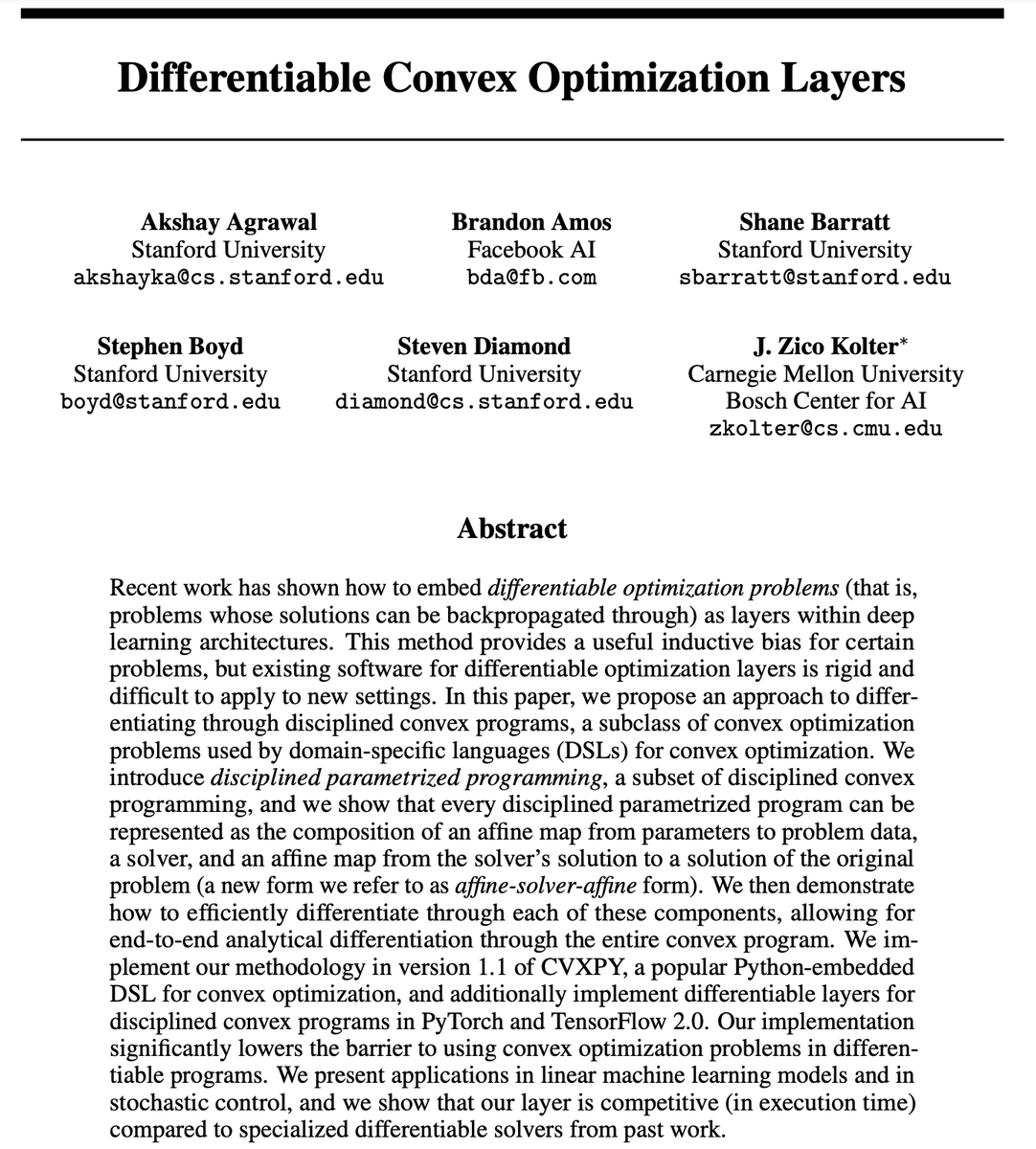
We've released differentiable convex optimization layers for JAX!
Code: https://t.co/eaE0j7mccy
Tutorial: https://t.co/b9Ev39kb8O
NeurIPS paper: https://t.co/8mYW3ZtJQv
Blog post: https://t.co/BJcZasljk3
With @akshaykagrawal, @ShaneBarratt, S. Boyd, S. Diamond, and @zicokolter
@rasbt Thank you so much for your suggestion. This sounds an excellent way to organize knowledge ! This will be certainly my first flag in my 2021 list. Great thanks!
(5/5) A: Not say assumptions doesn’t mean general. There are implicit assumptions of intuitions. If only rely on intuitions without further specifying and understanding underlying assumptions, this would be the most we would achieve, which would be a pity for it and the field.
(1/5) In our machine learning reading group at KTH, we had a very insightful discussion. It is about transfer learning, that is the generalisation without human involved specification what we want ? In other words, is the human involved specification what we don’t want?
(4/5) A: For sure, the method in XXX paper captures very important intuitions making its performance excellent, which is great for the field. But the generalisation without specifying how it generalises and how general it can be could be vague and misleading as well.