@Octmuseumpc@iclr_conf@jacobandreas@risteski_a@stellayu@guyvdb Haha I’d rather not assume bad intent 😳. But name collisions could be a real factor. Lots of Chinese names are identical in English, so maybe some profiles got mixed up? Hope it gets sorted out!
Has anyone else received an #ICLR2027 desk rejection related to profile or submission information that may be a misunderstanding? A co-author of ours got this notice, and all his submissions, including our joint paper, were desk rejected. We were notified on Oct 16 (~08:00 UTC).
We noticed a pattern: many affected authors have someone with the same name (but a different person) in their conflict-of-interest list on OpenReview. Since lots of Chinese names are identical in English, maybe that’s related? Just sharing in case it helps.
@Jerry_Life_Wu Thanks, but we don’t think so. Our co-author wasn’t involved at all, and at the time he even warned others not to take advantage of the leak. We’re still trying to figure out what was flagged.
He re-checked his OpenReview profile and couldn’t find anything inaccurate. He reached out to the PCs within two hours, and we understand they’re handling a huge workload. If you’ve had a similar experience, we’d be grateful to hear how it went 🙏 cc @iclr_conf
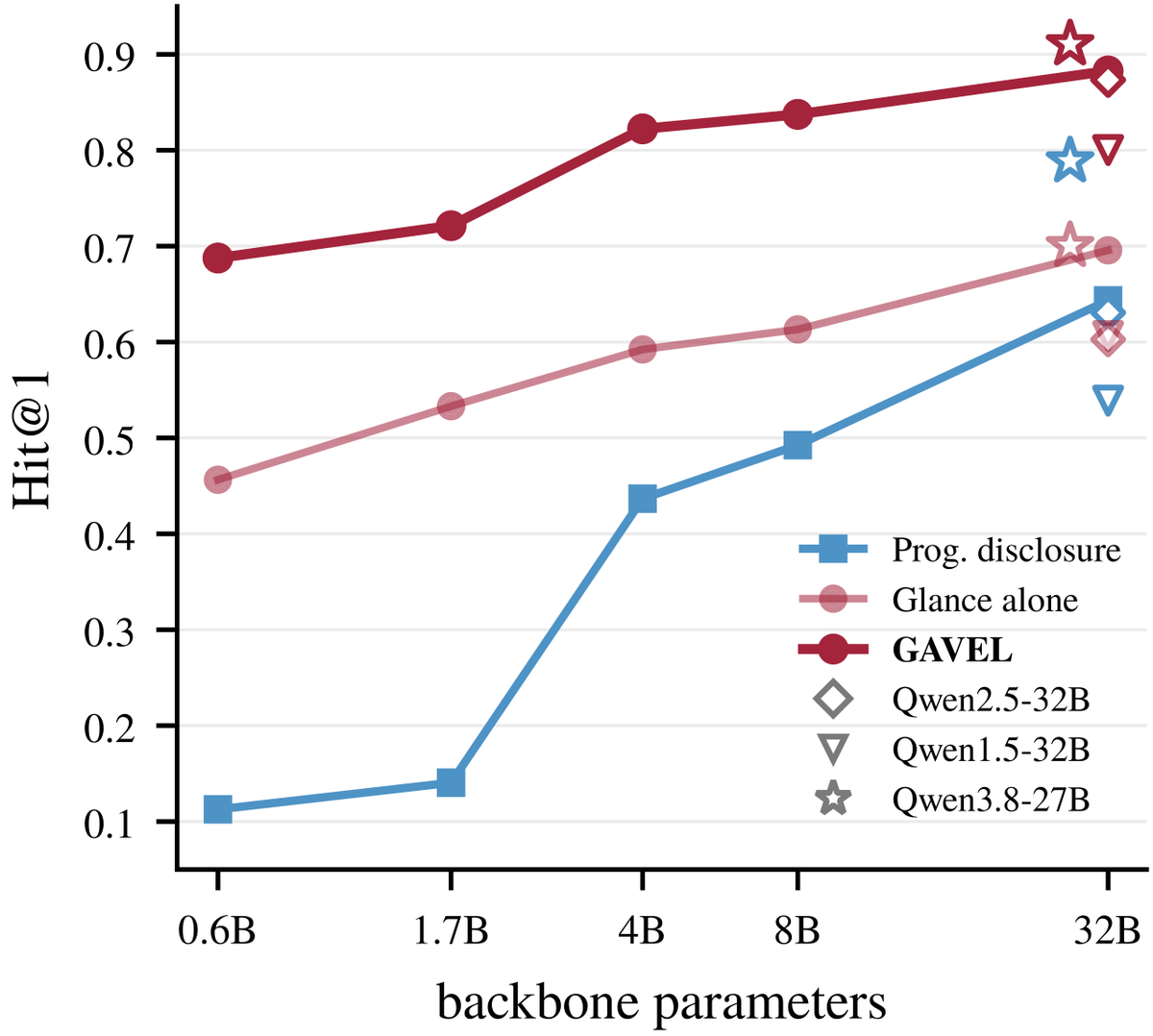
5/5 Routing improves with backbone capability. On SRA-Bench, even 0.6B GAVEL beats 32B progressive disclosure with a retrieved skill menu.
Building agents with growing skill libraries? We'd love to hear how you handle routing!
Paper: https://t.co/NCfwIpiImy
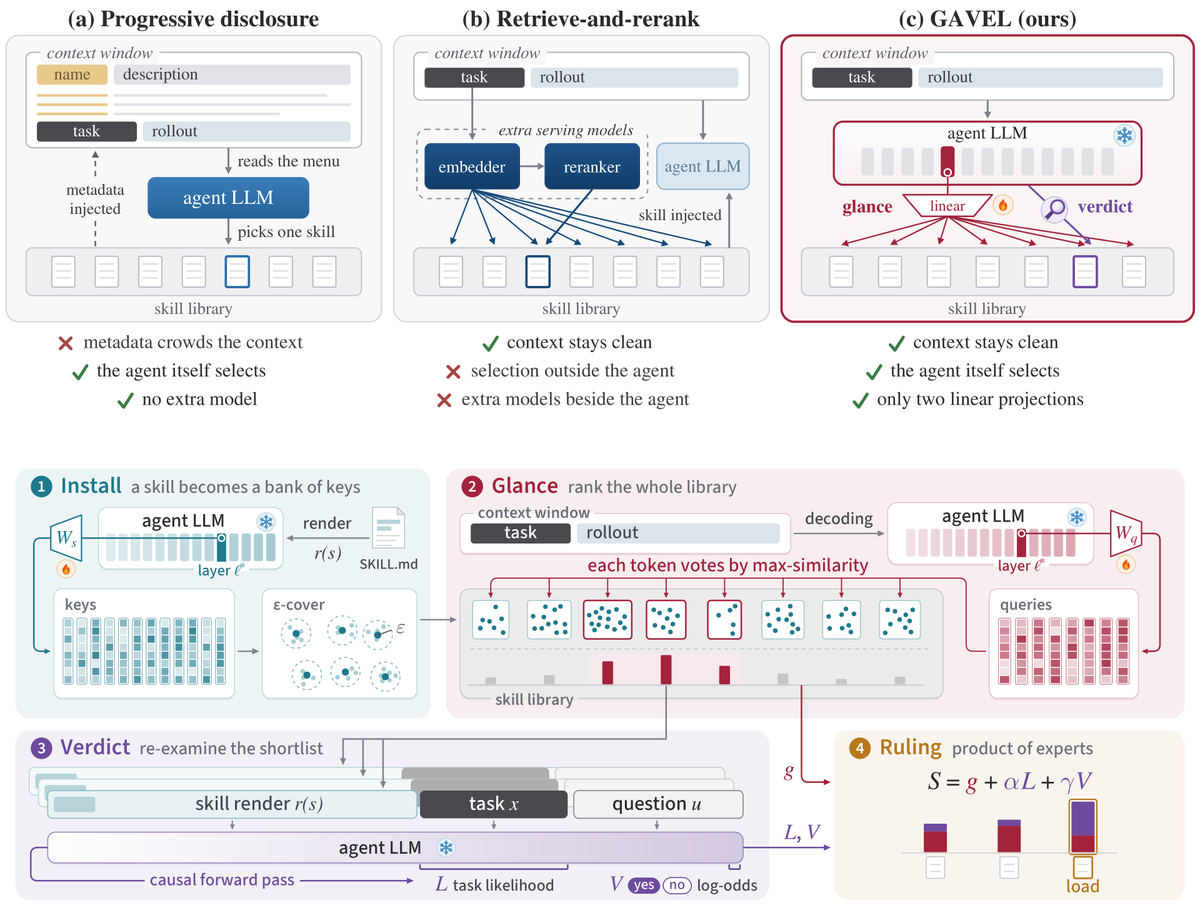
Can an LLM route skills without a skill catalog filling its context?
Introducing GAVEL ⚖️
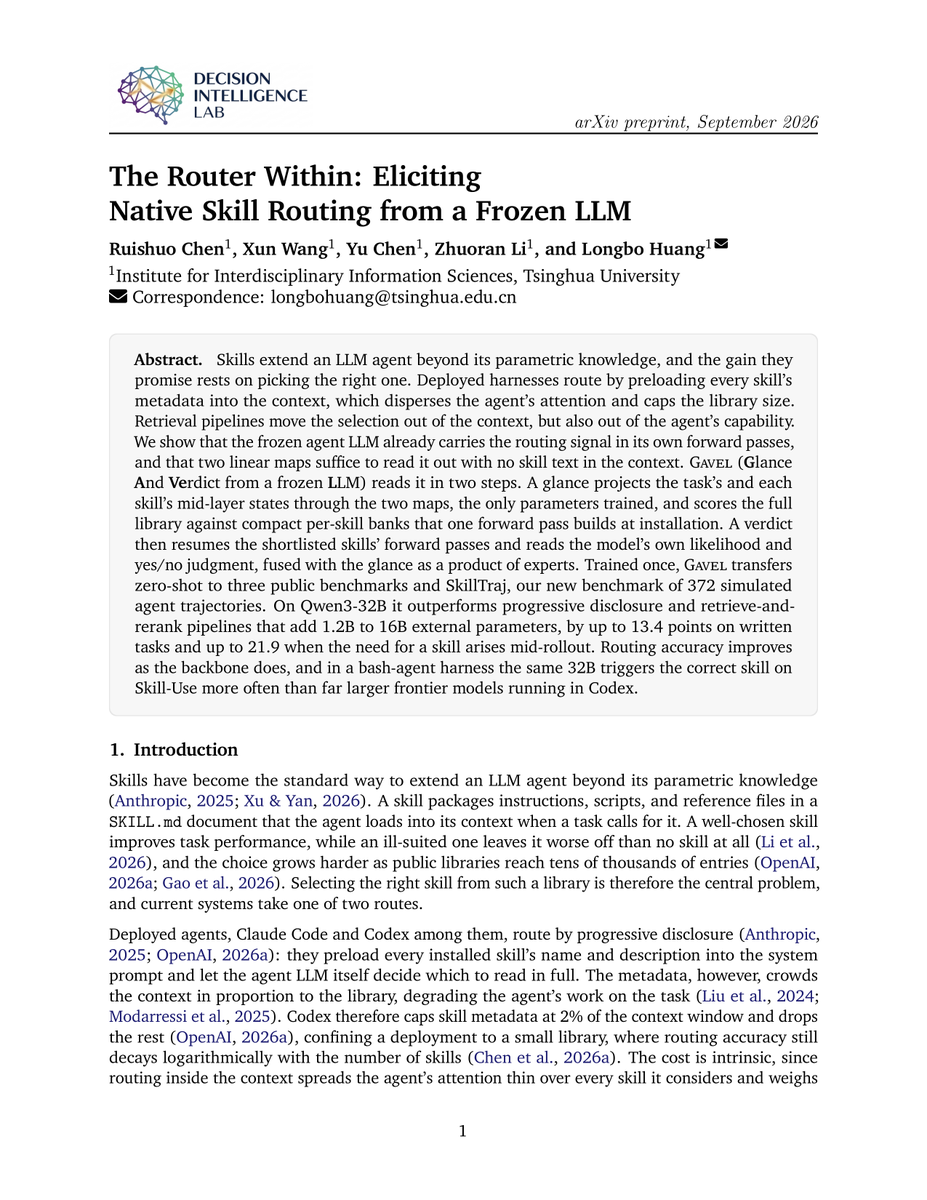
The Router Within: Eliciting Native Skill Routing from a Frozen LLM
If you find it useful, an upvote on HF would mean a lot! 👍
https://t.co/uwMxOdobxh
4/5 In a minimal bash agent, Qwen3-32B + GAVEL loads the correct skill on 90.9% of Skill-Use tasks.
That exceeds the frontier-model Codex baselines reported in Skill-Use, whose best reaches 86.4%.
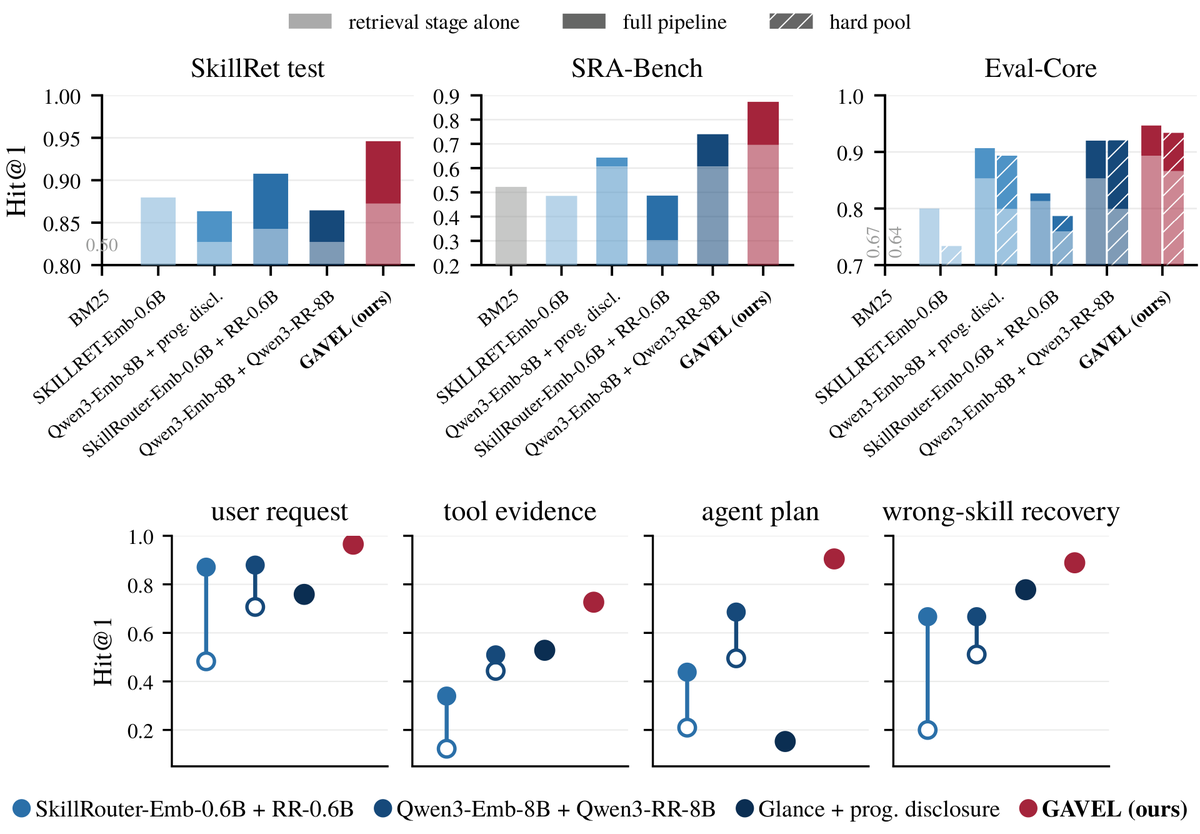
3/5 GAVEL leads on adjudicated routing accuracy across SkillRet, SRA-Bench and SkillRouter Eval-Core.
We also introduce SkillTraj: 372 simulated agent trajectories where skill needs arise amid noisy context. GAVEL leads across all four scenarios.
2/5 GAVEL uses two learned linear maps to read routing signals from a frozen LLM’s hidden states.
Glance shortlists skills. Verdict fuses the glance score with the same LLM’s likelihood and yes/no judgment as a product of experts.
Just 7.9M trained parameters on Qwen3-32B.
~50 posters at ICML 2026 were made with posterly.
Open-source skill, driven by any coding agent:
https://t.co/iyivO1AFGS
Site, blog, and a hosted service running my exact setup — no agent, don't trust yours, or don't want the hassle. Paid, receipt:
https://t.co/CyoPUzWJ6k
Is it art? Maybe debatable.
Is it usable? I think yes.
Open source here: https://t.co/iyivO1AFGS
Would love feedback, bug reports, and brutal academic-poster opinions.
#ICML2026#AcademicPoster#LLM#ResearchTools
Conference prep season is here, and I was once again reminded that making academic posters is strangely painful.
Blank canvas? Hard.
Inherited template? Also hard.
AI-generated poster? Often messy: bad rendering, fuzzy figures, broken alignment.
So I made POSTERLY.
I tested it on two first-author ICML 2026 papers and one NeurIPS theory-ish project I contributed to.
Yes, the examples are all purple. NJU and Tsinghua both have purple-ish vibes, and I will not be taking questions on this aesthetic decision.