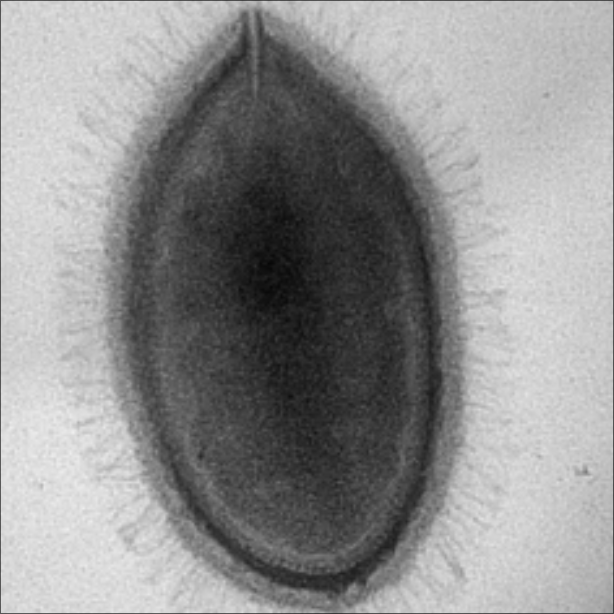
I'm thrilled to share that my main Ph.D. work has been published in Nat. Microbiol. We used multiple approaches to show where and how virus mRNAs are translated while using an almost "opposite" codon usage against its host. It's a wonderful collaboration!
https://t.co/S06ro6a2Hl
Excited to share my latest work on the consequence and evolution of the biased codon usage of giant viruses. It’s a great experience working with Lotte, @willemsen_anouk , @IwasakiLabRIKEN and being a student in @HiroDorcus lab!
https://t.co/PQQHinUYBw
Claude was trained on protein sequences, at scale.
We gave 20 language models the start of little-studied bacterial proteins and asked for the next amino acids. Only the latest Claude models predict them. Not GPT, not Gemini, not seven open-weight models.
Check out our new preprint on Sissivirus: A giant virus with a ~4Mb genome - the largest reported for a viral isolate - with 43% repetitive DNA!
Exciting collaboration with Julien Andreani, Mart Krupovic and Bernard La Scola!
https://t.co/mOwl6Jk3UI
🧬Possibly one of the most important genetics preprints of 2026 has just been published: the flagship paper of the Vertebrate Genomes Project.
An ambitious effort to generate near-complete and near-error-free reference genomes for all living vertebrate species.
The authors present 816 high-quality reference genomes covering around 95% of major vertebrate evolutionary lineages. Most assemblies are at chromosome-level quality and some are fully diploid telomere-to-telomere genomes.
Using this resource the authors reconstructed the genome of the last common ancestor of vertebrates, studied the evolution of sex chromosomes, explored 3D genome organization and compared epigenetic landscapes across hundreds of species.
This dataset will likely become a foundational platform for evolutionary biology and comparative genomics.
https://t.co/MuwxZD5bZd
#VGP #evolution #ComparativeGenomics #vertebrates #genomes
What happens when you train a transformer on 123 million bacterial proteins
Bacteria have been fighting viruses for billions of years. To do it, they have evolved a remarkable diversity of antiphage defense systems — molecular immune machines that detect and destroy invading phages. Yet fewer than 250 such systems had been experimentally validated. A new study in Science suggests we've barely scratched the surface.
Mordret and coauthors asked a simple but powerful question: can language models trained on protein sequences and genomic context learn the "grammar" of bacterial immunity well enough to predict entirely unknown defense systems at scale?
They developed three complementary deep learning models. ALBERTDF adapts the ALBERT transformer architecture to treat genes as words and genome neighborhoods as sentences — learning defensiveness from genomic context alone, without any sequence information. ESMDF fine-tunes the ESM2 protein language model with LoRA adapters to classify proteins as defensive or non-defensive directly from amino acid sequence — trained on a dataset of 123 million proteins drawn from 32,000 bacterial genomes. GeneCLRDF combines both signals through contrastive learning: it teaches the model that a gene's identity can be inferred either from its sequence or from the genomic neighborhood where it lives. This joint embedding achieves 99% precision and 92% recall on held-out benchmarks — far outperforming each approach independently.
The models aren't just impressive on paper. The authors experimentally validated 12 antiphage systems with no prior link to immunity, in both E. coli and Streptomyces albus. Some carry canonical defense domains; others involve proteins with no known association to antiphage function whatsoever.
Applied to over 32,000 bacterial genomes, GeneCLRDF predicts 2.39 million antiphage proteins. Around 1.5% of a typical bacterial genome is devoted to defense — three times previous estimates — and more than 85% of predicted protein families have no prior link to immunity.
The implications are immediate. The predicted atlas — including ~23,000 candidate operon families — is a ready-made discovery pipeline for novel nucleases, molecular effectors, and antimicrobial mechanisms directly relevant to phage therapy and programmable biologics. Language models are turning the bacterial pangenome into an actionable resource.
Paper: Mordret et al., Science (2026) — Science license | https://t.co/CzpyZWPNbO
@owl_posting RedNote is better for vertical contents. People prefer to watch long videos on Bilibili. There are many educational videos, such as 3Blue1Brown. Sometimes we call it, Bilibili University😂. Of course you can post on both platforms.
巨大ウイルス、宿主アメーバ内に「翻訳特区」を形成 コドン不一致でも高効率翻訳
岩崎 信太郎、緒方 博之 氏らの@NatureMicrobiol#OA#論文
A giant virus forms a specialized subcellular environment within its amoeba host for efficient translation
https://t.co/Vl0ckYlBh7
#オープンアクセス
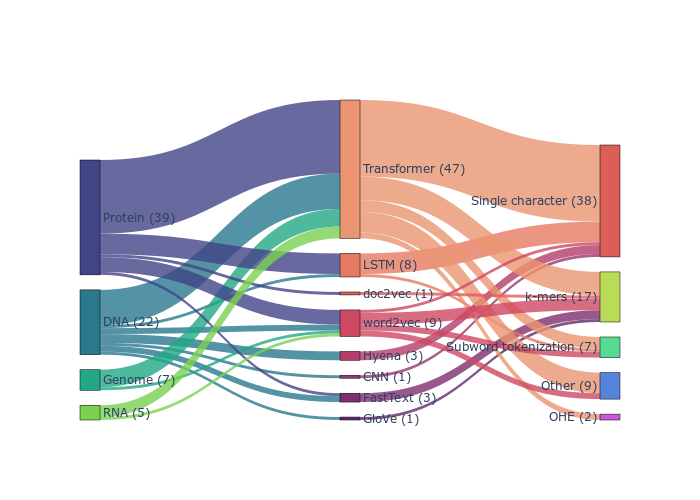
1/6 🧬📊 Curious about the buzz around NLP in biology? Feeling overwhelmed by the rapid developments? We've got you covered! Our review on NLP applications in genomics, by the wonderful @EllaRannon, is now out as a pre-print! #NLP#Bioinformatics https://t.co/RlNC5iq1wR
So excited to start the year w/ our new paper @CellCellPress! #proteomics spatial map of human cells + dynamics using #organelle IP at scale. 🙌 to amazing teamwork @czbiohub and beyond. Check out portal https://t.co/Gb1TvlKcCH and paper https://t.co/YskVRBUqZi. 1/n
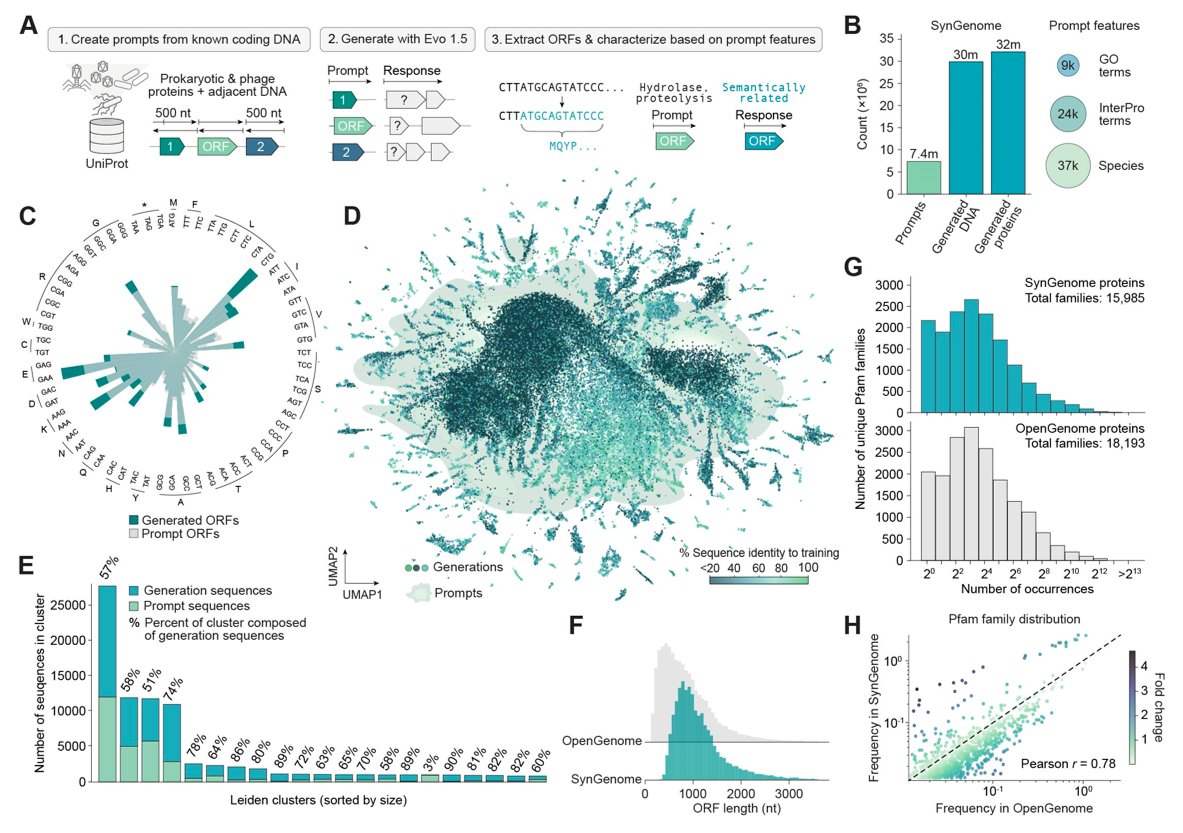
Finally, we wanted to systematically apply semantic mining to generate functional genes across prokaryotic biology. We used genomic sequences from UniProt as prompts to generate SynGenome, a database containing over 120 billion base pairs of synthetic DNA sequences. 9/N
Search your favorite protein sequences with Gaia🌎! We are excited to release a context-aware protein search tool, extending search and discovery capabilities beyond sequence and structure, to include *genomic context* https://t.co/m8MLGl88Fy 1/🧵
Excited to share my latest work on the consequence and evolution of the biased codon usage of giant viruses. It’s a great experience working with Lotte, @willemsen_anouk , @IwasakiLabRIKEN and being a student in @HiroDorcus lab!
https://t.co/PQQHinUYBw