If you're trying to give agents real work and control is what's stopping you, apply for early access today.
Every new account starts with $50 in free credits, enough to run an agent for a month, with no credit card needed.
Today we're announcing @runta's $20M seed, led by @a16z.
Software is constrained when you write it. Agents have to be constrained while they run.
Runta is the execution layer that controls what AI agents can actually do.
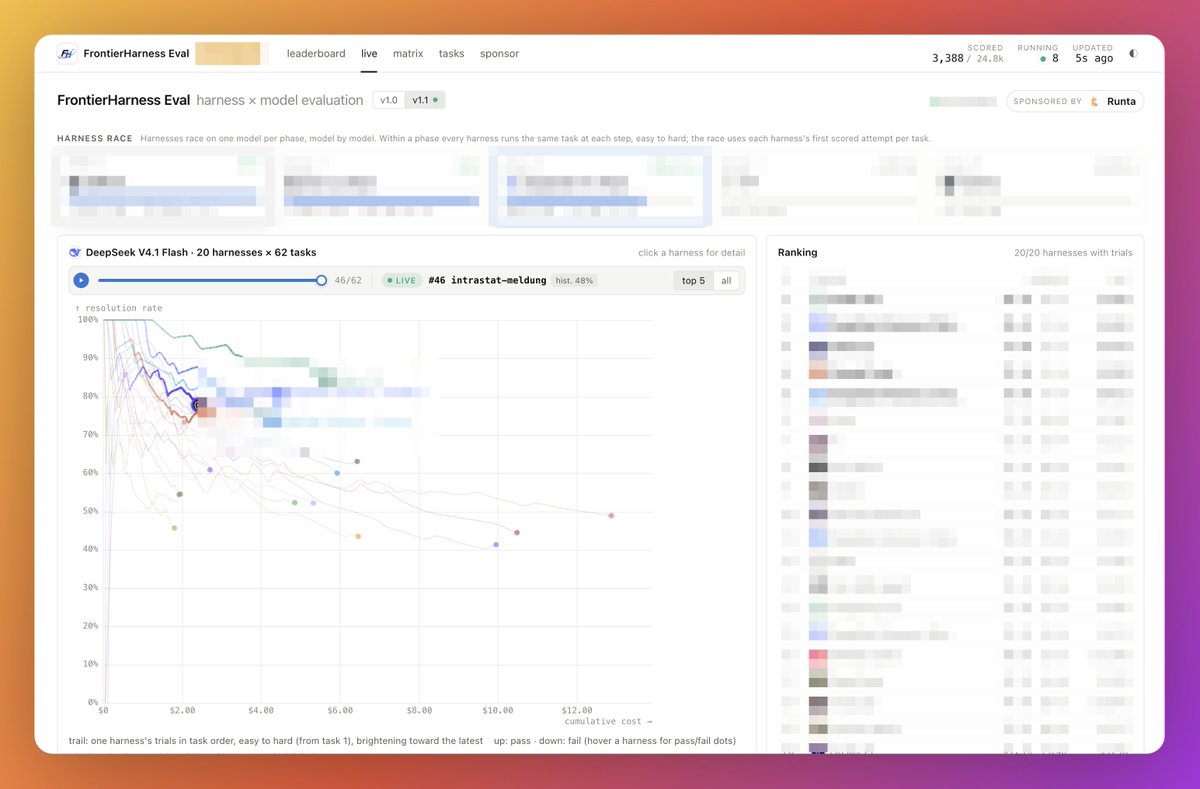
FrontierHarness v1.1 is past halfway.
21 harnesses, 5 models, 62 tasks.
Cost per pass:
1. Codex $0.57
2. Pi $0.67
…
21. Antigravity $1.32
First vs last: 2.3× cost per pass, 1.9× average cost per task.
Pass rates: 56.2% to 77.6%.
Which gap would actually make you switch harnesses, pass rate or cost?
Live board: https://t.co/L44GofxqKK
Every run executes in a @Runta runtime under the same limits, and shows up with its outcome, attempts, and token cost as soon as it finishes.
Rankings will shift as runs come in. Each harness × model pair is final after 248 runs.
The 62 tasks span software engineering (20), science and math (10), systems (8), data (7), ML (6), security (5) and 6 in other domains.
Harnesses include Claude Code, Codex, Pi, Oh My Pi, Hermes Agent, Cline, ZCode, KimiCode, DeepSeek Harness, Grok Build, Antigravity, OpenCode and Copilot.
best GLM-5.3 harness -> KimiCode
best Deepseek-v4.1-flash harness -> ZCode
best Kimi-K3 harness -> Codex
...so open-weight models work best on "other" vendor harness...
What’s the best harness for an open model on coding and agentic tasks?
We partnered with @Runta to investigate: 100B tokens and 26k trials later, the final results are coming in.
Full report next week.
Runs are live. Which harness will finish FrontierHarness v1.1 with the highest pass rate, and which with the lowest cost per pass?
Reply with your two picks. We’ll draw 5 winners from correct entries for $100 in Runta credits each. Entries close Nov 12, 9:00am PT.
We’re spending up to 100B tokens across 26,040 agent runs to answer one question: when you switch models, should you switch harnesses too?
Our v1.0 FrontierHarness leaderboard ranked harnesses on a single model.
V1.1 expands it to 21 harnesses × 5 models × 62 tasks × 4 attempts, 72x the size of v1.0.
Results are coming in live. Link below🧵
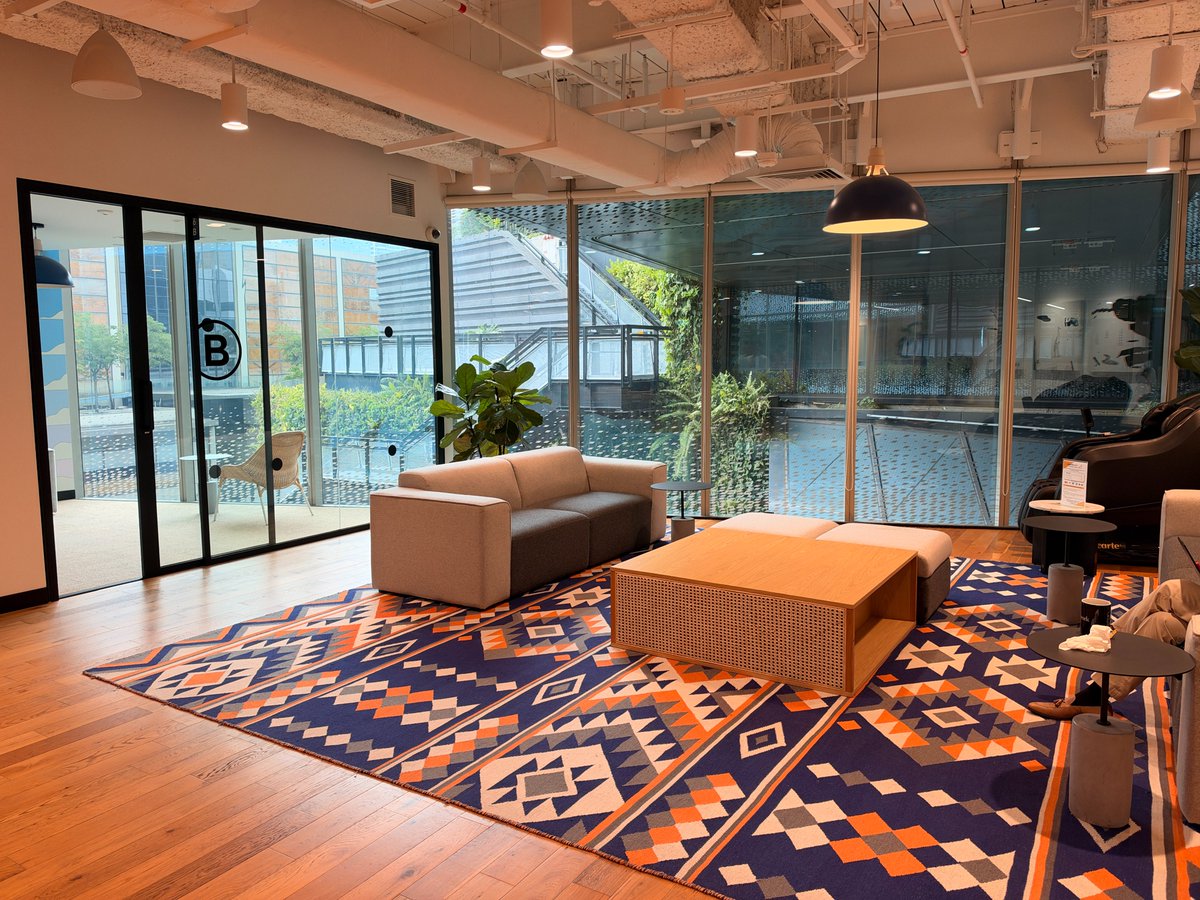
@Runta's Singapore office is open! 🇸🇬
Six months of preparation. Skipped the cramped high-rises for a green, light-filled workspace.
Hiring for agent infra team for both SG and US:
* Infra Engineer (FaaS / container scheduling / virtualization / RL infra)
* Product Engineer (build in public, open-source, community, design sense)
DM me if you’re into agent infrastructure.
Runta 10/10/2026 is now available!
Resize on cold checkpoint restore. Restore a cold checkpoint with a different CPU and memory shape, so you can scale the runtime without rebuilding its environment.
Smoother runtime creation at scale. Improved batching, scheduling, and higher API limits help runtime creation stay responsive during bursts.
Simpler ChatGPT subscription setup. New runtimes use your account’s default model, while unavailable subscriptions stay hidden.
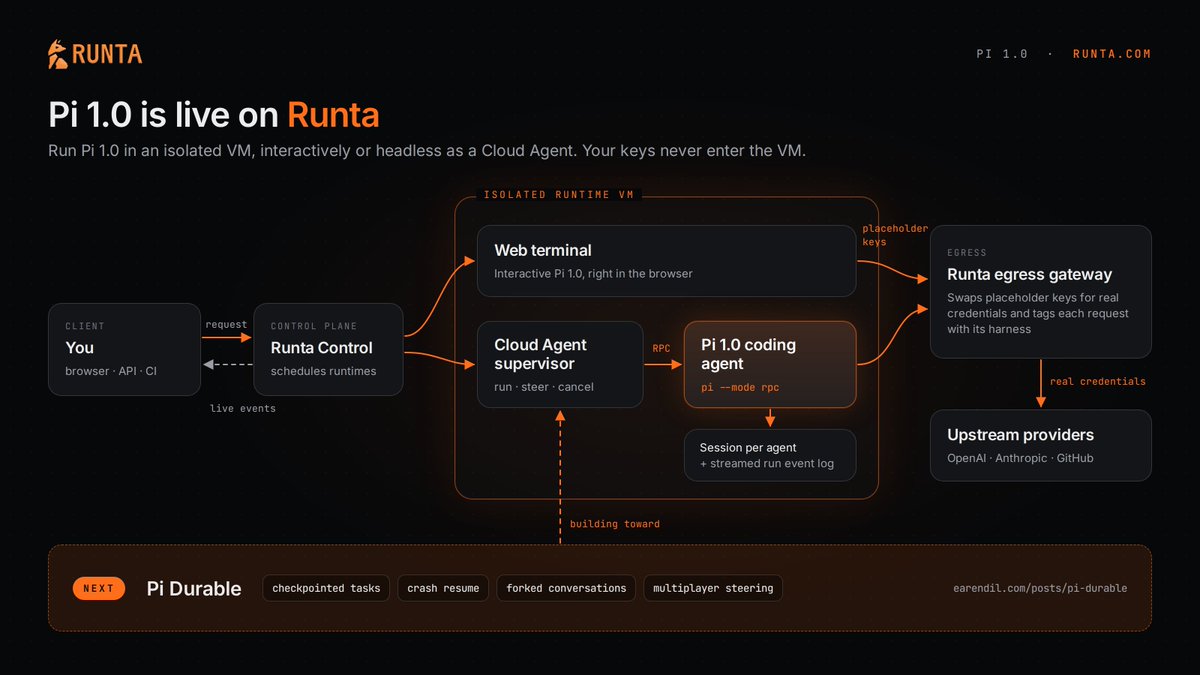
Pi 1.0 runs on Runta today.
Each agent gets its own machine: hands-on in a browser terminal, or headless over an API with live streaming, steering, and cancel. Pi never sees your real keys.
Our egress layer swaps in model and credentials on the way out.
Pi 1.0 runs on Runta today.
Each agent gets its own machine: hands-on in a browser terminal, or headless over an API with live streaming, steering, and cancel. Pi never sees your real keys.
Our egress layer swaps in model and credentials on the way out.
Your agent doesn't need to escape the sandbox to leak your files.
It just needs to run curl.
We looked inside Grok Bot and Muse to answer one question: what happens after the injection lands?
Our take: command review isn't enough. The check belongs at the exit, run by something the agent can't turn off.
FrontierHarness v1.1 is coming.
We're putting together an expert advisory group with maintainers of well-known coding-agent harnesses, plus related researchers from Stanford, Berkeley, and Caltech. A top-tier inference partner is also ready to sponsor the next eval runs.
In v1.1 we'll cover more models, more harnesses, and a more representative task set. Expect an order-of-magnitude jump in both run count and tokens used, so the harness × model picture gets clearer.
More soon.
This is exactly why we built Runta: so teams can spend their time building the agent experience, not rebuilding runtimes, computer use, persistence, and execution infrastructure. Errand is what that leverage looks like: one developer, one week, and an open-source product you can try today.
One of our engineers built Errand, our open-source take on Grok Bot and Muse, and wrote up how it came together. One developer, one week.
The app is ~4k lines of TS. Every agent still gets its own machine with a shell, a browser, and a filesystem that survives between tasks. He never wrote a provisioner or an event log infra.
If you're about to build this layer yourself, that's what Runta is. Week one goes into your product instead of a provisioner.
I'd like to hear where you're stuck, if you're in the middle of it right now.