Why Space Is So Cold: Heat, Emptiness, and the Physics of Nothingness.
When we say that space is cold, we are not describing a hostile freezer waiting to chill anything that enters it. We are describing an environment where heat has nowhere to stay.
That distinction matters, because much of the confusion about the temperature of space comes from importing everyday Earth-based intuition into a place where the usual rules of heat transfer simply do not apply.
Temperature, in physics, is a measure of the average kinetic energy of particles, how fast atoms and molecules are moving. On Earth, air is dense. Molecules constantly collide, exchanging energy through conduction and convection. When sunlight warms the ground, the air above it warms too, and heat spreads efficiently.
This is why we experience temperature as something smooth and continuous.
Space is different in a way that is hard to overstate. Even in regions between stars that we consider relatively “dense,” there may be only a few atoms per cubic meter. For comparison, Earth’s atmosphere contains around 10¹⁹ molecules per cubic centimeter.
The difference is not subtle. It is like comparing a packed football stadium to a single person standing alone in the middle of a vast desert. In such emptiness, the familiar mechanisms that move heat around simply stop working.
Without matter, conduction and convection are impossible. There are too few particles to collide, too little substance to carry energy from one place to another. The only way heat can move through a vacuum is by radiation, electromagnetic waves such as visible light or infrared.
This is why space can be simultaneously associated with intense heat and extreme cold. Near the Sun, radiation is abundant. Objects that absorb it can become very hot. In fact, the sunlit side of the International Space Station can exceed 120 °C, while the shaded side can drop below −150 °C.
There is no air to distribute that energy, no atmosphere to soften the contrast. Temperature becomes brutally directional.
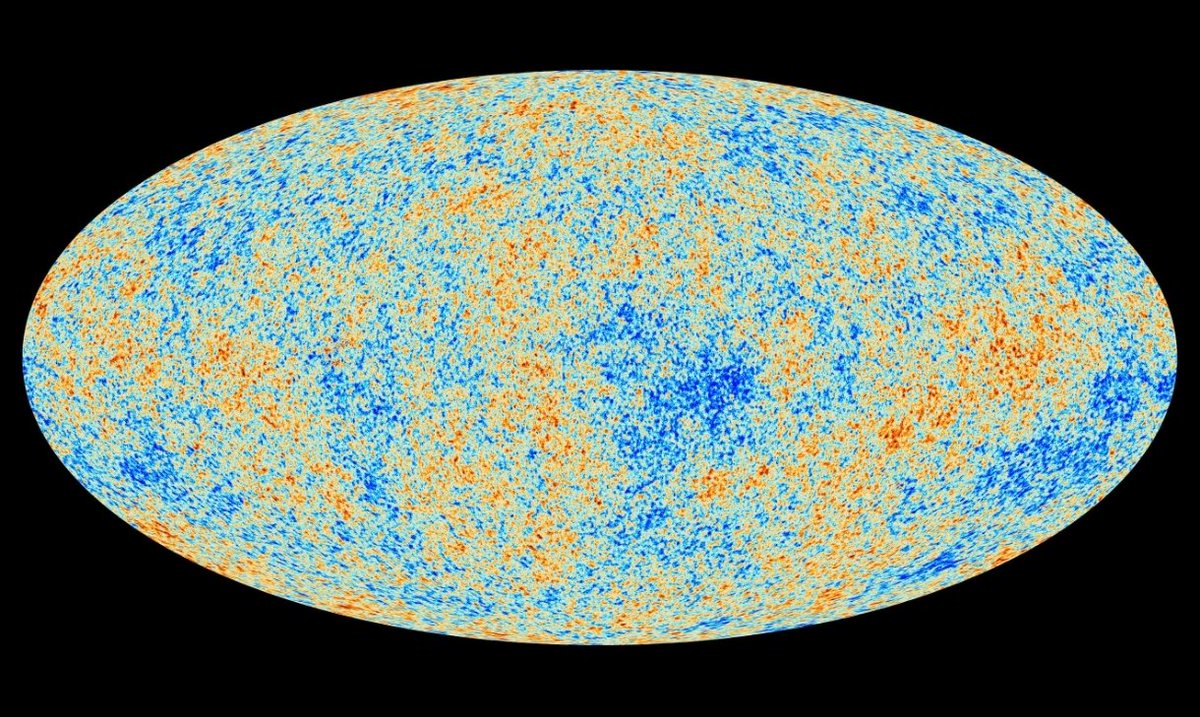
Far from stars, however, radiation thins out dramatically. In the deep void between galaxies, the dominant source of energy is the cosmic microwave background, the faint afterglow of the Big Bang itself.
That background corresponds to a temperature of about 2.7 kelvin, only a few degrees above absolute zero. This is not because space is actively cold, but because almost nothing is present to absorb or store energy.
This distinction becomes clearer if we consider what would actually happen to a human body in space. Contrary to popular films, a person does not instantly freeze solid. Freezing requires heat to be efficiently removed, and in a vacuum that process is slow. Without air, your body cannot lose heat through conduction. Instead, it radiates energy gradually as infrared light.
You would lose heat, yes, but not explosively. The danger comes from other factors: lack of oxygen, rapid decompression, and boiling of bodily fluids, not from an immediate plunge into icy cold.
This brings us to the key physical insight: cold is not a thing. There is no substance called “cold” that fills space and drains warmth from objects. Cold is simply the absence of heat.
Space does not cool things down in the way a freezer does. Objects cool themselves by losing their internal energy, radiating it away into an environment that cannot give anything back.
In that sense, space is not a cold place so much as a thermally indifferent one. It does not impose temperature; it merely fails to prevent energy from escaping. Left alone, without incoming radiation, any object will slowly shed its heat until it reaches equilibrium with the faint background glow of the Universe itself.
The cosmic cold, then, is not a mystery born of darkness or distance. It is a consequence of emptiness. Where there is almost nothing to hold energy, warmth cannot linger.
Have you heard of Cooper pairs?
In an ordinary conductive material, current flows because there are electrons that are free to move through the entire material. In some materials, the individual electrons that push their way through the conductor may become organised, forming a synchronised dance that flows without any resistance. The material has become a superconductor and the electrons are joined together as pairs. These are called Cooper pairs.
Cooper pairs behave completely differently to ordinary electrons. Electrons have a great deal of integrity and like to stay at a distance from each other – two electrons cannot be in the same place if they have the same properties. We can see this in an atom, for example, where the electrons divide themselves into different energy levels, called shells. However, when the electrons in a superconductor join up as pairs, they lose a bit of their individuality; while two separate electrons are always distinct, two Cooper pairs can be exactly the same. This means the Cooper pairs in a superconductor can be described as a single unit, one quantum mechanical system. In the language of quantum mechanics, they are then described as a single wave function. This wave function describes the probability of observing the system in a given state and with given properties.
The properties of this wave function play a leading role in the 2025 physics laureates’ experiments.
The 2025 Nobel Prize in Physics has been awarded to John Clarke, Michel H. Devoret and John M. Martinis “for the discovery of macroscopic quantum mechanical tunnelling and energy quantisation in an electric circuit.”
Scientists have discovered that high energy electrons from the Earth may be producing water on the Moon by analyzing the remote sensing data from India's Chandrayaan-1 lunar mission.
The study, which was lead by scientists from the University of Hawai'i (UH) at Manoa in the US, found that these electrons in Earth's plasma sheet are assisting in weathering processes on the Moon's surface, which involve the breakdown or dissolution of rocks and minerals.
According to the study, which was published in the journal Nature Astronomy, the electrons may have helped water form on the lunar body.
To comprehend the Moon's genesis and evolution as well as to provide water supplies for upcoming human exploration, the researchers said it is essential to grasp the Moon's water concentrations and distributions.
#chandrayaan1 #moonmission
Chandrayaan-3 Moon Landing Successful: India has created history as it became the first country to land on the South Pole of lunar surface. PM Modi congratulated Indians and space scientists for the achievement.
The real test of the mission began at the last leg of the landing. Prior to 20 minutes before landing, ISRO initiated Automatic Landing Sequence (ALS). It enabled Vikram LM to take charge and use its on-board computers and logic to identify a favourable spot and make a soft-landing on the lunar surface.
Experts say that the final 15 to 20 minutes were highly crucial for the success of the mission when Chandrayaan-3's Vikram lander descended down to its soft landing. Indians throughout the country and across the world are prayed for Chandrayaan-3 Successful Landing today.
#chandrayaan3 #softlanding #moonmission #successful
India would kickstart their ICC World Cup 2023 campaign against Australia on October 8 as the schedule for the tournament was announced at an event in Mumbai today.
The much-awaited India vs Pakistan clash is set to take place at the Narendra Modi Stadium on October 15
#India #IndVsPak #Pakistan #bleedblue #Cricket #ICC #BCCI #WorldCup2023 #WorldCup #IndiaVsPakistan