I've got an agent in a loop optimizing a renderer with the goal to minimize frame times (and tests to measure). It got times down from 88ms to 2ms and allocations down from ~150K to 500. Sounds good, right? Wrong. This is exactly why agent psychosis is a big fucking problem.
As an experiment, I rewrote the Ghostty core render state in Go, with access to identically laid out data structures as Ghostty and the exact same validation tests. I made a purposely naive renderer (simple, correct, but slow). 88ms per frame with 150,000 allocations (horrendous, lol)!
I then kickstarted a Ralph loop to bring the frame times down. I told it it can't modify input data structures or the public API or tests (they're correct), but it can do anything else it wants. It got to work.
It has worked for about 4 hours. I've spent around $350 on this experiment so far. The results?
88ms => 1.5ms
150K allocs => ~500 allocs
Incredible right? Nope.
My hand-written renderer I ported has frame times (same benchmark) of ~20us (0.020ms) and 0 allocations in the update path.
This is the problem with psychosis and lacking systems understanding. If you don't understand the system, you're going to accept that this is an incredible result. If you understand the system, you'll see better solutions immediately and can do roughly 75x better on throughput.
The people who blindly trust agent output are in the former camp. They're sheeple, overdrinking from a fountain of mediocrity.
Standard disclaimer: I use AI all the time. I like AI. The point I'm making is to not blindly accept results. Think. Analyze. Learn.
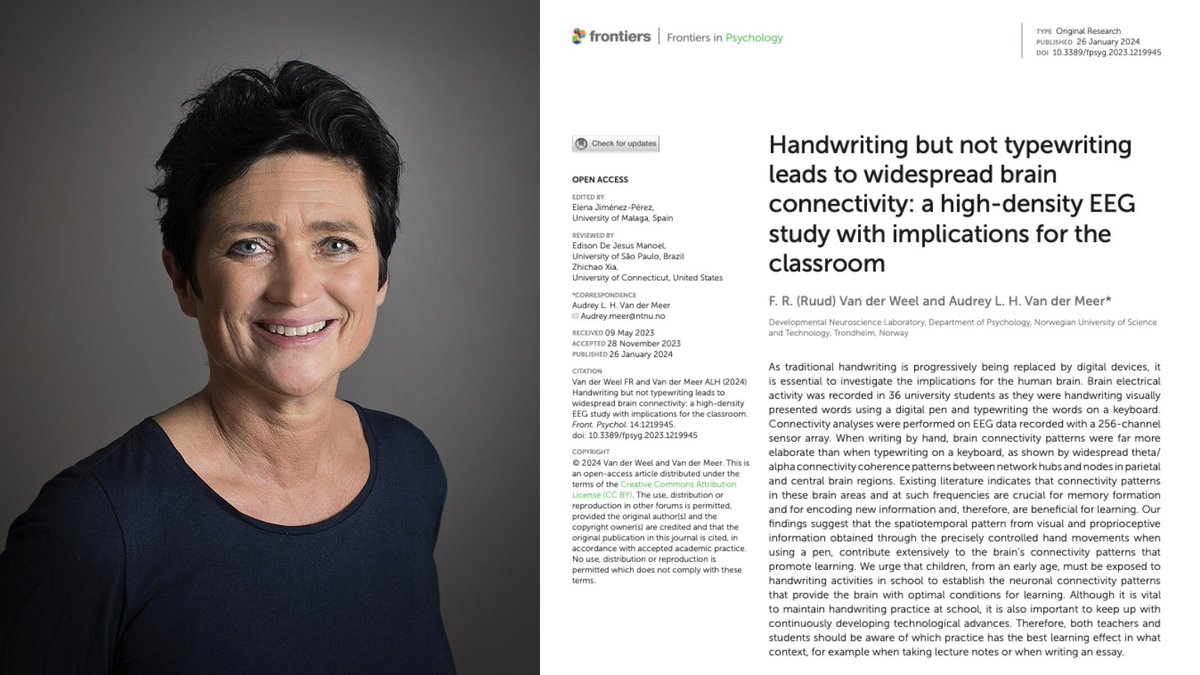
A Norwegian neuroscientist spent 20 years proving that the act of writing by hand changes the human brain in ways typing physically cannot, and almost nobody outside her field has read the paper.
Her name is Audrey van der Meer.
She runs a brain research lab in Trondheim, and the paper that closed the argument was published in 2024 in a journal called Frontiers in Psychology. The finding is brutal enough that it should have changed every classroom on Earth.
The experiment was simple. She recruited 36 university students and put each one in a cap with 256 sensors pressed against their scalp to record brain activity. Words flashed on a screen one at a time.
Sometimes the students wrote the word by hand on a touchscreen using a digital pen, and sometimes they typed the same word on a keyboard. Every neural response was recorded for the full five seconds the word stayed on screen.
Then her team looked at the part of the data most researchers had ignored for years, which is how different parts of the brain were communicating with each other during the task.
When the students wrote by hand, the brain lit up everywhere at once.
The regions responsible for memory, sensory integration, and the encoding of new information were all firing together in a coordinated pattern that spread across the entire cortex. The whole network was awake and connected.
When the same students typed the same word, that pattern collapsed almost completely.
Most of the brain went quiet, and the connections between regions that had been alive seconds earlier were nowhere to be found on the EEG.
Same word, same brain, same person, and two completely different neurological events.
The reason turned out to be something nobody had really paid attention to before her work. Writing by hand is not one motion but a sequence of thousands of tiny micro-movements coordinated with your eyes in real time, where each letter is a different shape that requires the brain to solve a slightly different spatial problem.
Your fingers, wrist, vision, and the parts of your brain that track position in space are all working together to produce one letter, then the next, then the next.
Typing throws all of that away. Every key on a keyboard requires the exact same finger motion regardless of which letter you are pressing, which means the brain has almost nothing to integrate and almost no problem to solve.
Van der Meer said it plainly in her interviews.
Pressing the same key with the same finger over and over does not stimulate the brain in any meaningful way, and she pointed out something that should scare every parent who handed their kid an iPad.
Children who learn to read and write on tablets often cannot tell letters like b and d apart, because they have never physically felt with their bodies what it takes to actually produce those letters on a page.
A decade before her, two researchers at Princeton ran the same fight using a completely different method and ended up at the same answer. Pam Mueller and Daniel Oppenheimer tested 327 students across three experiments, where half took notes on laptops with the internet disabled and half took notes by hand, before testing everyone on what they actually understood from the lectures they had watched.
The handwriting group won by a wide margin on every question that required real understanding rather than surface recall.
The reason was hiding in the transcripts of what the two groups had actually written down.
The laptop students typed almost word for word, capturing more total content but processing almost none of it as they went, while the handwriting students physically could not write fast enough to transcribe a lecture in real time, which forced them to listen carefully, decide what actually mattered, and put it in their own words on the page.
That single act of choosing what to keep was the learning itself, and the keyboard had quietly skipped the choosing and skipped the learning along with it.
Two studies. Two countries. Same answer.
Handwriting makes the brain work. Typing lets it coast.
Every note you have ever typed instead of written went into your brain through a thinner pipe. Every meeting, every book highlight, every idea you captured on your phone instead of on paper was processed at half depth.
You did not forget those things because your memory is bad. You forgot them because typing never woke the part of the brain that would have made them stick.
The fix is the thing your grandmother already knew.
Pick up a pen. Write the thing down. The slower road is the faster one.
OVERRATED: running tons of agents in parallel; working on too many things at once; perpetual context-switching; opening lots of low-quality PRs that may never land.
UNDERRATED: using one or two agents at a time; focusing on the task in front of you; thinking deeply; finishing stuff; making your code works in prod.
JUST IN: Two hundred helium containers are stranded in the Persian Gulf right now. Each one holds 41,000 litres of liquid helium cooled to minus 269 degrees Celsius. They have 35 to 48 days before the cryogenic systems fail, the helium boils off, and the gas vents into the atmosphere and is lost forever. Those containers were heading to semiconductor fabrication plants in Taiwan and South Korea that manufacture 90 percent of the world’s advanced chips. The helium inside them cools the extreme ultraviolet lithography machines that print transistors at two nanometres. Without it, the machines cannot operate. Without the machines, the chips do not exist. Without the chips, the AI models that are currently selecting targets in this war stop running.
This is the connection that nobody has made. The same Strait of Hormuz that carries 20 percent of the world’s oil also carries the helium that cools the machines that make the chips that power the artificial intelligence that the Pentagon is using to prosecute Operation Epic Fury. Maven, the AI targeting system that compressed 2,000 analysts to 20 and selected over 1,000 targets in the first 24 hours, runs on processors manufactured by TSMC using helium sourced from Qatar. Qatar’s Ras Laffan facility, which produced 33 percent of the world’s helium as a byproduct of LNG processing, was struck by Iranian missiles on March 18 and 19 and declared force majeure. The supply is offline. The containers are stranded. The clock is ticking at minus 269 degrees.
TSMC says it has 6.2 weeks of inventory and 68 to 95 percent on-site recycling. Samsung holds roughly six months but depends on Qatar for 65 percent of its supply. Both are rationing toward AI and high-bandwidth memory production, starving consumer chips to keep the advanced nodes alive. The calculus is explicit: the war gets priority over your next phone.
But here is the paradox that should terrify every strategist in Washington. The AI that selects the targets requires chips that require helium that transits the chokepoint that the war has closed. The cognitive infrastructure of the air campaign depends on a supply chain that the air campaign is destroying. Every strike on Iranian naval assets that keeps Hormuz closed for another day is another day of helium inventory burned at TSMC. Every week the strait stays shut brings the fab closer to rationing. Every month of war brings the AI targeting system closer to the moment when the chips it runs on cannot be replaced because the gas that made them evaporated in a container floating off Fujairah.
The Pentagon is fighting a war with artificial intelligence manufactured in Taiwan using helium from Qatar transported through the strait the war has closed. The war is eating its own brain.
Taiwan imports 95 percent of its energy. Seventy percent of its oil came through Hormuz. TSMC alone consumes 10 percent of Taiwan’s electricity. The island that makes 90 percent of the world’s advanced semiconductors is powered by fuel from the chokepoint that is shut, cooled by gas from the facility that is offline, and defended by interceptors depleting faster than they can be replaced.
And the country that controls the rare earth magnets, the BeiDou navigation, the helium alternative sources, and the peace talks is the same country: China. The war will end when the helium runs out, when the interceptors run out, or when Beijing decides it should. All three clocks are ticking. All three lead to the same room.
Read the full analysis - https://t.co/dAOBBMsgDS
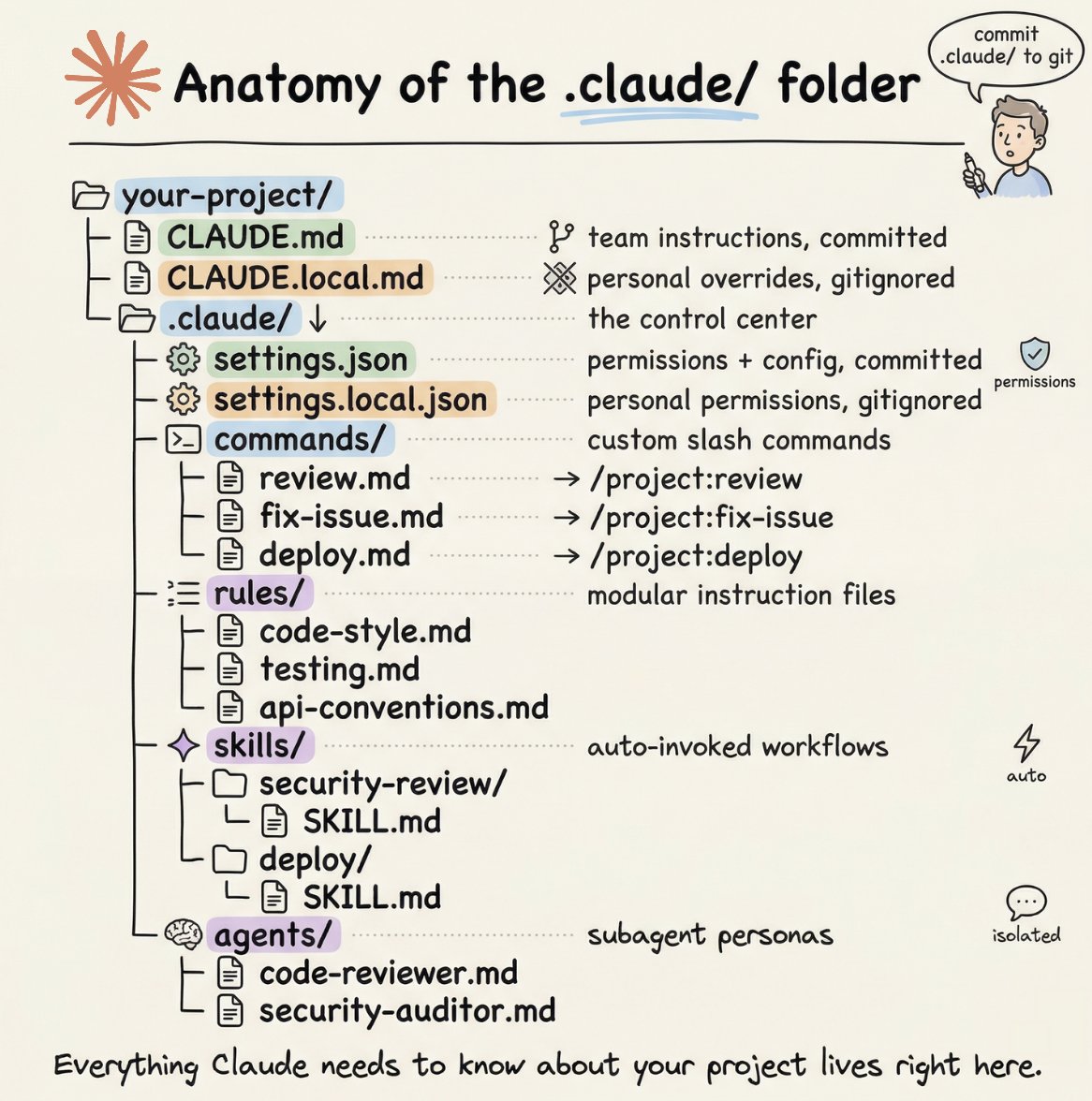
How to setup your Claude code project?
TL;DR
Most developers skip the setup and just start prompting. That's the mistake.
A proper Claude Code project lives inside a .𝗰𝗹𝗮𝘂𝗱𝗲/ folder. Start with 𝗖𝗟𝗔𝗨𝗗𝗘.𝗺𝗱 as Claude's instruction manual. Split it into a 𝗿𝘂𝗹𝗲𝘀/ folder as it grows. Add 𝗰𝗼𝗺𝗺𝗮𝗻𝗱𝘀/ for repeatable workflows, 𝘀𝗸𝗶𝗹𝗹𝘀/ for context-triggered automation, and 𝗮𝗴𝗲𝗻𝘁𝘀/ for isolated subagents. Lock down permissions in 𝘀𝗲𝘁𝘁𝗶𝗻𝗴𝘀.𝗷𝘀𝗼𝗻.
There are two .𝗰𝗹𝗮𝘂𝗱𝗲/ folders: one committed with your repo, one global at ~/.𝗰𝗹𝗮𝘂𝗱𝗲/ for personal preferences and auto-memory across projects.
The .𝗰𝗹𝗮𝘂𝗱𝗲/ folder is infrastructure. Treat it like one.
The article below is a complete guide to 𝗖𝗟𝗔𝗨𝗗𝗘.𝗺𝗱, custom commands, skills, agents, and permissions, and how to set them up properly.
We just crossed $300M in ARR. It's a big moment for us that comes as we're seeing high demand for infrastructure for AI and agentic systems.
From agent memory to RAG apps to real-time AI infrastructure, teams are building systems that need fast context, not just more compute.
@sundeep@IanAndrewsDC This is one of the reasons semantic caching with a real-time memory layer becomes very interesting at scale.
Dramatically speeds up responses and saves tokens.
"Why didn't Trump's security try to negotiate with the shooter?"
Ukrainian paramedic asks a stupid question to demonstrate how stupid people sound when they say: “Why doesn’t Ukraine try to negotiate with russia?”
This week I came across an article that suggested replacing Redis with Postgres. So I asked myself, is this really a good idea? That's what I wanted to find out in this video:
https://t.co/BkqhqtNquA
#redis#postgres#databases#cache#bolhadev cc @sseraphini@john_owl