Teach: @CtrRelPol | Research: @myfaithcounts | Books: The Nones, Great Dechurching, Vanishing Church | Former Pastor: @AmericanBaptist | Graphs about Religion
Some personal news.
Starting August 1, I will be joining the Danforth Center on Religion and Politics at WashU (@CtrRelPol) as a Professor of Practice.
I think it's a perfect step for my career as Senator Danforth envisioned the Center to be a place for public engagement around religion and politics.
That's where I see myself headed in the next stage of my career.
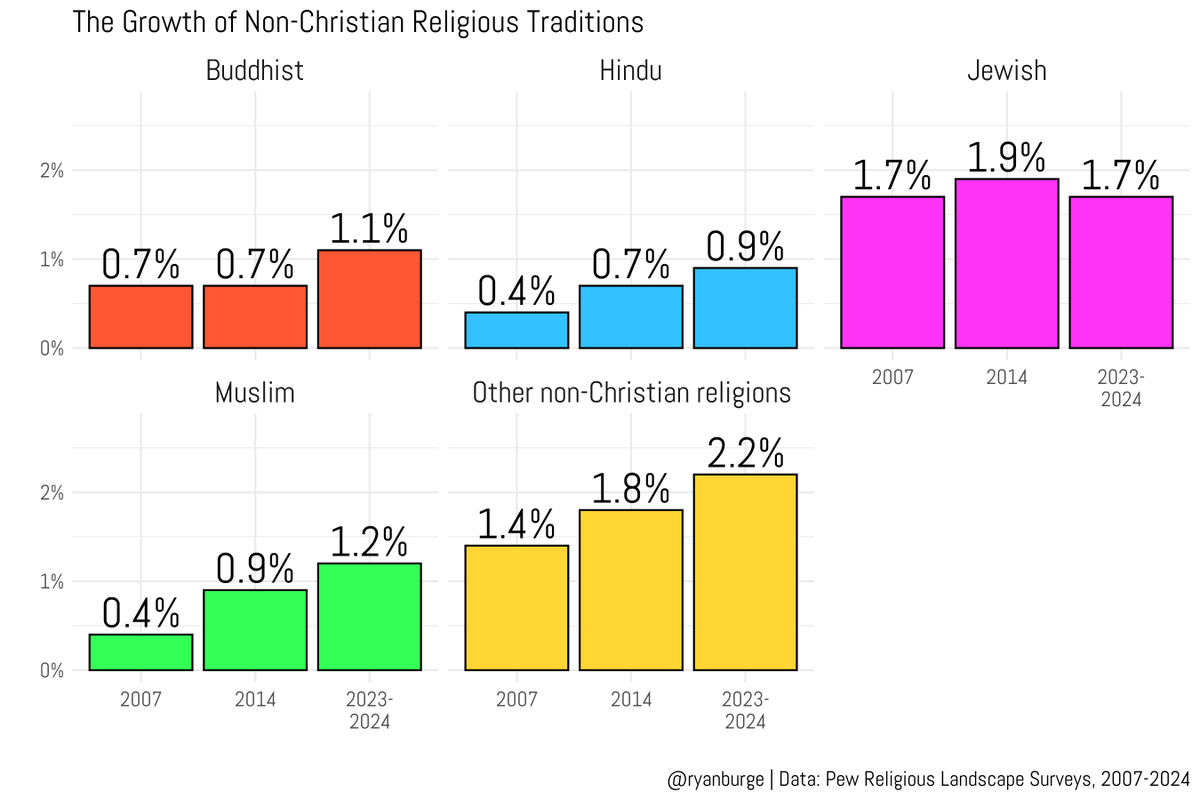
Buddhists, Hindus, Muslims, and Jews combine for about 5% of the population of the United States.
Since 2007:
Buddhists have grown by .8% of the population.
Hindus are up .5%
Muslims have increased by .8%
Jews are the same size today as in 2007.
In 1972, 90% of Americans were Christians.
73% were white Christians.
16% were non-white Christians.
In 2024, 65% of Americans were Christians.
47% were white Christians. Down 27 points.
18% were non-white Christians. Up 2 points.
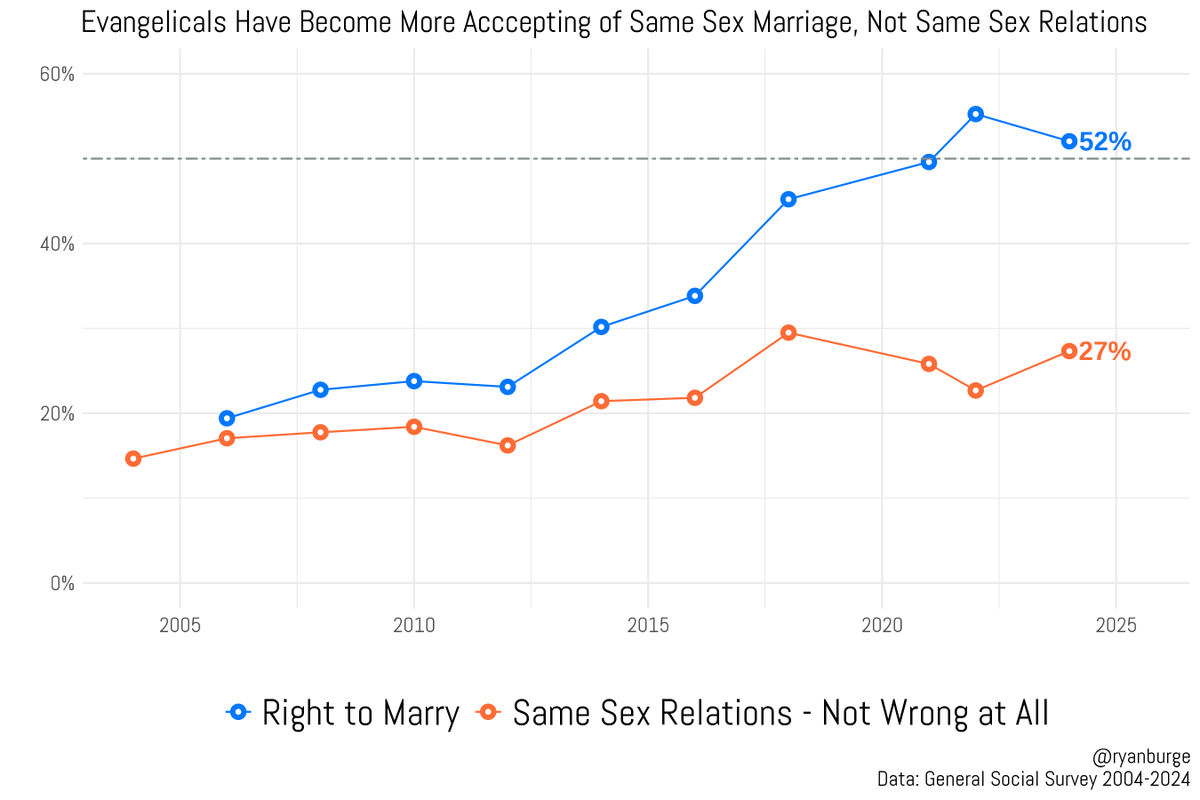
Among evangelicals in 2006:
19% were in favor of giving homosexuals the right to marry.
17% believed that same-sex relations were not at all wrong
Among evangelicals in 2024:
52% were in favor of same-sex marriage.
27% believed that same-sex relations were not at all wrong
It's hard to get a good sense of the size of many Protestant denominations.
Let me put it this way.
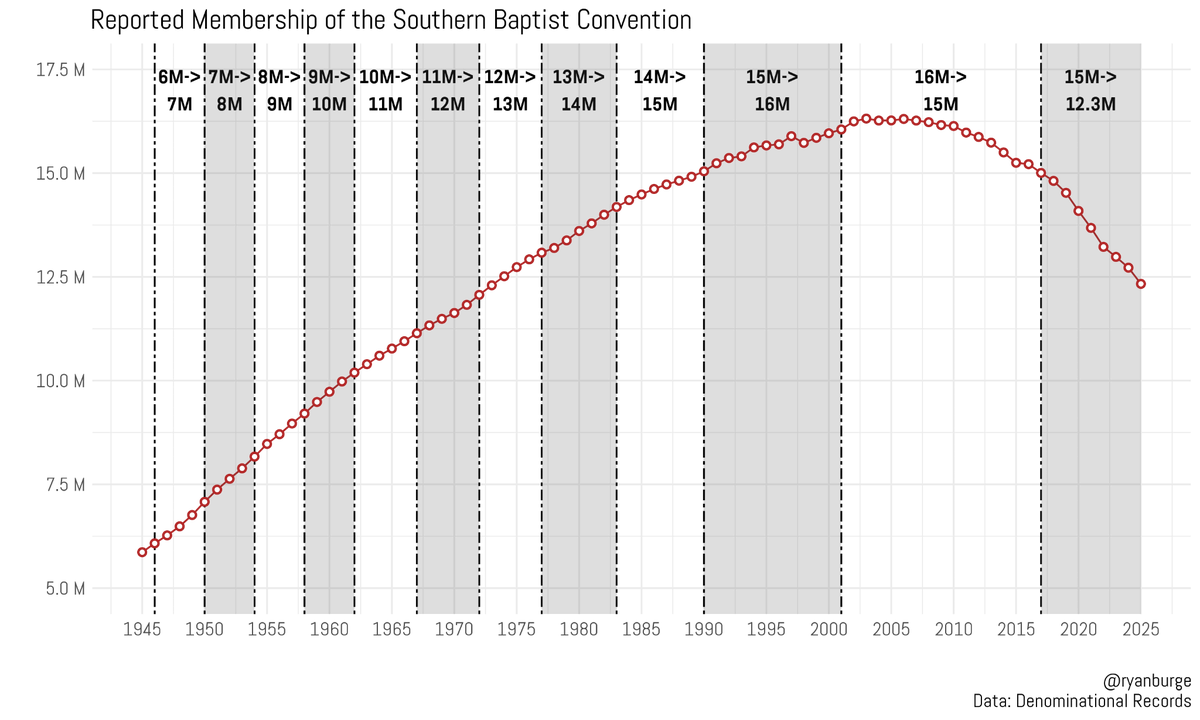
Just between 2020 and 2024, the SBC reported losses of 1.8M.
Those losses alone are larger than every Protestant denomination except for 3: UMC, AG, and ELCA.
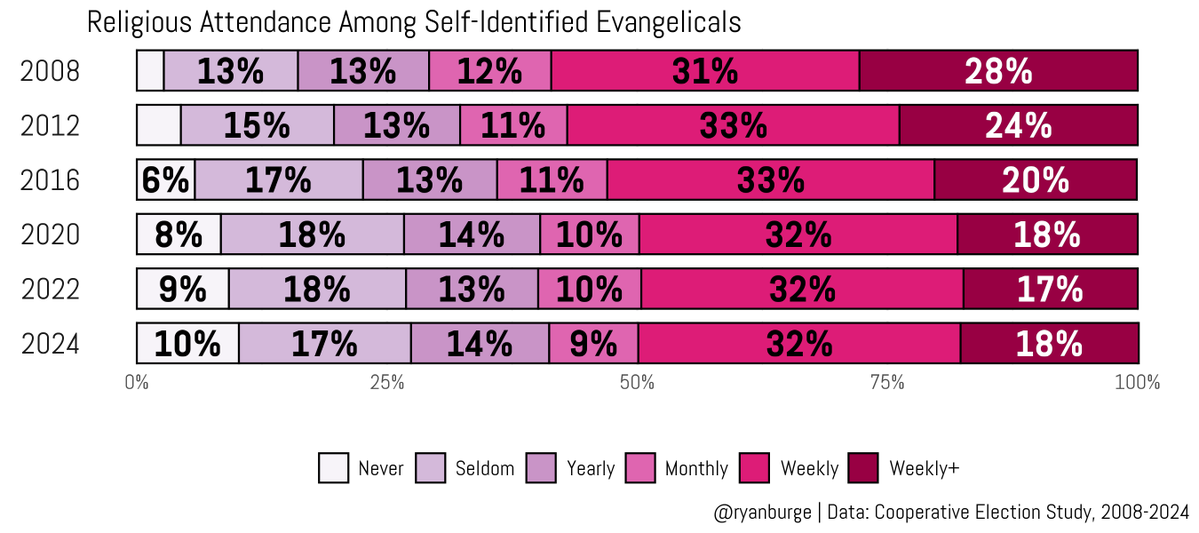
The vast majority of evangelicals who never go to church believe in Hell - 76%.
But that's not true for mainline Protestants who never attend. Half of them don't believe in Hell.
It's only slightly higher among never attending Catholics - 54%.
As is my annual tradition, I wrote a long report about the problems the SBC is facing.
I see nothing in these numbers that point to a future where the Convention is going to record growth.
Just the opposite.
https://t.co/xVcSiszGwb
The Southern Baptist Convention's annual meeting is next week.
It's the largest denominational gathering in the United States.
But the denomination itself is shrinking rapidly.
Down nearly 4M members since 2006.
Back to membership levels last seen in 1971.
One of the untold stories of higher ed is that state support has collapsed, even in blue states.
Adjusted for inflation, Eastern Illinois University's direct state operating funding decreased by 42% between 2004 and 2025.
The new budget is a 1% bump, which is basically a cut.
In Spring of 2016, the on campus enrollment at Eastern Illinois University was 6,991.
In Spring of 2026, it was 3,660.
That's a decline of 48% in just ten years.
This is happening right now to dozens of directional universities throughout the Midwest.
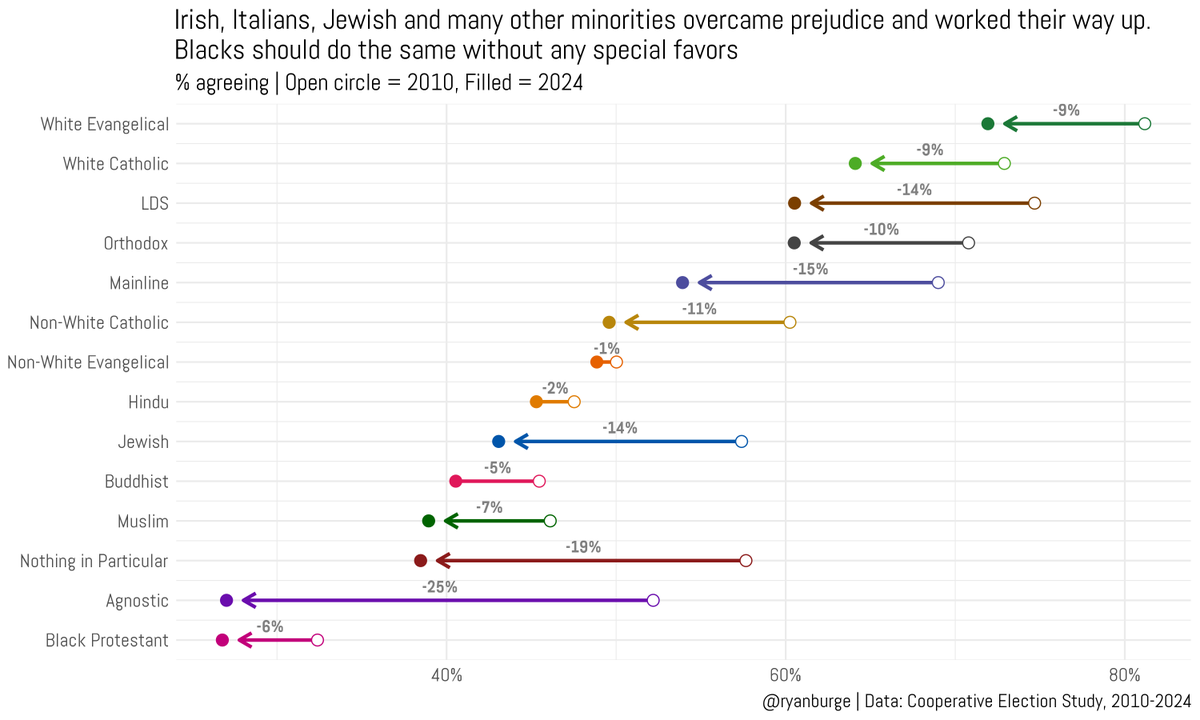
"Irish, Italians, Jewish and many other minorities overcame prejudice and worked their way up. Blacks should do the same without any special favors."
The % of Americans who agree has declined since 2010.
Biggest drops?
The non-religious.
Mainline.
Jews.
LDS.
Even among evangelicals, the view that, "Humans have existed in their present form since the beginning of time" is not the prominent. Just 26%.
Instead, 2/3 believe that, "Humans have evolved over time due to processes that were guided or allowed by God or a higher power."
Here's how religious attendance shifts from childhood to adulthood.
Notice that the general trend is downward.
Among people who grew up going weekly, 43% attend less than once a year now.
Among people who attend weekly or more now, 6% grew up never attending.
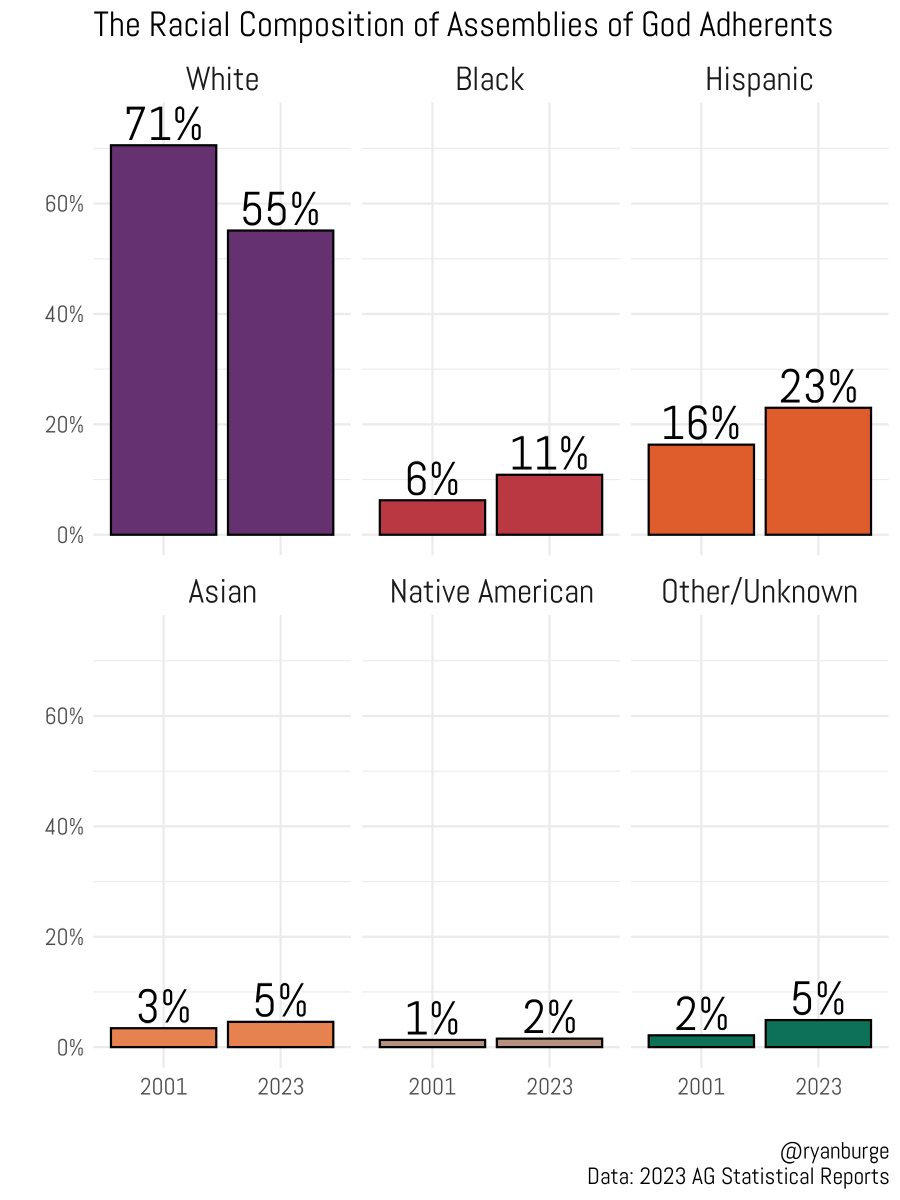
One of the most interesting stories in American religion is the Assemblies of God.
They are the only large denomination that has recorded consistent growth over the last 20 years.
One possible explanation for that growth is that they have become a lot more racially diverse.
@conradhackett Strongly agree with point 1 here.
I would vote in favor of a proposal that would remove the 2021 GSS from the cumulative file once the 2026 data has been added.
It just causes way too many problems.
In 2022, 36.2% of the Cooperative Election Study was non-religious.
In 2025, it was 31.8%.
A decline of 4.4 pts.
But how did that happen?
It wasn't some sort of a Gen Z revival.
The biggest drop in the nones were among Boomers.
Boomers: 28% -> 20%.
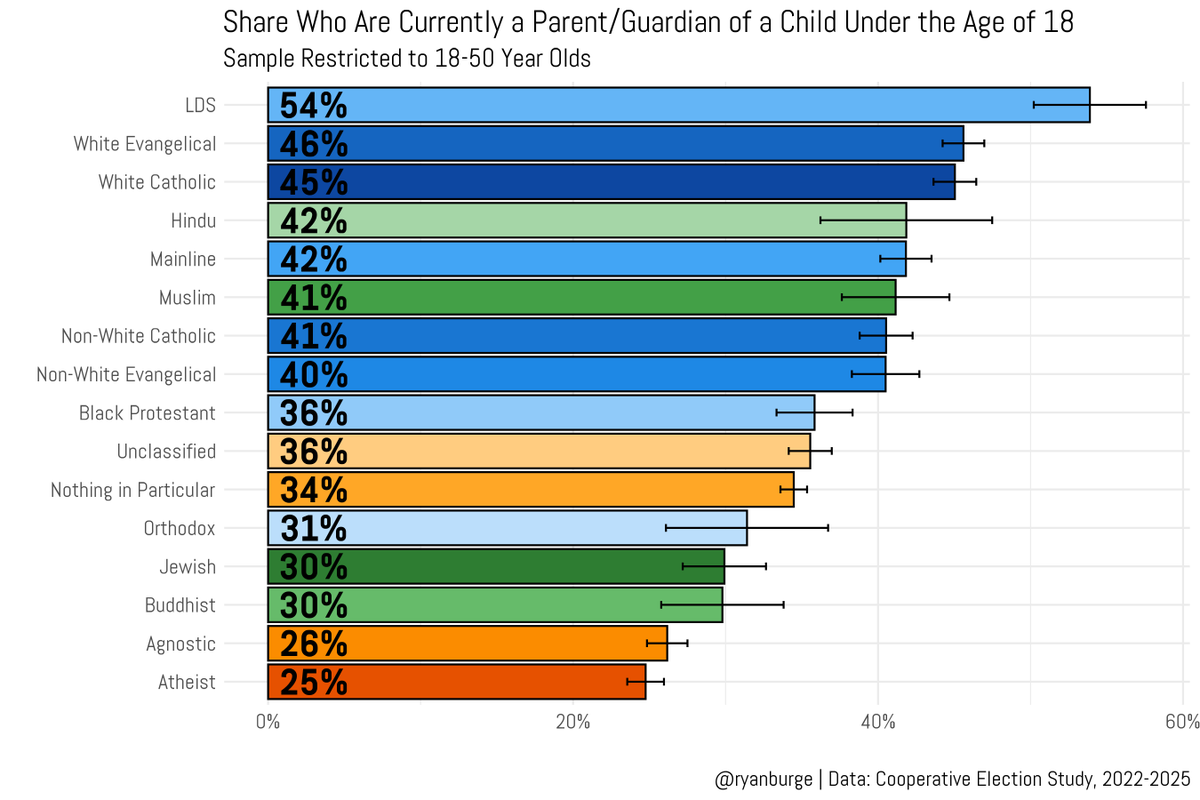
Of all religious traditions, Latter-day Saints are the most likely to be parents.
And it's not even that close.
54% are currently parenting a minor child.
The next closest are white evangelicals/Catholics.
The lowest rate?
Atheists + agnostics.
~25% are parents.
Latter-day Saints were obviously huge fans of Mitt Romney back in 2012.
But they were not at all sold on Donald Trump in 2016, barely half supported him. A quarter cast a ballot for Evan McMullin.
Two got 2/3 of the LDS vote in 2020 and 2024, though.
I know that there are lots of memoirs written about people leaving evangelicalism
But the data says that between 2012 and 2022, there were actually net INFLOWs into evangelicalism.
For every 100 people raised evangelical, 17 additional converts arrived from other traditions.