I have just learned of the passing of András Riedlmayer, who for more than three decades directed The Documentation Centre for Islamic Architecture at Harvard University’s Fine Arts Library.
A historian and native of Budapest, Riedlmayer's fieldwork for the International Criminal Tribunal for the former Yugoslavia (ICTY) was instrumental in securing convictions against a litany of war criminals in Bosnia and Herzegovina, and Kosovo, in particular those involved in the destruction of cultural heritage, and personally testified in the trials against genocidaire Slobodan Milošević, Radovan Karadžić, and Ratko Mladić, as well as the genocide case brought by Bosnia and Herzegovina against Serbia at the International Court of Justice in 2007.
Last year, I was privileged to be gifted by Riedlmayer a portion of his incredible collection of scholarly literature on the Western Balkans and Southeastern Europe. I pass those books everyday, and have thought of his extraordinary labors on behalf of the people of the region everyday as a result. Much of the rest of his collection of books and documents can be found at The András Riedlmayer Collection at the University of Connecticut, which I hope to be able to visit one day.
I can also tell you that András remained a voracious, critical reader of the highest order. I don't know that there was an article, op-ed, or book written on the region in the past forty years that he did not read, and could not debate with you on the spot. His scholarly gaze was one of the first to make me feel like my own writing had merit, that its contents mattered -- and that someone might have profound feelings about whether to use American or British standard spellings.
Few individuals have done more for the memory and remembrance of the victims of the systematic crimes against humanity in Bosnia and Herzegovina and Kosovo by the genocidal Milošević regime than András Riedlmayer. His passing is an enormous loss but his life was as well-lived as as could have been. He was a personal inspiration, and a friend.
My sincerest condolences to his family, friends, colleagues, and his many, many, many admirers.
Thank you for everything. Rest now.
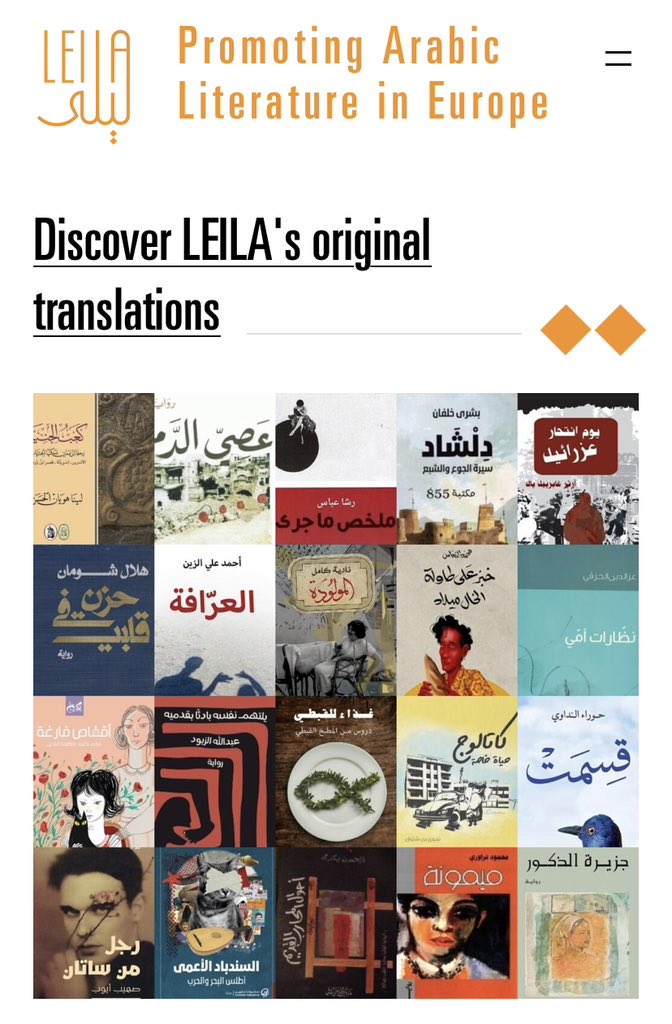
I’m very happy to have been part of this important and much needed project, LEILA @ATLAStrad which promotes the translation & dissemination of Arabic literature in Europe. The website is now LIVE! Make sure to check the catalogue of authors & texts.
https://t.co/faWeiQ1fZR
City Lights asks author @adamshatz 5 questions about his inspirations, where he's writing from and what he's reading now.
Adam graces our virtual halls tonight at 6pm PT to discuss his new book WRITERS AND MISSIONARIES, out now from @VersoBooks.
https://t.co/I40Vv1h5dC
We’re live!!!
https://t.co/1TWpSosFIr
~
Archive Stories is a website about how to work with creative, community and anticolonial archives.
We invited people who already do this work to take us on their journey with archiving. Enjoy!
~
As of today, there are *checks notes*
539 public repos on GitHub for sites using Wax.
We'd really appreciate hearing from all of you out there running those sites(!) as well as those of you working with Wax off the GH grid.
@hchesner@bodleianlibs@jteplitsky@Footprints_Heb You're right. Being able to read from the monograph and then view the digitized leaf and its story directly on Footprints really doubles the impact of cases like these. Straight onto my "to read" shelf Prince of the Press goes!
The CCAS community was deeply saddened to learn of the passing of Dr. Halim Barakat, a renowned Arab sociologist and novelist, and a professor at CCAS for 27 years. Please see the link for information about Dr. Barakat and his memorial service.
https://t.co/XFgN3nOX2i
***MELA Call For Papers 2023***
"MELA is inviting proposals in the form of panels, papers, or roundtable discussions that center relationships, responsibility, and care in Middle East Studies Librarianship and library and information science (LIS) work."
https://t.co/FLGlhBCoE6