Ethereum's next major upgrade, "Fusaka" goes live in under a month.
Its core feature, called PeerDAS, lets nodes store only parts of each blob instead of the entire thing.
This lets Ethereum scale to more blobs per block.
More blobs → cheaper DA → cheaper L2 transactions.
The Dawn of Perpetual Solar Powered Bitcoin Home Mining
Meet the Solarbit $0 / Kwh / Ths
Your Bitaxe perpetual energy partner.
Summary of Specs:
-Off-grid (wifi coverage required)
-Outdoor (uv & water resistant)
-Day time ops only
-Fully autonomous power management
-Fully autonomous 2 axis Sun tracking
-30w / 60w Solar PV model dependant.
-Esp32 S3 with external antenna
-4 xINA260AIPWR power monitoring ICs for extensive
power monitoring.
-Case temp monitoring for thermal management
-Compatible with all Bitaxe series of $BTC miner (5v barrel jack and 12v XT-30)
-Bitaxe accessory port (BAP) ready
Note: As this is a live project, all data is subject to change at any time.
Ethereum fees were down $679m in Q2 (57%), while the network turned inflationary. If you want to understand why, you need to understand this chart.
Here's what's going on:
Ethereum Improvement Proposal (EIP) 4844 was implemented on March 13th. It was the most important network upgrade since The Merge as it dramatically increased the scalability of L2s, while lowering fees for users.
You can think of it as the "broadband moment" for Ethereum.
Essentially, what EIP4844 did is improve the way that data is handled on Ethereum by introducing "blobs" — which is just a term for "more data availability."
In essence, the Ethereum Foundation created a new glut of block space — which is the product that blockchains sell.
By increasing the supply of the product, fees dropped.
The result?
L2 margins improved dramatically. L1 fees dropped dramatically.
----
This is all really good for Ethereum. The network is scaling. The UX is improving. The Ethereum Foundation continues to execute.
But if you don't appreciate the nuance, you might look at the financials and think that Ethereum had a really bad quarter.
That's not the case. The reality is that:
- Transactions on L2s were up 63% in Q2.
- Active users on L2s were up 81% in Q2.
Ethereum's network effects and demand for ETH are growing.
But fees on L2 were down 61% as user activity grew.
----
The takeaway?
Ethereum "disrupted itself" by improving the UX while reducing its economics in the short run.
If past computing movements are any indication, the new supply of block space enabled by EIP4844 will create new use cases (new demand) for developers.
As new demand flocks to the EVM, I would expect Ethereum's economics to improve with it.
Data: L2 combined cost of revenue posted EIP4844 powered by @tokenterminal
[L2s included: @arbitrum , @Optimism , @zksync , @Starknet , @base , @Immutable , @blast , @Scroll_ZKP , @LineaBuild , @0xMantle , @MantaNetwork ]
----
P.S. we covered these concepts in detail in The ETH Report and The Ethereum Investment Framework.
If you'd like to download a free copy, see the link in the first comment 👇
The Bitcoin ETFs would be "Cash Creation" only.
What does this mean?
TL;DR
- Cash Creation outsources execution to the ETF issuer, yet execution is not the issuers' specialty.
- In-Kind Creation on the other hand allows experts in slippage minimization to best handle the problem.
- Expect high frequency traders scalping ETF flows when issuers strike the NAV (i.e. when they determine the fund's NAV at the end of the trading day)
Cash vs. In-Kind Creation/Redemption:
‣ In-Kind ETFs: In an in-kind ETF, creations and redemptions involve the exchange of the underlying assets (in this case, Bitcoin) directly. Market makers or authorized participants deliver or receive the actual assets.
‣ Cash ETFs: In a cash-based ETF, creations and redemptions are conducted with cash instead of the underlying asset. This means the ETF issuer needs to buy or sell Bitcoin in the market to manage the fund's holdings.
Execution Risk and Timing:
‣ In-Kind: The execution risk (the risk associated with the actual buying or selling of Bitcoin) is borne by the market makers. They can manage this risk more effectively because they control the timing and method of their trades.
‣ Cash ETFs: The issuer is responsible for executing trades, often targeting a specific time (like the 4PM Net Asset Value strike price). This can introduce more uncertainty, especially if the market is volatile, as is common with Bitcoin.
Impact on Bid/Ask Spreads:
‣ In response to the increased uncertainty and risk associated with cash-based ETFs, market makers should widen their bid/ask spreads to compensate for the potential slippage (the difference between the expected execution price and the actual execution price) and the additional risk they take on.
Slippage:
‣ In a volatile market like Bitcoin, slippage can be a significant and unpredictable factor. Since market makers cannot control execution in cash ETFs as they can in in-kind ETFs, they face greater uncertainty.
Potential manipulation around Striking the NAV:
‣ If a large market maker corners enough of the market they would know which direction the market would go when Striking the NAV, allowing them to "pre-hedge" client flow and make a fortune in doing so.
Overall Market Impact:
‣ Cash Creation should lead to less efficient pricing and higher trading costs for investors in cash-based Bitcoin ETFs compared to in-kind ETFs.
My 401K has been entirely GBTC for a long time, but I intend to convert my GBTC over to Fidelity once the ETFs launch in order to support decentralization of custody.
https://t.co/bIT7cJnQVS
@malwrhunterteam@HelpfulNotes@elonmusk There are so many scam ads that I have gone from reporting them to Twitter to simply blocking them. Such amount is unmanageable
It's time to start organizing for OP_CTV activation: https://t.co/b0a7ka1AOF
It has overwhelming technical consensus from individuals, devs & businesses: https://t.co/I4o4Hq7wOQ
It brings massive scalability & privacy improvements: https://t.co/o65bST6DSV
On January 3, 2009, the #Bitcoin experiment began. The world was changed forever. The separation of money and state became a real possibility for billions. Thank you, Satoshi 🙏🧡
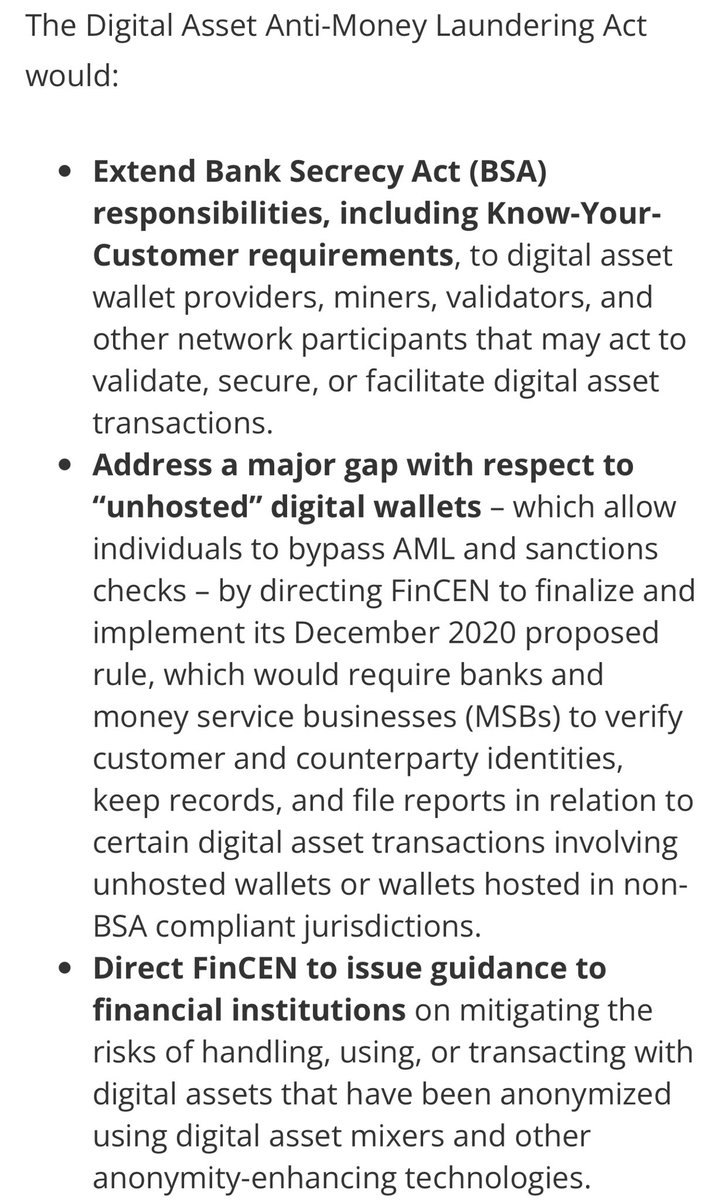
Make no mistake, the bill that Senator Elizabeth Warren has introduced in the Senate and continues to gather momentum would be a de-facto ban on self-custody and P2P transactions in the United States.
To reiterate, Bitcoin is now as Turing Complete as any other chain, and this requires zero changes to Bitcoin.
It’s become a canon maxi talking point that Turing Complete = Bad. This is silly for a number of reasons.
Firstly nothing in our reality will ever be TRULY Turing Complete, because the technical definition of Turing Complete actually requires an UNBOUNDED runtime, and we just don’t have an unbounded amount of space and time to accommodate for that.
Along the way a small cabal of script hackers such as @robin_linus and @super_testnet have figured out how to hack in all of the functionality we would want from a generalized computer into Bitcoin’s extremely limited OP set, so the only thing that has kept Bitcoin’s VM from being as Turing complete as something like Ethereum’s was not a matter of expressivity, but simply a matter of Runtime, with the most stringent limitation being the stack size limit.
All BitVM does is allow us to split the runtime of some logic that would be out of bounds of a single transaction ACROSS MULTIPLE TRANSACTIONS. That’s it. We aren’t adding any new semantic features, we just are exponentially increasing the length of the programs we can run.
So Bitcoin really isn’t any more Turing Complete by the technical definition as it was before, it simply has been given a runtime to its programs that we can reasonably say it’s “Turing complete enough” for any program that we could realistically want to execute.
Secondly this is the best thing possible for ossification. Why add in an Opcode when Bitcoin can already simulate any opcode imaginable? The debate now shifts to features to increase efficiency, privacy, security and not about features. Adding in this kind of functionality actually REDUCES risk for Bitcoin, precisely because it reduces the need for it to change in the future.
Thirdly being able to have satisfaction of arbitrary logical constraints means that you can cut out all kinds of trusted or semi-trusted escrow services that a version of Bitcoin without this requires. Congestion control/Coinjoin aggregators, sidechain quorums, certain types of DLC oracle type stuff all can go from trusted/semi trusted to 100% trustless. Bitcoin’s trustlessness is only as strong as the weakest link in the interaction you are engaging in with it. Oh and it means that Drivechains are unnecessary.
Finally this is opt-in. If you don’t trust your coins being locked to some Turing complete contract (totally reasonable) then don’t lock them to a Turing complete smart contract. One of beauties of the UTXO system is security sandboxing.
If people really feel strongly that Bitcoin shouldn’t have this functionality, perhaps for issues of incentives or something, that’s a conversation that should be had, but basically it would require ripping out Taproot, which seems very dumb at this point.
For god's sake @elonmusk , please change or improve the report of impersonations in CT because it is getting out of hand. I would charge to do this, seriously, it's too much work to be so ineffective
1/2
The full decision is a slaughterfest of the SEC arguments, and requires a full review of Grayscale's application.
SEC options from here on out are:
1. Delay decision and come up with new fake reason
2. Concede and approve
3. Request en banc appeal of the case.






![JustDeauIt's tweet photo. Ethereum fees were down $679m in Q2 (57%), while the network turned inflationary. If you want to understand why, you need to understand this chart.
Here's what's going on:
Ethereum Improvement Proposal (EIP) 4844 was implemented on March 13th. It was the most important network upgrade since The Merge as it dramatically increased the scalability of L2s, while lowering fees for users.
You can think of it as the "broadband moment" for Ethereum.
Essentially, what EIP4844 did is improve the way that data is handled on Ethereum by introducing "blobs" — which is just a term for "more data availability."
In essence, the Ethereum Foundation created a new glut of block space — which is the product that blockchains sell.
By increasing the supply of the product, fees dropped.
The result?
L2 margins improved dramatically. L1 fees dropped dramatically.
----
This is all really good for Ethereum. The network is scaling. The UX is improving. The Ethereum Foundation continues to execute.
But if you don't appreciate the nuance, you might look at the financials and think that Ethereum had a really bad quarter.
That's not the case. The reality is that:
- Transactions on L2s were up 63% in Q2.
- Active users on L2s were up 81% in Q2.
Ethereum's network effects and demand for ETH are growing.
But fees on L2 were down 61% as user activity grew.
----
The takeaway?
Ethereum "disrupted itself" by improving the UX while reducing its economics in the short run.
If past computing movements are any indication, the new supply of block space enabled by EIP4844 will create new use cases (new demand) for developers.
As new demand flocks to the EVM, I would expect Ethereum's economics to improve with it.
Data: L2 combined cost of revenue posted EIP4844 powered by @tokenterminal
[L2s included: @arbitrum , @Optimism , @zksync , @Starknet , @base , @Immutable , @blast , @Scroll_ZKP , @LineaBuild , @0xMantle , @MantaNetwork ]
----
P.S. we covered these concepts in detail in The ETH Report and The Ethereum Investment Framework.
If you'd like to download a free copy, see the link in the first comment 👇](https://pbs.twimg.com/media/GUUA8yEWwAALb61.jpg)