Rugby League is more marketable than Rugby Union. But it’s not because of scrums.
With all this talk about "depowering" scrums to "save" the game, we need to have an honest conversation about what actually makes rugby marketable.
Let’s be real. Rugby League is objectively more marketable to a global audience. It’s streamlined. It’s high-speed. There is zero nuance. You run, you get tackled, you stand up, you do it 5 more times. You turn the ball over.
A few years back took some American family members to Eden Park to watch the Blues vs the Stormers. If you thought they'd like the tries, the wide passes, the highlight reels, well then you (like me) were wrong.
They spent the entire first half staring at Eben Etzebeth.
They watched two 130kg men grab another 120kg man by the hem of his shorts and launch him into the air to catch a ball. They couldn't believe it. To an outsider, a lineout isn't "dead time" it’s a hook, an attraction, a moment that sets our game apart from the rest.
When it came to scrums, they didn't care about "binding" or "hinging." They didn't even care about the number of resets. They were simply mesmerised by 8 absolute units pushing with all their might against 8 more. Men with thighs the size of an ordinary human's entire body, contorting themselves into some sort of human tank and smashing themselves into the other forward pack.
And finally, my family was baffled by the "hooligan's game played by gentlemen" culture of rugby. They saw 23 guys spend 80 minutes trying to physically destroy each other, only to hug and sit down for a beer afterwards. No trash talk. No "look at me" celebrations. Just a handshake and a "thanks, sir" to the ref.
Rugby shouldn't try to compete with League on "simplicity." We will lose.
Instead, we should market what sets us apart.
Market the fact that we lift giants into the air. Market the 200kg squats. Market the fact that we have 1 tonne of human muscle machine pushing against another tonne. And market the fact when all is said and done, our heros shake hands, drink beer, and hang out with each other's families.
These are the moments that decides the fate of nations. These are the moments that make our game like no other.
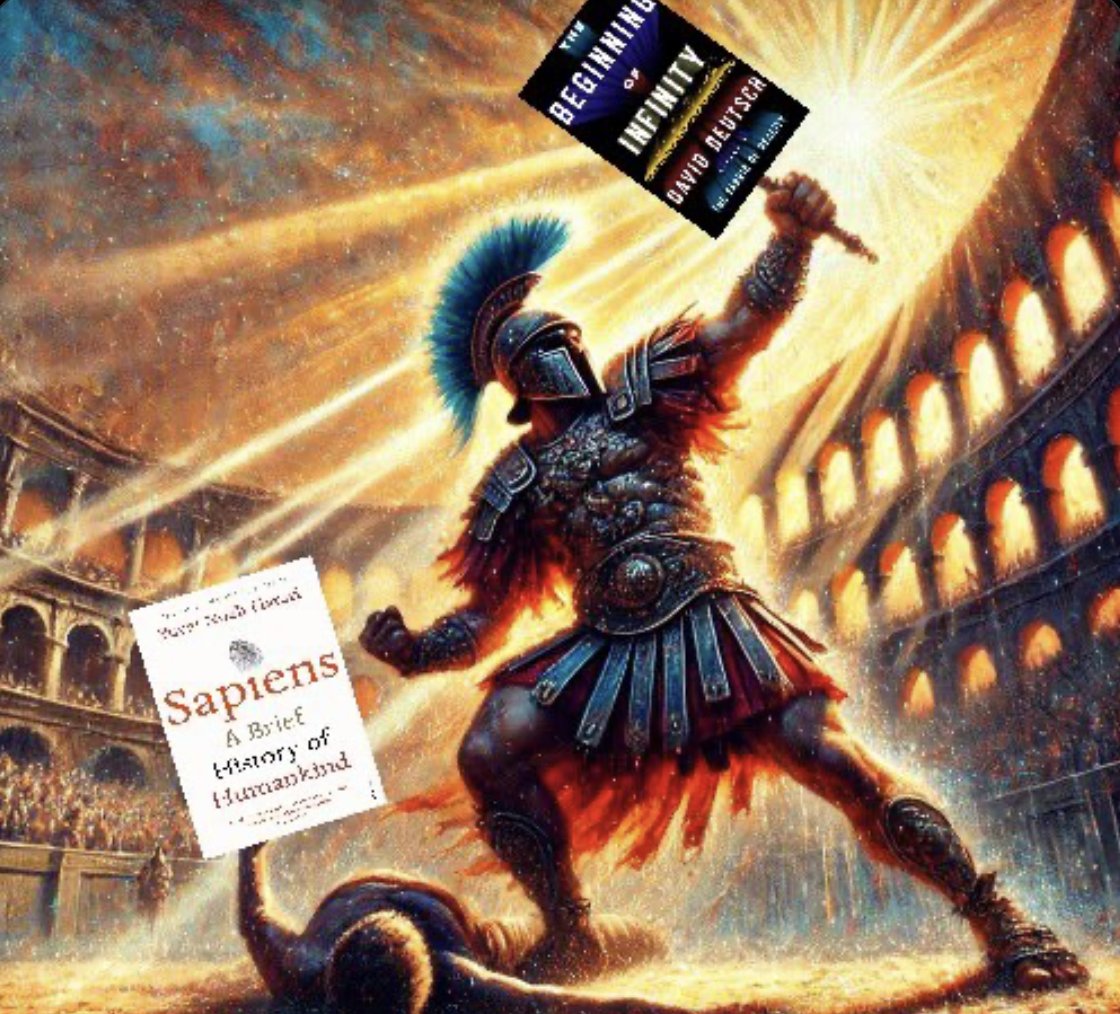
I used to think Sapiens was a great book. Sweeping, provocative, the kind of book that makes you feel like you finally understand the big picture of human history. It's on every CEO's bookshelf, assigned in universities, praised as a masterwork of synthesis. Yuval Noah Harari is treated as one of the serious thinkers of our time.
But something nagged at me. Some passages felt off. Claims that human rights are just figments of our collective imagination, not real things, just stories we tell ourselves. That nations, laws, money, justice, doesn't exist outside our heads. That meaning itself is a delusion we've invented to cope. That we're far more powerful than ever before but not happier. That hunter-gatherers had it better because they had no dishes to wash, no carpets to vacuum, no nappies to change, no bills to pay.
That sounded depressing to me, but was perhaps just the realistic scientific worldview? What it meant to see the world clearly, without comforting illusions.
Then I read The Beginning of Infinity by @DavidDeutschOxf. Deutsch has a concept he calls 'bad philosophy.' Not philosophy that's merely false, but philosophy that actively prevents the growth of knowledge. Ideas that close doors rather than open them. That makes problems seem unsolvable by design.
After soaking in Deutsch's framework (it's dense, a bit like digesting a delicious whale), it becomes clear: Harari's books are riddled with bad philosophy. They're smuggling nihilism in under the guise of scientific objectivity. Some examples:
On meaning: "Human life has absolutely no meaning. Humans are the outcome of blind evolutionary processes that operate without goal or purpose... any meaning that people inscribe to their lives is just a delusion."
On human rights: "There are no gods in the universe, no nations, no money, no human rights, no laws, and no justice outside the common imagination of human beings."
On free will: "Humans are now hackable animals. The idea that humans have this soul or spirit and they have free will, that's over."
On progress: "We thought we were saving time; instead we revved up the treadmill of life to ten times its former speed." The Agricultural Revolution? "History's biggest fraud." We didn't domesticate wheat, "it domesticated us."
On our cosmic significance: "If planet Earth were to blow up tomorrow morning, the universe would probably keep going about its business as usual. Human subjectivity would not be missed."
On the future: "Those who fail in the struggle against irrelevance would constitute a new 'useless class.'" Homo sapiens will likely "disappear in a century or two."
This is bad philosophy. It tells us our problems are cosmically insignificant, our solutions are illusions, and that progress is neither desirable nor within our control. It's also perfect nonsense. No one would ever go back to being hunter-gatherers. Would you rather worry about your kid spending too much time on Roblox, or face the 50% chance she won't reach puberty?
And our so-called "fictions"? They ended slavery. They gave women equal rights. They solved hunger. They eradicated smallpox. They turned sand into computer chips. They got us to the moon, and hopefully soon, to Mars and beyond. These "fictions" are already reshaping the universe, and over time they may become the most potent force in it.
Now compare Deutsch:
"Humans, people and knowledge are not only objectively significant: they are by far the most significant phenomena in nature."
"Feeling insignificant because the universe is large has exactly the same logic as feeling inadequate for not being a cow."
"Problems are soluble, and each particular evil is a problem that can be solved."
"We are only just scratching the surface, and shall never be doing anything else. If unlimited progress really is going to happen, not only are we now at almost the very beginning of it, we always shall be."
Where Harari sees a species of deluded apes stumbling toward obsolescence, Deutsch sees universal explainers, the only entities we know of capable of creating explanatory knowledge, solving problems, and potentially seeding the universe with intelligence.
The difference isn't academic. Ideas shape action. If you believe life is meaningless, progress is a trap, and humans are hackable animals with no free will, how does that affect what you build? What you fight for? What you teach your children?
Harari's books sell because they flatter a fashionable pessimism. They let readers feel sophisticated for seeing through the "delusions" everyone else lives by. That smug cynicism is corrosive. And it's everywhere: in schools, in media, in bestselling books. More than half of young adults now say they feel little to no purpose or meaning in life. This is what happens when you teach an entire generation bad philosophy. Less progress, less health, less wealth. Less flourishing. And ultimately, a higher chance that civilization and consciousness go extinct.
Fortunately, there's another equally well-written, but much truer, account of homo sapiens, appropriately titled 'The Beginning of Infinity'. And this one smuggles no despair in by the backdoor. But let's give Harari credit where it's due. He is right about one thing: if planet Earth blew up tomorrow, we wouldn't be missed. Because there'd be no one left to miss us, just a careless universe, blindly obeying physical laws. We are the only ones who can miss, but we're not going to. We're going to aim, hit, and keep going.
Full credit for the amazing meme to @Ben__Jeff
Harris wants "equity" in outcomes, not just equal opportunities.
If you are not good with math, or economics, or history, or psychology, or thinking in general, let me explain what that means.
It means that if you do everything right, and work hard to build an average or above average life, Harris wants to take that from you and your family and give it to people who didn't earn it the way you did.
It also means the complete destruction of the economic system over a short period of time. History is emphatic about that.
Elon Musk shuts up Don Lemon after the former CNN host tried slamming Musk for not censoring content on X.
I’m seeing why Lemon’s deal with X was scrapped.
“I'm against censorship. I'm in favor of freedom of speech. Freedom of speech only is relevant when people you don't like say things you don't like. Otherwise, it has no meaning.”
A very simple concept that is hard for a 🍋 to grasp.
Video: @alx
Billionaire Ken Griffin, who gave Harvard $300 million last year:
“I’m not interested in supporting the institution.”
He asks if Harvard will return to educating young people to be leaders or remain “lost in the wilderness” of DEI.
What an absolutely beautiful, kind and classy tribute to Siya Kolisi by Squidge Rugby. This is not only a tribute to Siya but in some ways, a love letter to the Boks and maybe, just maybe, to us as South Africans too.
NEW: Billionaire and Democrat voter Chamath Palihapitiya admits that he was wrong about President Trump and says he now "appreciates" what Trump was able to do.
Chamath also said Trump Derangement Syndrome did more damage than Trump ever did.
“The work on the border wall, we didn't like the messenger, so we killed the message. Turned out it was right.”
“Issuing long-term debt to refinance when rates were at zero. We didn't like the messenger, so we killed the message.”
“Peace in the Middle East. We didn't like the messenger, so we killed the message. When are we gonna stop shooting ourselves in the foot?”
Remarkable.
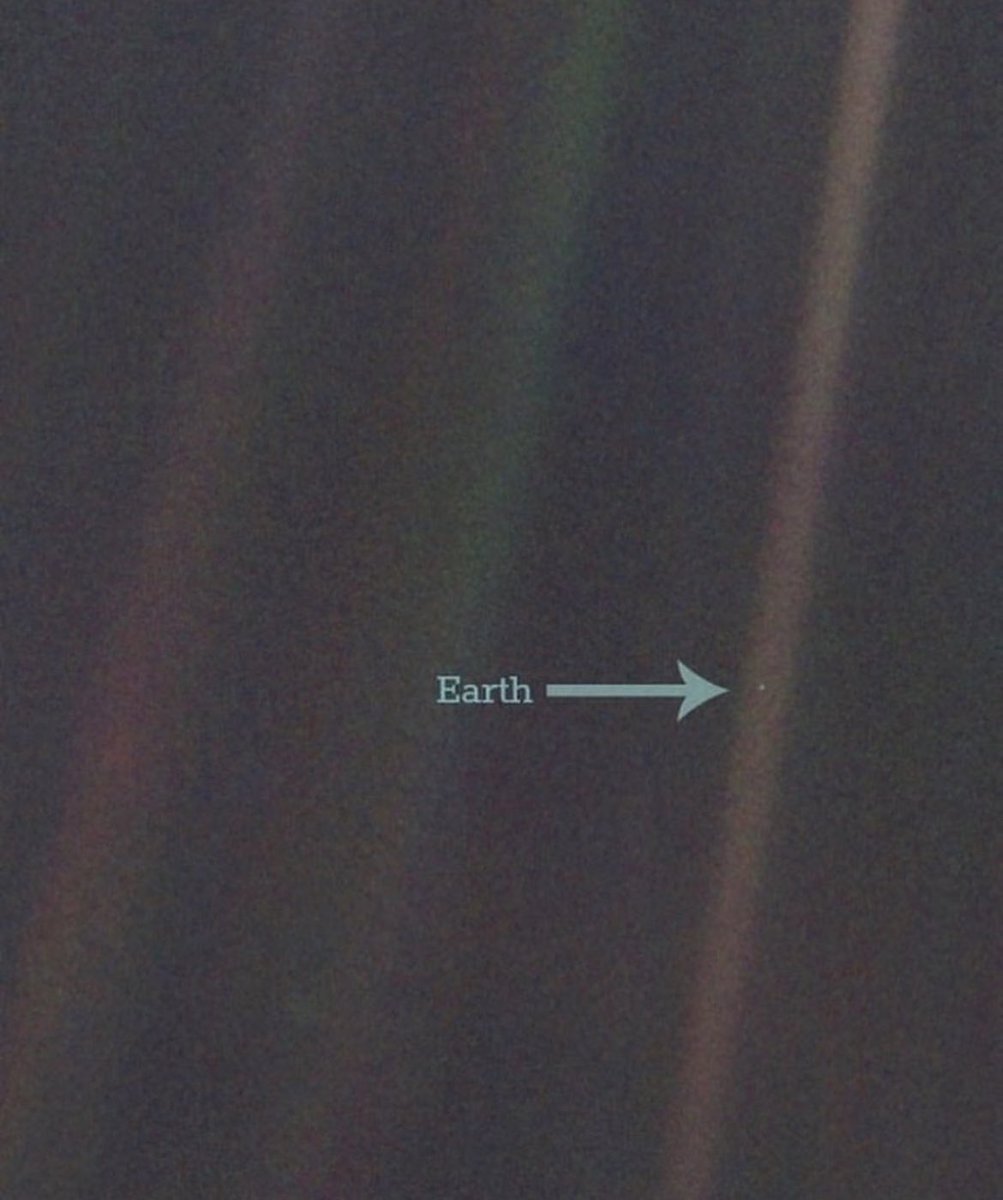
Pale Blue Dot is a photo of Earth that was taken by the Voyager 1 space probe in 1990 from a distance of about 6 billion kilometers (3.7 billion miles) as it was leaving our solar system. This is what Carl Sagan said about the photo:
"Look again at that dot. That's here. That's home. That's us. On it, everyone you love, everyone you know, everyone you ever heard of, every human being who ever was, lived out their lives. The aggregate of our joy and suffering, thousands of confident religions, ideologies, and economic doctrines, every hunter and forager, every hero and coward, every creator and destroyer of civilization, every king and peasant, every young couple in love, every mother and father, hopeful child, inventor, and explorer, every teacher of morals, every corrupt politician, every 'superstar,' every 'supreme leader,' every saint and sinner in the history of our species lived there — on a mote of dust suspended in a sunbeam.
The Earth is the only world known so far to harbor life. There is nowhere else, at least in the near future, to which our species could migrate. Visit, yes. Settle, not yet. Like it or not, for the moment the Earth is where we make our stand. It has been said that astronomy is a humbling and character-building experience. There is perhaps no better demonstration of the folly of human conceits than this distant image of our tiny world. To me, it underscores our responsibility to deal more kindly with one another, and to preserve and cherish the pale blue dot, the only home we've ever known.”
"Eat at a local restaurant tonight. Get the cream sauce. Have a cold pint at 4 o’clock in a mostly empty bar. Go somewhere you’ve never been. Listen to someone you think may have nothing in common with you. Order the steak rare. Eat an oyster. Be open to a world where you may not understand or agree with the person next to you, but have a drink with them anyways. Eat slowly. Tip your server. Check in on your friends. Check in on yourself. Enjoy the ride."
- Anthony Bourdain
“I really can’t emphasize this enough. We must protect free speech. It’s only relevant when it’s someone you don’t like saying something you don’t like . . . For those who would advocate [censorship], just remember at some point that will be turned on you.” — @elonmusk on @billmaher