Thank you, Ma'am! We did not import the name/the plant from Greece; we had our own precise Sanskrit vocabulary based on how the plant behaved:
- Tanduliya/Tandula: This was the classical Ayurvedic name for the amaranth plant family. It tracks the grain aspect, closely linking it to nutritious food structures.
- Rajagiri: Literally translated as The King of the Hill/Royal Grain. This name was given because the robust amaranth crop could survive intense frost, droughts & poor soil conditions on high altitudes where other grains collapsed.
- Chaulai / Lal Sag: The vernacular Hindi evolution tracking the rich crimson, iron-dense leaves (Red Keerai).
In fact, your recipe is perfect, Ma'am. Ancient healers did not know the words pesticides/pathogens, but they understood Krimi (microscopic organisms, parasites & toxins). Sushruta mandated treating raw river-bank greens with warm water, Saindhava Lavana (rock salt) & Haridra (turmeric) to neutralize external toxins & pacify excess Kapha (moisture/mucus) on the leaves. Grated coconut helps absorb fat-soluble compounds (like Vitamin A/Beta-Carotene in red keerai). Ayurveda calls this the principle of Anupana (the vehicle).
Tanduliya is naturally Rooksha (dry) & Sheeta (cooling). If you eat it plain, it can aggravate Vata. By cooking it with a healthy fat like coconut/ghee & a bit of heat (chillies/black pepper), ancient cooks modulated the bio-availability of the plant, lubricating the digestive tract & allowing the nutrients to assimilate smoothly. Also, Ma'am, you are spot on about the daytime consumption. Eating greens when the sun is high is a core rule of Agni (the metabolic fire). Ayurveda dictates that leafy greens require strong digestive fire to break down their heavy cellular fiber. Eating Keerai at night when Agni naturally cools down leads to Ama (undigested toxic byproduct). 🙏🙏
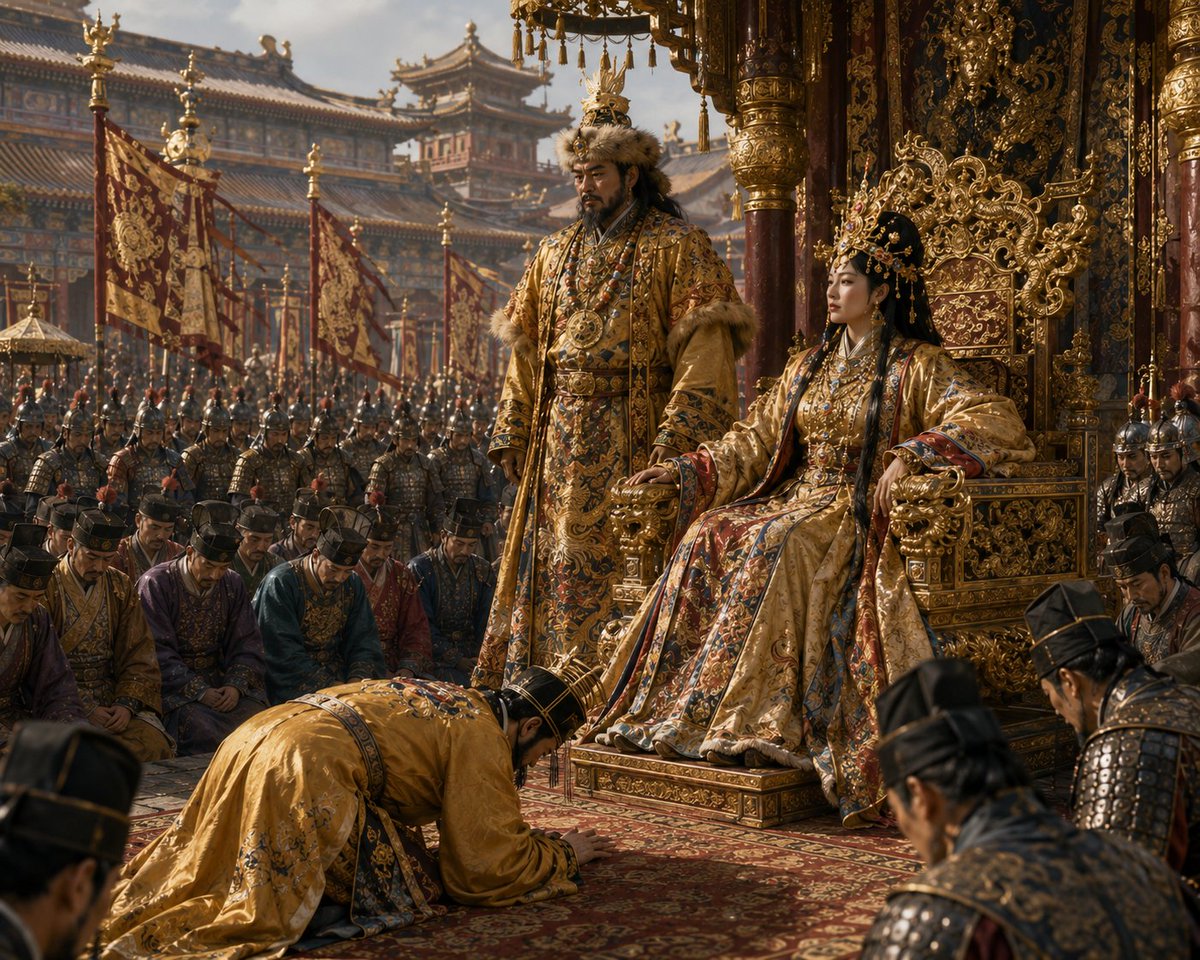
Chinese are calling Tibetans "the Jeet of their land"
Bro, Tibetans used ro thrash your ancestors. Tang emperor used to give tribute of 50000 rolls of silk to Tibetan Emperor.
When the new Chinese emperor violated the treaty and stopped giving tribute he was humiliated and Tibetan king's wife was made the emperor of China. Huhh!!
@MrAdnanRashid All I hear are fabrication of an incident with blatant disregard to facts which fails even basic facts check like date check by a Sunni "self-declared" scholar and a blatant hate towards Shia sect, believer of Islamic Prophet and his descendants.
This is the condition of the Punjab mansion of Hindu businessman Todar Mal who paid 7,800 gold coins and bought 4 yards of land from the Mughal emperor Aurangzeb to bury the bodies of the 2 young sons and mother of Guru Gobind Singh on December 13, 1705.
The Mughal faujdar Wazir Khan had ordered the two young children be bricked alive as they refused to accept Islam. When they died, their grandmother died of shock
The Mughals did not want to allow the cremation to humiliate the martyrs. They stipulated that the buyer can take only as much space as he could cover with give gold coins for the land. All the Sikh chiefs just stood helplessly
That's when Todar Mal produced the coins and bought the piece of land, and cremated the three bodies.
This is biggest irony of life, India is only country where its true heritage is hidden from next generation and falsehood Is taught.
@vastalitech@VedicWisdom1 If everything is phala of karma, then how will new karma be added to a person. There will be no rising or falling due to karma as all will be pre-determined. There will be no free will and conscious effort, implying no phala of karma.. breaking the cycle of karma.
@thefeyz@Bulvarpress FYI. He doesn't believe or want to enter Heaven by doing this. None of Hindus ultimate goal is Heaven its Moksha.
It would be difficult to explain to people following a primitive or new born religion. It's an advanced topic but still try to search about it.
The race that wiped out millions out of hatred because Churchill believed Indians bred like rabbits and didn’t need grain in famine. 3 million died. The race that thought it had the burden to destroy indigenous cultures across the globe in the garb of ‘civilising’ them.
But yes! Least racist! Race or religious superiority was never the motivation. Just pure business, I believe.
1 of the oldest stories in the Markandeya Purana tells of Surya (the Sun), who possessed such blinding, intolerable heat & brilliance that his wife, Sanjna (which translates to twilight/torm cloud), could no longer stand to be near him. She fled to the cooler polar regions, leaving her shadow, Chhaya, in her place.
When Surya discovered the swap, her father, Vishwakarma (the divine architect), stepped in to shave off 1/8th of the Sun’s raw brilliance, restoring equilibrium so the couple could reunite.
For centuries, Western scholars dismissed this as simple campfire folklore. However, modern archaeo-astronomy & ice-core data have completely vindicated the rishis: Recent global analysis of ice cores drilled from Greenland & Antarctica revealed a massive, freak anomaly in the earth's atmosphere: a violent, apocalyptic Coronal Mass Ejection that struck Earth around 7176 BCE. (Reference Paper: https://t.co/79Sz0Tu1Wd)
This event was estimated to be 2 order of magnitude larger than the Carrington Event of 1859. It completely ionized the upper atmosphere, causing the entire sky to blaze with an intense, super-bright luminosity that made the Sun appear blindingly hot even during the day, accompanied by spontaneous, widespread lightning.
The ancient Indians witnessed this terrifying cosmic event, tracked the Sun's eventual return to baseline stability & perfectly preserved the data log of a massive solar max-min cycle inside an unforgettable allegorical story.
In our ancient texts, when the rishis mapped the internal enemies of human consciousness (Shadripu), they listed things like lust (Kama), anger (Krodha) & greed (Lobha). But the ultimate, most subtle virus they identified was Matsarya (मात्सर्य).
Modern dictionaries loosely translate Matsarya as jealousy. In Sankhya philosophy, Matsarya is much more sinister. It is defined as the inability to bear the presence/happiness/rise of another being. It is the pain our ego feels simply because someone else exists & is being noticed.
X is a platform designed entirely to trigger Matsarya. Every time an individual posts a success/an opinion/a moment of spotlight, it lands directly on the feeds of 1000s of others whose minds are in a state of Asat (restlessness).
The ego cannot process the other person's space, so it immediately weaponizes Krodha (anger) as a self-defense mechanism to pull them down. The hatred on X is nothing but millions of bruised egos experiencing Matsarya simultaneously in a digital public square.
Thiruvalluvar lived at least 2,500 years ago.
The only way of life that existed at that time was Sanatan Dharma (today’s Hinduism)!
Christianity originated only 1,993 years ago.
Islam originated only 1,416 years ago.
Some fools keep repeatedly spinning tales that Thiruvalluvar belongs equally to all religions and is a “common scripture” for everyone. This is nothing but silly politics.
Intelligent people will accept that Thiruvalluvar preached about all the Hindu gods — such as Trivikrama, Vishnu, Lakshmi, Brahma, Yama, Adi Bhagvan, and Indra — and also taught the core principles of Sanatan Dharma: Aram (Dharma), Porul (Artha), Inbam (Kama), and Veedu (Moksha).I
In Shaivism, Lord Shiva is worshipped as the Supreme God. Along with the 63 Nayanmars who propagated Sanatan Dharma, Thiruvalluvar is also included as the 64th. Even today, the tradition of Tamils is to celebrate this by taking out a grand procession during the Arupathu Moovar urchavam (festival) in Mylapore. Can anyone deny this?
From now on, stop talking about Thiruvalluvar’s religion. The sacred colour of Sanatan Dharma is saffron . The colour of fire is saffron. The colour of the sun is saffron. Saffron is nature and Without saffron, there is no world. One who understands this is wise. One who does not is a fool!
Narayanan Thirupathy.
INSTEAD OF WATCHING AN HOUR OF NETFLIX TONIGHT.
This 1 hour Stanford lecture by Joel Peterson will teach you more about negotiation and getting what you want than most people learn in years.
Bookmark it and give it an hour, no matter what.
Britain abolished slavery in 1833. Three years later, they invented its replacement. They used Indians to run it.
Between 1.9 and 3.5 million people. Lied to, Shipped across oceans. Worked under a system survivors called "slavery with the chains taken off."
The story India almost forgot featuring powerful insights from @ShawnBinda
Story time?
Back in the winter of 1955, an Uzbek politician and writer named Sharaf Rashidov went on a diplomatic trip to Jammu and Kashmir.
While he was there, he saw a live performance of "Bombur ta Yambarzal" (The Bumblebee and the Narcissus), a famous 1953 opera by the local poet Dina Nath Nadim.
On stage, characters played literal forces of nature: the spring narcissus, (Yambarzal) and the king of bees (Bombur) represented life and freedom, while winter blizzards symbolised oppression.
Rashidov was so moved by the performance that he went home and turned the story into a 1956 book called "The Kashmir Song", translating the flower's name to its more common regional equivalent, "Nargis".
By 1965, this local Kashmiri tale traveled all the way to Moscow's Soyuzmultfilm studio, that turned it into a gorgeous animated short film called *Nargis*. The animation team crafted the film in the ornate, miniature-painting style characteristic of traditional Russian Palekh lacquer art known for its folkloric elegance. At the same time, the characters’ flowing draped garments, vibrant attire, and decorative jewelry clearly draw inspiration from Indian cultural aesthetics, giving the film an exotic, fairy-tale quality that blends Soviet artistic traditions with the story’s Indian roots.
The film arrived at the perfect time. During the 1950s and 1960s, India and the Soviet Union shared a massive cultural exchange. Hindi cinema was wildly popular across the USSR with films starring actors such as Raj Kapoor drawing large audiences and becoming cultural touchstones. Amid this mutual fascination, Nargis served as a vivid example of how a great story can easily cross borders and connect completely different worlds.