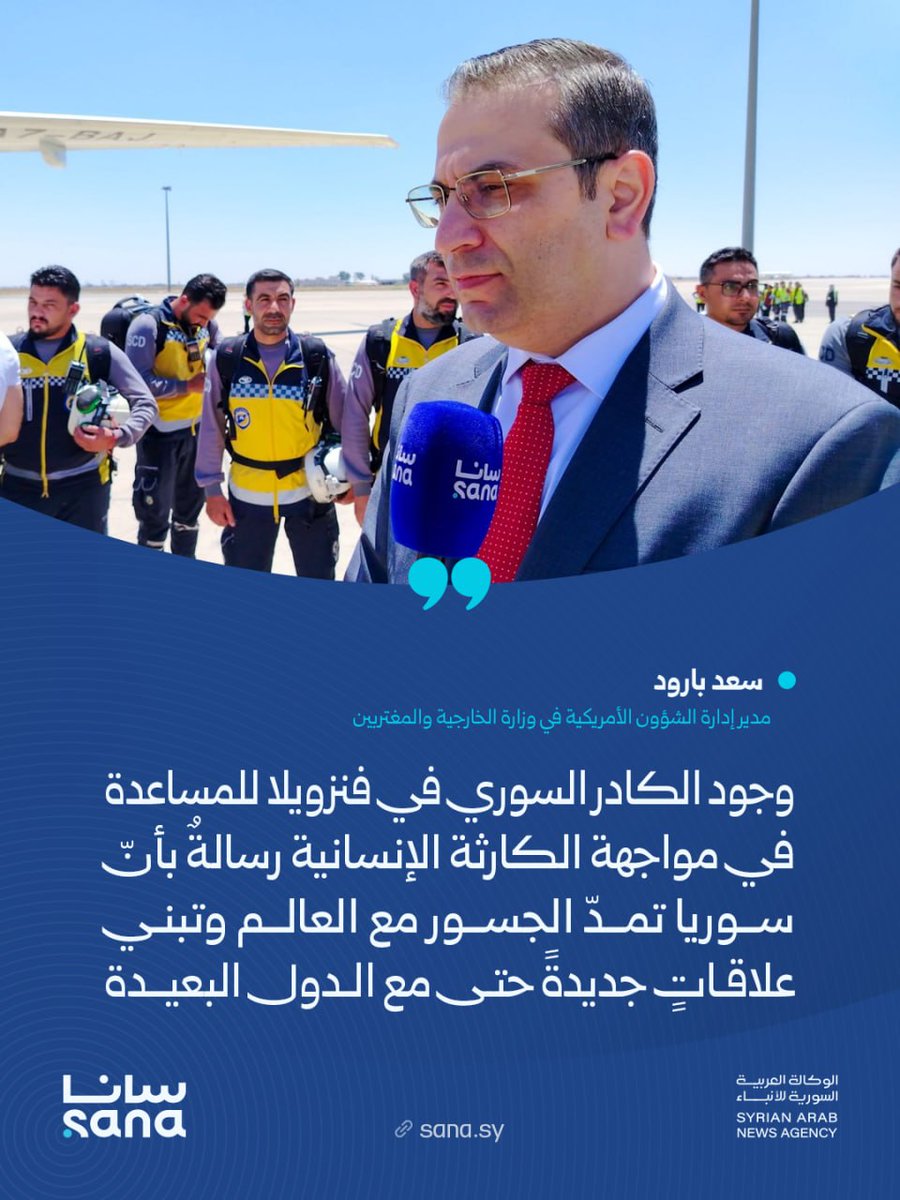
مدير إدارة الشؤون الأمريكية في وزارة الخارجية والمغتربين سعد بارود لـ سانا خلال استقبال فريق الإنقاذ السوري العائد من فنزويلا:
▪️ انتقلت سوريا خلال أشهر من دولة مستقبلة للمساعدات إلى دولة قادرة على تقديم الخبرات والكوادر إلى مختلف أنحاء العالم.
▪️ وجود الكادر السوري في فنزويلا للمساعدة في مواجهة الكارثة الإنسانية رسالةٌ بأنّ سوريا تمدّ الجسور مع العالم، وتبني علاقاتٍ جديدةً حتى مع الدول البعيدة.
#سانا
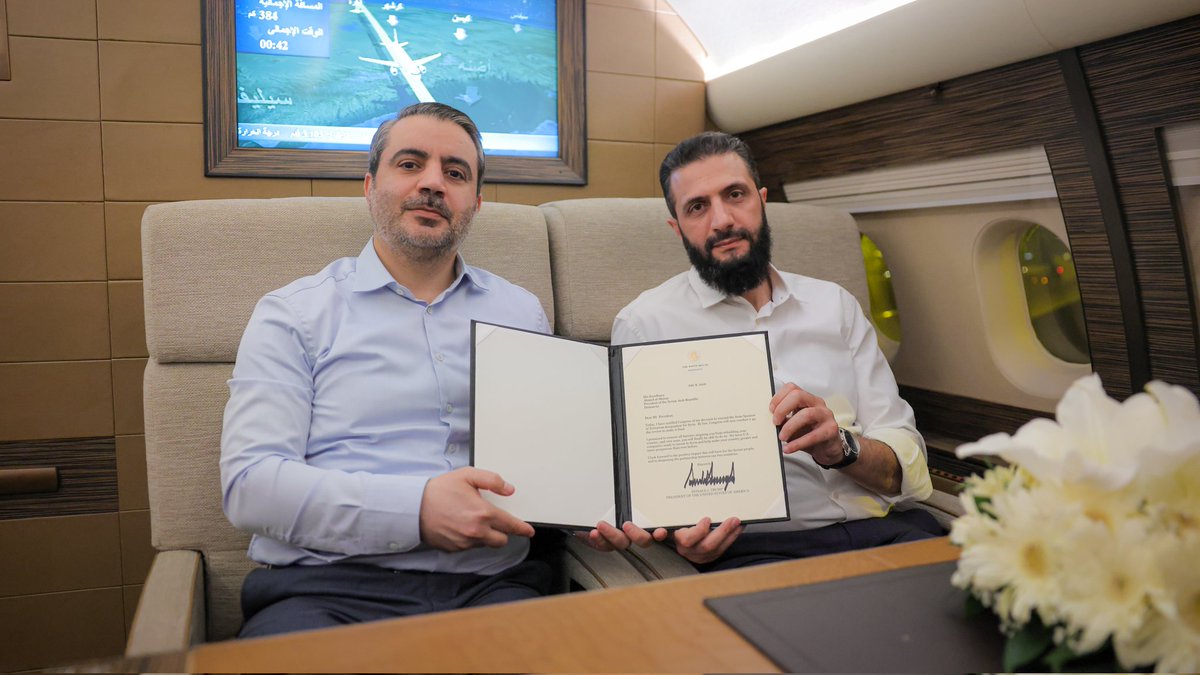
ضمن توجيهات فخامة رئيس الجمهورية أحمد الشرع، أغلقنا صفحة سوداء في تاريخ سوريا برفع التصنيف الذي فرض عليها بسبب سياسات النظام البائد 1979
كل الشكر والتقدير للولايات المتحدة بقيادة الرئيس ترامب على هذا القرار، ولصديقي وزير الخارجية ماركو روبيو وللسفير العزيز توم باراك ولكل من وقف إلى جانب سوريا.
Reporter: Are you going to remove Syria from the state sponsor of terrorism list?
Trump: I think I will. Yeah, I think, why wouldn't I? He's done a great job.
Exclusive: U.S. intelligence agencies have warned the Trump administration that Israeli Prime Minister Benjamin Netanyahu is likely to take steps that will undermine President Trump’s effort to reach a lasting peace deal with Iran. https://t.co/LF1mowtp08
🇮🇱 Gwyneth Paltrow Is Helping Israel Sell Stolen Coastline Apartments
She's the face of 51 Park, two luxury towers on the Herzliya seafront. That beach was the Palestinian village of al-Haram, emptied of its people in 1948.
Israelis call it luxury living. The people who were driven off that shore used to call it home.
#Syria's province of #Suwayda has emerged as a narco state, run by remnants of #Assad's regime & organized crime leaders -- and protected by #Israel.
My latest for @newlinesmag contains *a lot* of exclusive information.
https://t.co/Tz1uXWwGkw
Confession time: I used to think Bitcoin was just a speculative asset. As far as I could tell, it served no real purpose.
Sound familiar?
Looking back, I realize that my view came from ignorance and a lack of empathy and imagination. I simply couldn't see what Bitcoin offered to people whose circumstances were nothing like mine. Sorry.
In reality, Bitcoin belongs in the same category as the smartphone and the Internet when it comes to utility. But unlike those earlier innovations, it benefits people in the global South first, the West last.
That order of impact explains why so many of us in the West initially fail to see what it does for us, and then wrongly conclude it does nothing for anyone.
Bitcoin analyst @willywoo estimates 350 million people now use Bitcoin, with adoption growing rapidly. Here is a snapshot of who those users are and why they turn to it:
1.2 billion people are unbanked. Of them, 57% are women and 90% are people of color.
4 billion people live under autocratic or semi‑autocratic regimes, where governments can freeze accounts, track spending, and silence dissent through the financial system.
In Afghanistan, 8.1 million adult women are legally barred from opening a bank account, starting a business, or earning an income because of their gender.
More than 300 million people live in economies experiencing hyperinflation, including Turkey, Lebanon, Argentina, and Venezuela.
These are the people who see Bitcoin’s utility first. It is not those of us in the West who take stable banking, low inflation, and basic financial access for granted.
You might be asking: how exactly does Bitcoin help them?
For the unbanked, it removes the need for a bank entirely. A basic feature phone and a small amount of education are enough to start receiving, saving, and making payments.
Across Africa, we are watching a financial revolution unfold. The poorest communities are leapfrogging traditional banking and moving directly to internet‑native money. That is why Africa is adopting Bitcoin faster than any other continent.
For people living under autocratic rule, Bitcoin makes it possible to transact without government surveillance, censorship, or the risk of having funds frozen. That is why Nigeria has become one of the largest adopters; human rights activism is a major driver.
For women in Afghanistan, Bitcoin Lightning wallets offer a way around state‑imposed discrimination. They can and do use them to secure financial independence that the law otherwise denies them.
For those facing hyperinflation, Bitcoin provides a means to preserve savings that might otherwise lose half their value in a single year.
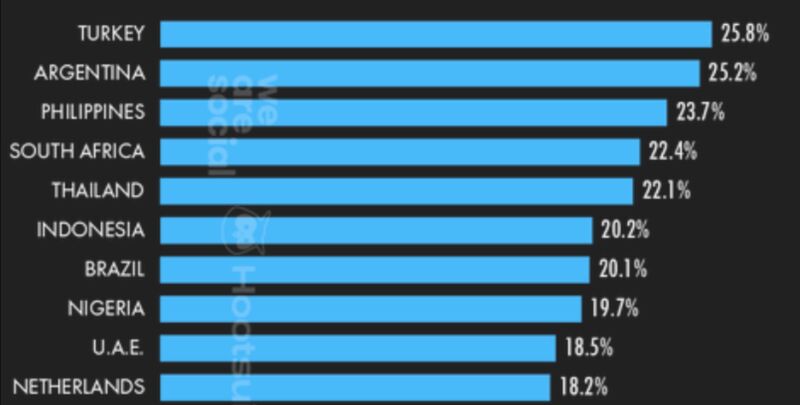
Look at the top 10 countries adopting Bitcoin:
The top 2 have hyperinflation
*7 of the top 8 were colonized and carry heavy IMF or World Bank debt
*8 out of 10 are autocratic or semi‑autocratic regimes
*7 out of 10 are in Africa, LATAM, or SE Asia
For over half the world, Bitcoin ranks as the most useful technology in a generation.
One of the most powerful trading firms on Wall Street just got caught in the crosshairs.
Jane Street.
They don't do interviews or don't make headlines.
They move billions in silence up until now.
Two days ago, a lawsuit dropped in Manhattan federal court.
Filed by the administrator unwinding Terraform Labs, the company behind the $40 billion crypto collapse of 2022.
Insider trading, market manipulation, front-running a financial catastrophe.
The complaint alleges Jane Street had a man on the inside.
A former Terraform intern turned Jane Street trader.
They shared secrets through a private group chat called "Bryce's Secret."
When Terraform quietly pulled $150 million in liquidity from its pools, Jane Street allegedly knew.
Minutes later, they dumped $85 million in UST.
Panic spread and Luna went to zero.
$40 billion vanished and many retail investors were destroyed.
And Jane Street? They allegedly avoided $200 million in losses and then profited from the wreckage.
But here's what traders noticed this week.
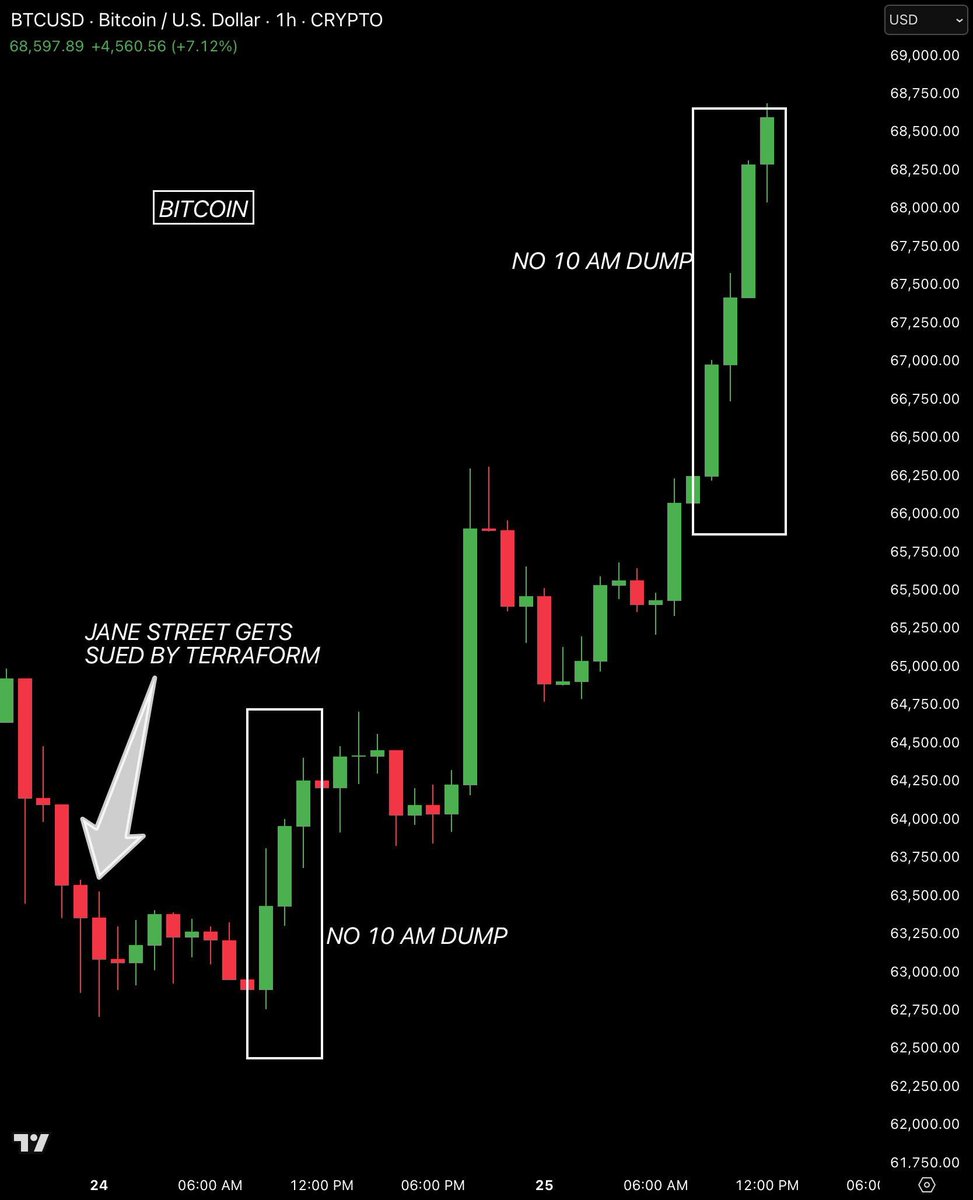
For months, Bitcoin has been getting slammed at exactly 10 AM Eastern.
Every single morning like clockwork.
Over 60% of sessions since November showed this exact pattern.
Traders called it "the 10 AM dump."
They blamed one firm.
Jane Street.
Jane Street is an authorized participant in BlackRock's Bitcoin ETF.
They can create and redeem shares directly.
They hold nearly $800 million in IBIT. They have the infrastructure to move markets.
Then the lawsuit dropped on February 23rd.
And something changed.
The 10 AM dump didn't happen Monday. It didn't happen Tuesday.
Bitcoin ripped 10% and dded $120 billion in market cap.
The weekly candle turned green after five straight red weeks.
Coincidence? Maybe.
But this isn't Jane Street's first rodeo.
Last July, India's market regulator barred Jane Street entirely.
Seized $567 million and accused them of manipulating the country's stock index through derivatives.
They allegedly made $4.3 billion doing it.
Now they're accused of helping blow up Terra.
Accused of running a daily suppression algorithm on Bitcoin. And the moment they get sued, the pattern breaks.
Jane Street says the lawsuit is "baseless."
The market says otherwise.
And now the world is watching.
The events in Syria over the past few days—and the rapid collapse of the SDF—offer a stark lesson for US policymakers. Unfortunately, after 15 years in DC, I have little confidence that lesson will be learned. This is a town where there is little accountability for bad policy and where “failing up” is all too common.
The United States spent billions of taxpayer dollars training and equipping a militia that collapsed in less than 48 hours. The SDF, long mythologized as a heroic force that defeated ISIS and “saved the world,” was always destined to crumble the moment US military protection was withdrawn. For years, we warned that this arrangement was unsustainable and that the absence of a political endgame was laying the groundwork for an eventual Arab–Kurdish civil war.
That outcome was baked in from the start. The YPG—the Syrian branch of the PKK—was rebranded by Obama-era officials as the “Syrian Democratic Forces” with little regard for long-term consequences. Successive administrations maintained this construct without a viable political endgame, even as it governed territory and populations it could only control under U.S. military protection.
Sustaining the SDF required a permanent American military presence. The group was at odds with many Syrian Kurds, ruled over an overwhelmingly Arab population that resented it, clashed with Turkey, alienated the Syrian opposition, and even fell out with Iraqi Kurdistan. The moment the US stepped back, a revolt was inevitable.
Why? Because the force some Congress members now issue indignant tweets about was never viewed on the ground as “the Kurds” or as a democratic liberation movement. Syrians saw it as an alien, PKK-dominated, ethno-Marxist project imposed by force. The SDF abducted Kurdish female minors to serve as child soldiers, ethnically cleansed Arab towns to advance its “Rojava” fantasy—one that Syria’s geography and demography were never hospitable to—and prioritized tunnels and militias over schools, hospitals, and jobs.
It committed widespread abuses while branding virtually all opposition as “ISIS,” echoing the Assad regime’s playbook. It rejected meaningful negotiations—including with rival Kurdish parties—even when Barzani attempted to mediate. Non-Syrian PKK cadres repeatedly torpedoed compromise. The result was a force deeply detested across Syria—hence the scenes of jubilation now unfolding in town after town as it has been expelled.
Yet Western commentators and activists, often viewing Syria through an orientalist lens, persisted in portraying the SDF as a feminist, egalitarian “oasis of democracy.” For locals, the reality was starkly different. I still recall an NYU professor returning from a guided tour of SDF-controlled areas describing conditions residents experienced as hell on earth as serenely peaceful—“even ducks were bobbing placidly” in the ponds.
Propping up such a deeply resented force appealed to some regional actors eager to keep Syria weak and divided, and to use it as a thorn in Turkey’s side. These goals were divorced from US interests, Syrian interests, and from the long-term interests of Arabs and Kurds alike. Still, Washington stayed on. As one senior official once told me, “we owed the Kurds”—a phrase that conveniently blurred the distinction between Syrian Kurds and a PKK-run militia. Publicly, the mission was framed as ensuring the “enduring defeat of ISIS.” In reality, it meant an open-ended U.S. military commitment to defend a political order rejected by the people it ruled—an arrangement that was financially wasteful and politically untenable.
Ultimately, both Syrian and US interests point in the same direction: a stable, unified Syria in which all Syrians—Arab and Kurd, Muslim and Christian alike—enjoy the same rights under a single state. That outcome, not the indefinite propping up of militias, is the only realistic path to preventing renewed conflict and ensuring the enduring defeat of ISIS—this time for real.