Today, the Wisdom House Kindergarten celebrated its 10th graduation, and for the first time since the war, the ceremony was held in the newly repaired original Wisdom House building.
This school exists because back in 2015, ordinary people in the U.S. saw the Syrian refugee crisis and chose to support a small group of Syrian teachers caring for children in an underground classroom in Idlib. That support and community grew year after year, creating a safe space for kids to be kids.
January 27th, 2020 the fighting in Syria reached the small village of Al-Ghadfa, the original Wisdom House and its surrounding community were devastated. The Assad regime conducted over 800 airstrikes in a single day, and families were forced to flee for their lives. The Wisdom House reopened the very next school year, far from the front lines, so children could keep learning even in displacement.
When the Assad regime fell in December of 2024, the Wisdom House community was eager to return to their homes. Thanks to the generosity of donors, we were able to rebuild the original Wisdom House in its original building.
Education is one of the most important parts of Syria’s recovery and we are committed to ensure that these students grow up to achieve their greatest potential and biggest dreams.
Another crisis in the #Gaza Strip.
Rats and parasites are surging.
Skin infections are spreading.
Risk of disease is increasing.
Hundreds of UNRWA medical personnel are treating around 400 cases a day, but they could do more if they received adequate quantities of medications. Over 125,000 cases of skin infections related to rats and parasites were reported between January and May 2026 in the Gaz Strip.
Supplies need to be allowed into Gaza at scale.
#UNRWAworks
The US identifies four countries as State Sponsors of Terrorism. Should Syria still be one of them?
My latest on how the Assad-era SST designation is complicating Syria's economic recovery: https://t.co/L5OfNyp8CG
Today marks Nakba Day, an annual day of remembrance to commemorate the expulsion of more than 700,000 Palestinians between 1947 and 1949 during the creation of the State of Israel and the year that followed.
Inea is a New Yorker and a Nakba survivor. She shared her story with us — one of home, tradition and memory over generations.
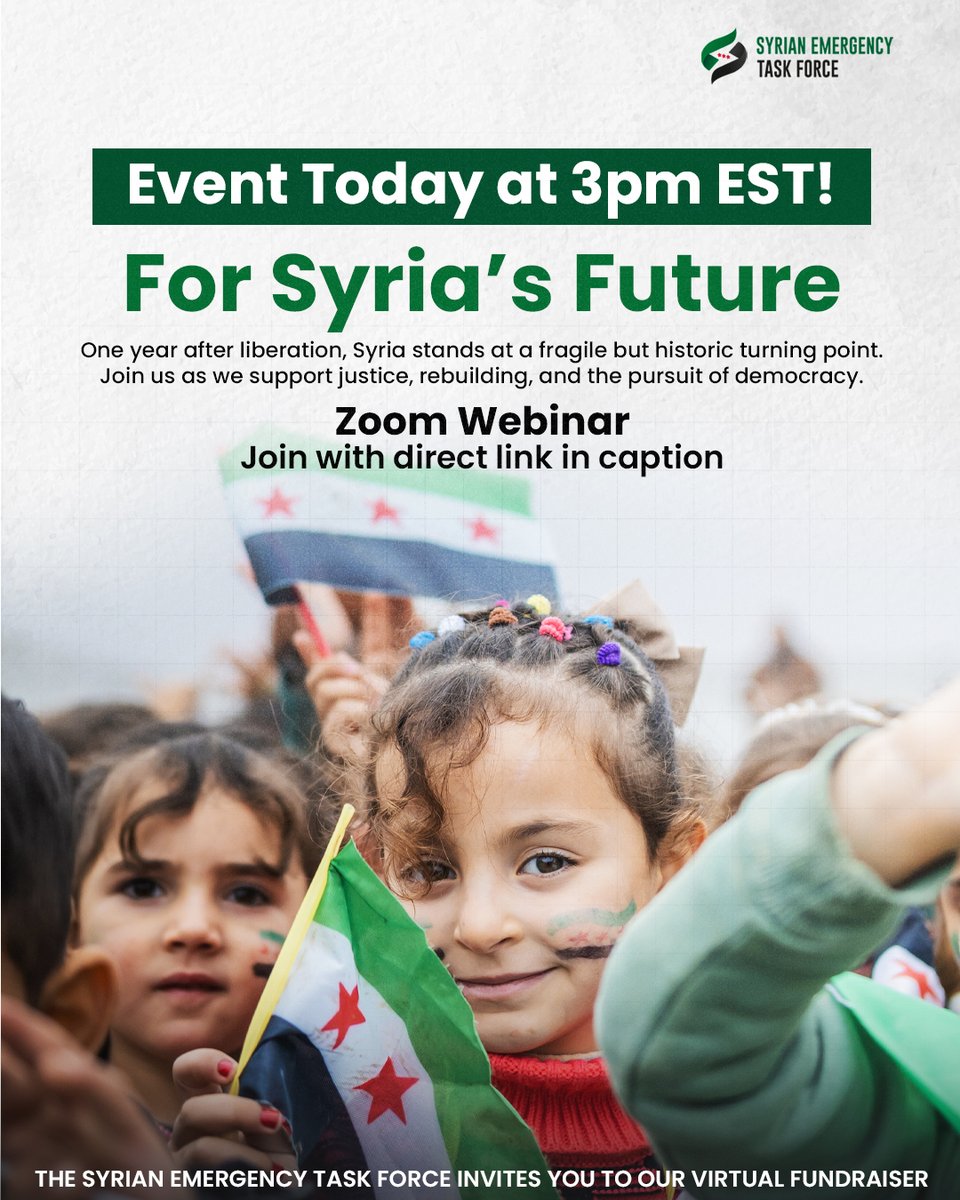
Can’t wait for this virtual event today, an important update from SETF on Syria. Tune in! Here’s the direct zoom link for 3pm EST today
https://t.co/H68t0ena0q
Today at 3PM EST
Join us for For Syria's Future, our virtual fundraiser.
One year after liberation, Syria stands at a fragile but historic turning point.
Join us today on Zoom as we come together for Syria.
https://t.co/6Usvf31klg
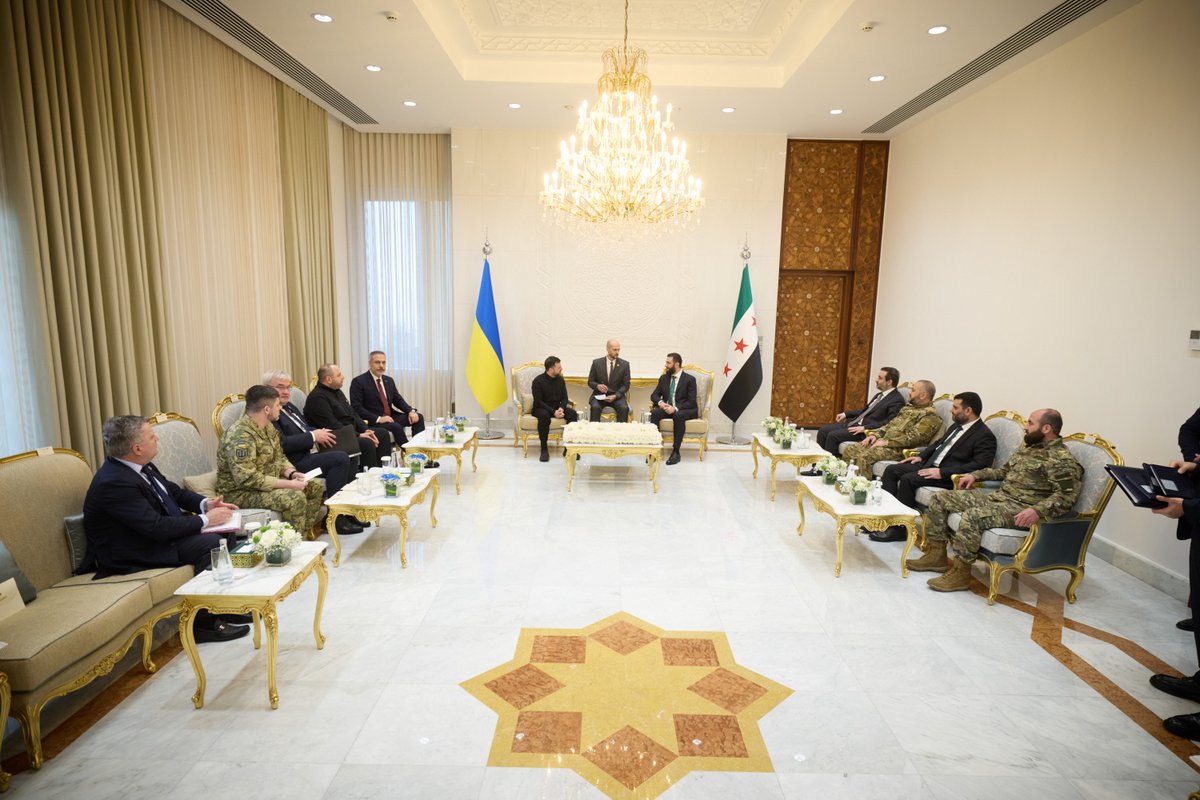
Перемовини з Президентом Сирії Ахмедом аш-Шараа.
Домовилися працювати разом, щоб дати більше безпеки й можливостей для розвитку нашим суспільствам. Обговорили ситуацію в регіоні та перспективи щодо її зміни до кращого. Обговорили й обставини війни Росії проти України, вдячний за підтримку. Є великий інтерес до обміну воєнним і безпековим досвідом. Дякую за слова поваги до наших людей.
Також торкнулися ролі України як надійного постачальника продовольчої продукції та обговорили спільні можливості посилити продовольчу безпеку в усьому регіоні. Дуже добре розуміємо, які енергетичні та інфраструктурні виклики має Сирія зараз. Готові працювати разом, щоб можливості наших держав і народів збільшувались.
Abu Mohammad, Abu Omar, and Abu Said are some of the most remarkable people I’ve had the privilege to know. I’m truly grateful to have worked alongside them in Rukban and to call them friends.
These three men lived inside Rukban Camp for nearly a decade, besieged, cut off from the world, without medicine, without doctors, without enough food or water for their families. And still they showed up.
Abu Mohammed was at the heart of everything on the ground inside Rukban. He ran our programs from within the camp itself, coordinating aid distribution, keeping operations alive under siege, and leading the Hope Pharmacy, the first and only no-cost pharmacy Rukban ever had.
Abu Saeed made sure the children of Rukban didn't lose their future. Working from inside the camp, he led Rukban's schools, keeping classrooms running in the middle of a desert under blockade, with no curriculum or supplies. Thousands of children kept up with their education because of him and the dozens of women who volunteered to teach.
Abu Omar was the quiet backbone of the team, the scribe, the one who kept things documented and moving when the chaos of Rukban would inevitably spill over. Abu Omar was the rock and is widely described as a brother to all those on the team.
All three endured what most of us cannot imagine: ten years of siege and they chose to serve their community and neighbors until Syria’s liberation.
Rukban is closed and all families are back home. That homecoming was possible, in part, because of the work these men did from inside the camp, day after day, year after year.
Another important week for #Syria, with President Sharaa meeting the King in #London; #Ukraine's Zelensky visiting #Damascus; Kurds beginning citizenship process; the UN response plan revealed; #Suwayda instability & more.
This is FREE for all readers:
https://t.co/WFi2JbSQht
Very interesting optics around today's visit to #Syria by #Ukraine President @ZelenskyyUa.
I don't recall seeing a Presidential video like this for any previous state visit -- plus the military band on arrival, #Ukraine flags on roadways, etc.
#Russia certainly didn't get it.
NEW -- #Syria just completed its most stable (1) week & (2) month in 15 years, despite being surrounded by regional conflict.
These all-time lows come amid a broader trend of gradual stabilization that began in August 2025.
Full data & analysis -- https://t.co/Ac40OzXz8W
The Egyptian television drama series Sahab El Ard (The Owners of the Land) with English subtitles portrays the suffering of Palestinians in Gaza during the genocide. It has already drawn criticism in Israeli media. Today, a spokeswoman for the Israel army claimed that the series “turns the killer into a victim” and promotes what she called a false narrative.
But this series reflects much of what we have actually lived.
I feel a deep sadness when friends tell me about watching clips from it. They say it brings the terror and horror they endured flooding back into their minds and souls. It forces them to relive moments they have tried, and failed, to escape.
And yet, it is important to watch. Because remembering is resistance.
This is a short clip from the first episode.
Episodes are available for free here https://t.co/wWtyOwbRKl
Israel is wiping out critical bridge after critical bridge in South Lebanon.
Civilians can’t flee.
Ambulances can’t reach the wounded.
Entire communities are cut off from food, medicine, and essential supplies.
This is intentional.
This is a crime against humanity.
“My report shows that torture extends far beyond prison walls, in what can only be described as a torturous environment imposed by Israel across the entire occupied Palestinian territory,” @FranceskAlbs told the @UN Human Rights Council in Geneva.
#HRC61➜https://t.co/TnkLkevBCq
Israel is dropping white phosphorus on the town of Khiam in South Lebanon.
On homes.
On civilian areas.
Burning villages.
Burning agricultural land.
This is a war crime.
And still — not a peep from the international community.
What is happening across the West Bank is not a mistake; it is a policy of terror and ethnic cleansing, encouraged by the government and under the auspices of the army.