A crypto address was meant to be a destination.
It became an identity.
Share it once and you've handed over a permanent, searchable record of everything you've done and will do.
No other financial system works this way.
Your account number isn't your public profile.
The single reusable address was a technical shortcut in 2009.
It became crypto's biggest privacy failure by default.
The pace of crypto development is also its biggest vulnerability.
Protocols ship before they're battle-tested.
New features open new attack surfaces faster than anyone can audit them.
Every innovation is also an unexamined door.
The industry rewards being first.
Attackers reward everyone who was first and unprepared.
For over 20 years, our CEO @MehowHacks has been finding security flaws before they become global problems.
From hacking electronic voting machines for the U.S. government to building one of crypto's most ambitious security companies, his mission has stayed the same: fix the infrastructure before it fails.
Read his latest profile by @Entrepreneur UK on why he believes crypto's biggest vulnerability isn't the blockchain, it's how people actually use it.
Q2 2026 just became the most hacked quarter in crypto history.
83 incidents.
Double the previous record for attack frequency.
But the dollar losses weren't record-breaking.
The shift is the story: not a few giant exploits anymore. A constant stream of smaller ones.
The attack surface didn't shrink as the industry matured. It multiplied.
Crypto impersonation scams grew 1,400% year-over-year.
Fake support agents.
Cloned exchange reps.
Stolen data used to make the contact feel legitimate.
The scam works for one reason: you can't verify who's actually contacting you.
Identity, on both sides of every interaction, is the unsolved problem underneath almost every scam in the space.
Traditional finance has a feature crypto rarely talks about: discretion by default.
Your bank doesn't publish your balance.
Your broker doesn't expose your positions.
Your employer doesn't broadcast your salary.
None of this is anonymity. It's privacy, verified parties, confidential details.
Crypto built radical transparency and called it a feature. For institutional capital, it's the single biggest reason to stay out.
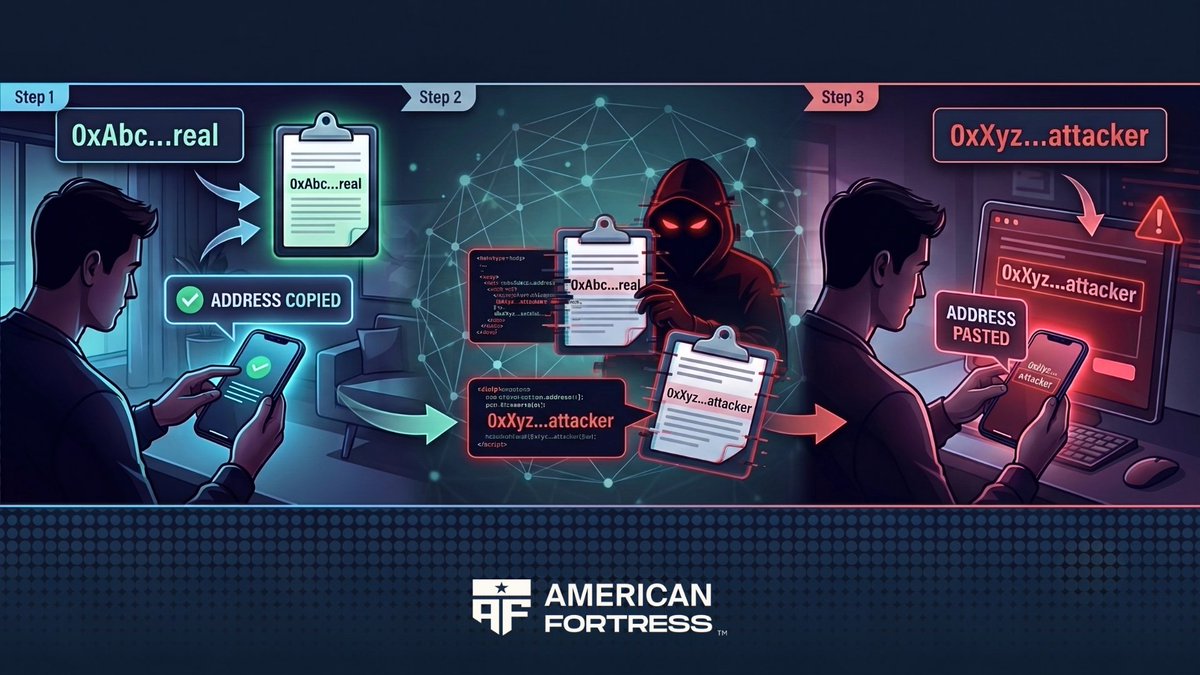
A new strain of malware is quietly rewriting crypto addresses on infected devices.
You copy a legitimate address. The malware swaps it for the attacker's before you paste. You confirm a transaction that looks right and isn't.
One recent campaign targeted 217 banking and crypto apps with this exact technique.
Before any transfer: verify the pasted address against a separate trusted source.
The clipboard is not a safe place to trust an address.
Analysts agree on the biggest weakness in the privacy coin sector: the off-ramps.
You can transact privately all you want.
The moment you convert to fiat, AML and KYC constraints expose everything at the exit.
Privacy that ends at the off-ramp was never complete privacy.
The real challenge isn't hiding transactions on-chain.
It's a privacy model that stays compliant all the way through the exit, so disclosure happens by choice, not by force at the worst possible moment.
"Decentralized" is doing a lot of heavy lifting in crypto right now.
How decentralized is decentralized enough?
DeFi platforms are facing pressure to add identity-attestation, which raises the obvious problem: if a protocol can verify identity, how decentralized is it really?
The answer isn't more centralization or less. It's identity that can be proven cryptographically without a central party holding the records.
Verification and decentralization aren't opposites. The infrastructure just hasn't caught up to that yet.