Earlier this year, I resigned from my w2 job. But it wasn't actually the job I was quitting. I quit the business model.
I'm leaving behind the old SBA model to build the future one.
It's been said time and time on The Art of SBA Lending podcast. "The model is broken."
📉 How many SBA departments have you seen downsize and outright close in the past 24 months? A lot.
🏦 Only 13% of banks and CUs are participating in the 7(a) program despite it being such an amazing product for both the institution and the small business owner.
🔸And while the industry has made some progress, the SBA process has not caught up to the expectations of our borrowers. In fact, the gap is widening.
I'm tired of talking about the issues year after year. I wanted to finally do something about it. And now we are.
And I'm reuniting with some old friends along the way.
This might have been the worst kept secret in the world, butttt...
I'm officially part of Lendesca — a first-of-its-kind SBA fintech.
Our mission is to modernize the SBA lending landscape by bringing new SBA lenders into the ecosystem and allowing them to leverage our infrastructure to provide SBA loans faster and easier than ever before.
15 years into my SBA career and I couldn’t be more fired up.
Here’s to Act II 🥂
🎬
Answering "when can we close?" is like a Choose Your Own Adventure book. I've heard:
"45–60 days"
"We move as fast as you do"
"It depends"
"We can't give you a close date"
None of those answers are necessarily untrue, but they ARE incomplete. Vague at best, they leave everyone in the transaction unsure if and when a closing will ever happen.
I've closed SBA loans in 30 days, and I've closed them in a year.
The timeline isn't always clear, but the steps are always the same.
The closing date is the sum of a dozen deadlines that most borrowers never see until one gets missed:
👉 The QoE
👉 The valuation
👉 The appraisal
👉 Lien searches
👉 The tax clearance letter
👉 The executed purchase agreement
…and more.
So I built a free tool to put all of it on the table.
The SBA Ray Closing Date Planner works backward from your target closing date and maps every deadline for the borrower, seller and lender:
→ Tells you right away if your date is unrealistic, and gives you the earliest realistic close
→ Rush Mode lays out what has to happen if you're up against the clock
→ Tracks every piece of due diligence: what's ordered, what's outstanding and when it's due
→ Filters tasks by who owns them, so everyone knows their part
Use it to hold your lender accountable, stay on top of every third party, and hold yourself accountable too.
After all, a deal only moves as fast as everyone in it.
"Does the buyer have industry experience?"
That's the question most lenders still lead with.
After this project, I think it's the wrong one.
Today, most people buying a small business have never worked in the industry they're buying into.
So I spent the last couple of months talking to people who see what actually happens after these deals close: the co-founder of a buyer accelerator, an accountant who's been inside the books on over 100 acquisitions, and one of the biggest SBA acquisition lenders in the country.
What I found: missing industry experience is rarely what makes an acquisition fail. But it's often why the real problem doesn't get caught in time.
The buyer misses something in diligence, takes the seller's word for it, and six months later it shows up as a cash crunch.
So the better question is: what gaps does this business create, and can this buyer fill them or cover them?
The world of buying and selling businesses has changed a lot over the last five years. Buyer experience can't be a check-the-box underwriting item anymore.
If you're a lender, or anyone who needs to assess whether a buyer has the chops to run a specific business, this video will help.
More small U.S. businesses are ailing. Firms offering merchant cash advances promise quick relief. The catch: effective finance costs as high as 2,000%. https://t.co/Se0VUPF5i0
In the earlier days of SBA lending, having direct industry experience in the business you were acquiring was expected. Today... it's rare.
Back in 2021, I got on here and found a community of M&A lenders, brokers and attorneys talking about buying small businesses. It was a great community. Lot's of solid folks.
But then came the gurus and the influencers, selling the dream of getting rich buying a business with OPM, and making it sound a lot easier than it is.
That movement changed who's buying businesses.
The buyer pool is more diverse than ever, and most first-time buyers have never worked in the industry they're buying into.
So lenders are left to judge whether a buyer's experience "transfers" or is "relevant"
But what does that actually mean?
Ask 10 lenders and you'll get 10 different answers.
Buyers get conflicting feedback.
Good buyers get turned away.
Poor buyer fits get through.
I wanted a better answer, so I went to the people who see what happens after the deal closes:
Chelsea Wood, co-founder of @Acquisition_Lab, who has watched over 400 of their members close on a business.
@patrickdichter , owner of Appletree, who's been inside the books on over 100 acquisitions and has bought four businesses himself, in an industry he didn't come from.
John Randall, Managing Director at Live Oak Bank, who helped build one of the largest SBA acquisition lending teams in the country.
The biggest thing I learned surprised me.
Missing industry experience is rarely what makes an acquisition fail. But it's often why the real problem wasn't caught in time.
Which means we've all been asking the wrong question.
It's not "Does the buyer have industry experience?"
It's "What gaps does this business create, and can this buyer fill them?"
I turned my research into this video.
I also created a white paper which is linked in the description.
The reason I made this video is because: not everyone should buy a business, and not every business is right for every buyer. Too many people are betting their life savings, a personal guarantee, and sometimes their house, that they'll figure it out after closing. I'd rather they figure it out before.
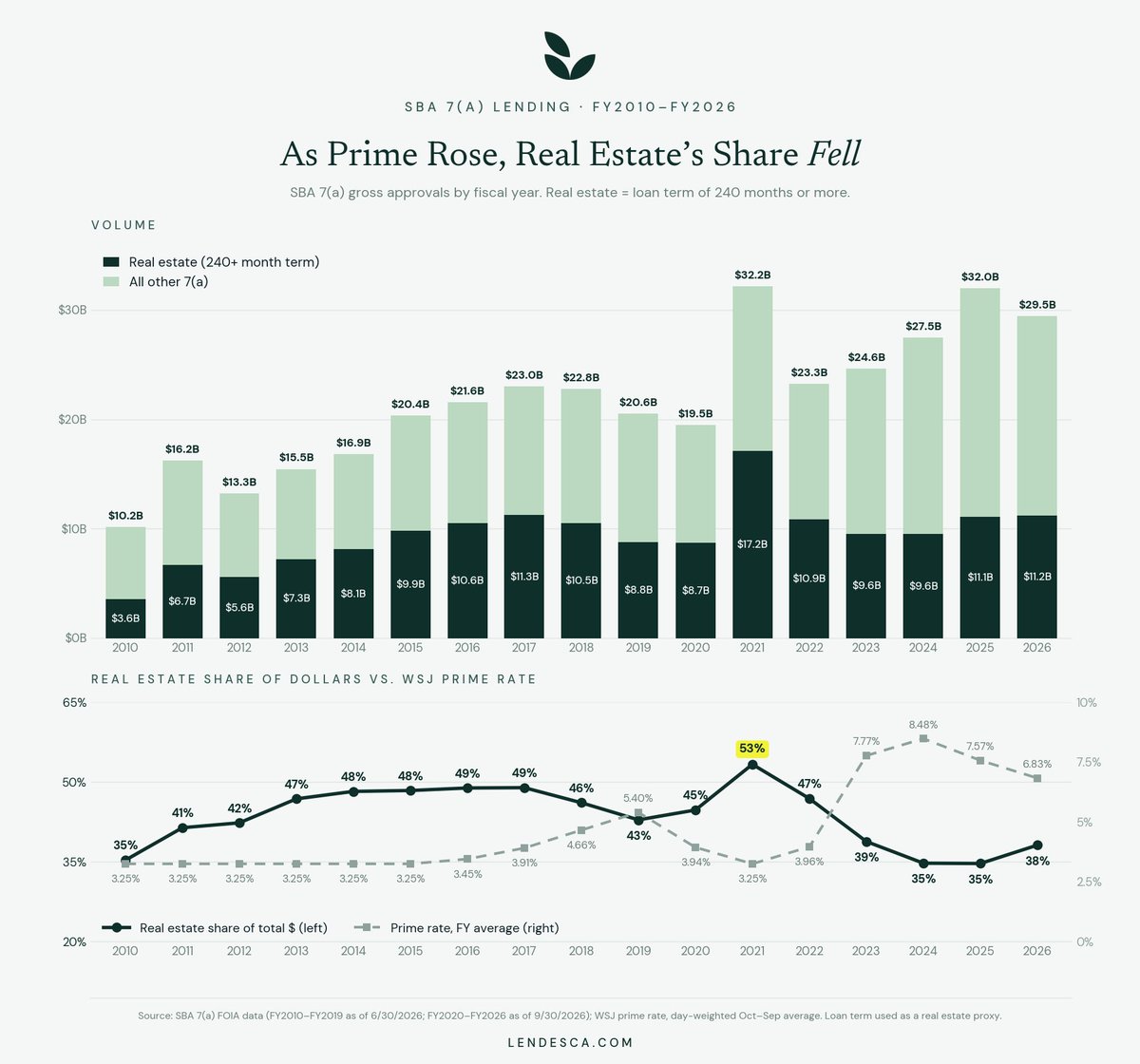
🔸 Prior to 2020, 7a lending was contracting. Something happened in recent years that has SBA lenders lending more aggressively toward non-real estate loans.
What are your thoughts on the overall trends in SBA lending?
🔸 The difference lately, has been the drastic increase in non-real estate lending which has driven overall 7a lending up since 2020 despite higher rates.
Why aren't more people talking about this new feature of SBA 7a loans?
If you own a business, you can borrower up to 100% financing to acquire another business as long as the first 4 digits of the NAICS codes match.
The rule used to be that it would have to be an exact match
Couple caveats:
- Your business needs to have positive equity
- You cannot include working capital in the loan
At @LendescaLLC, we take a more modern approach to SBA lending. If you're a small business owner looking for capital to grow your business - the DMs are open!
🔹 Supermarket operator (445110) buying a convenience store chain (445120)
🔹 Architecture firm (541310) buying an engineering (541330) or landscape architecture (541320) practice 🔹 Hotel operator (721110) buying a bed and breakfast (721191)
🔹 Hair salon (812112) buying a nail salon (812113) or barbershop (812111)
🔹 Landscaping company (561730) buying a janitorial (561720) or carpet cleaning (561740) business
🔹 Hardware store (444130) buying a paint and wallpaper store (444120)
So what does that mean in practice?
Here are some examples of strategic acquisitions that are eligible for up to 100% financing via an SBA 7(a) loan:
🔹 Auto repair shop (811111) buying a car wash (811192) or body shop (811121)