THIS IS BIG!
The Cancer Cells That Changed Their Minds
A KAIST team just reversed cancer without killing a single cell — and the method may matter more than the result.
For a century, oncology has had exactly one strategy: find the cancer and destroy it.
Chemotherapy poisons it. Radiation burns it. Surgery cuts it out. Immunotherapy teaches the body to hunt it. Every weapon differs in precision, but not in philosophy. The tumor is an enemy. You win by killing.
Now a team at South Korea's KAIST has proposed a heresy: *what if the tumor doesn't need to die?*
In a study led by Professor Kwang-Hyun Cho of the Department of Bio and Brain Engineering, published in Advanced Science ("Control of Cellular Differentiation Trajectories for Cancer Reversion," DOI 10.1002/advs.202402132), researchers took colon cancer cells and — without poisoning, irradiating, or cutting them — turned them back into normal cells.
Not dead. Not damaged. Just normal again.
The tumors, grown in mice, shrank dramatically. The surrounding tissue was left intact, because there was never an attack to survive.
This is early research — cell lines and animal models, no human trials, real obstacles still unsolved. But the conceptual break is the story. For the first time, cancer treatment has a second verb. Not just destroy. Also: convert.
The digital twin of a cell
The KAIST team's insight begins with a redefinition of what cancer is.
The conventional view treats cancer as a pile of broken machinery: mutations accumulate, checkpoints fail, cells proliferate. Cho's group looked at the same evidence and saw something different — a trajectory. During oncogenesis, they observed, normal cells don't just break. They regress, sliding backward along the differentiation path they followed when they matured. A colon cell becomes, in effect, a confused stem cell: immature, proliferative, lost.
If cancer is a wrong turn on a developmental road, then the treatment question changes. You don't blow up the road. You build a map and find the turn.
That map is what the team calls a digital twin — a complete computational model of the gene network governing a cell's differentiation. Using data from 4,252 intestinal cells, they reconstructed a network of 522 interacting components, capturing how genes regulate one another as a cell matures or degrades.
Then they did the audacious thing: they asked the simulation which levers, flipped together, would push a cancer cell back down the road toward normalcy.
The answer came through a system they built called BENEIN (Boolean Network Inference and Control), which models gene interactions as logical relationships and systematically tests which interventions redirect the network's state. The simulation pointed to three master regulators — the genes MYB, HDAC2, and FOXA2 — acting together as the switch that holds the cancerous state in place.
Turn all three off simultaneously, the model predicted, and the cell would stop proliferating and differentiate into something resembling a normal intestinal cell.
They tested it, and it worked.
In three colon cancer cell lines, suppressing MYB, HDAC2, and FOXA2 together strongly induced differentiation into normal-like cells. The cancer cells began expressing markers of healthy intestinal tissue. Proliferation collapsed — not because the cells died, but because they grew up.
In animal models, tumors formed from the reprogrammed cells were dramatically smaller than controls, and under the microscope they looked far more like normal tissue. The signature achievement, and the one that would matter most to any patient reading this: there was no collateral damage. Nothing was poisoned, burned, or irradiated. The healthy tissue never came under fire, because there was no fire.
1 of 2
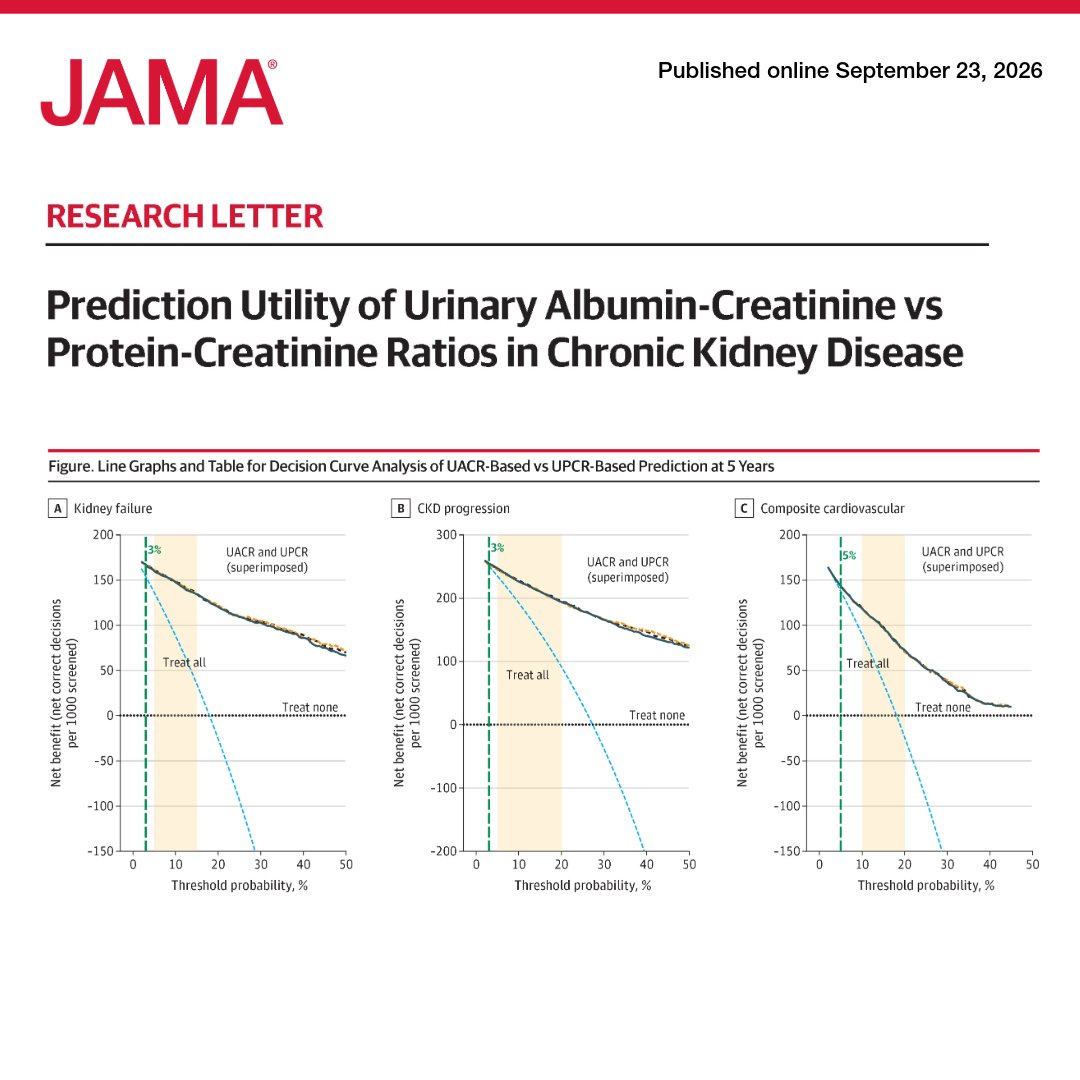
In #ChronicKidneyDisease, the urinary albumin creatinine ratio and urinary protein creatinine ratio provided clinically similar risk prediction for kidney and cardiovascular outcomes in a large cohort with established disease.
Although the urinary albumin-creatinine ratio was more strongly associated with kidney failure statistically, it did not provide meaningfully better discrimination, reclassification, or decision support than the urinary protein-creatinine ratio.
https://t.co/LTLb4fBRZP
The benefits of coffee include lowering the risk of atrial fibrillation, Type 2 diabetes, and lowering blood pressure (J-curve, see summary below)
A summary of the data and statement from @American_Heart https://t.co/m20TCPa2S5
At least 10% of the population has a significantly elevated Lp(a) above 50 mg/dL (~125 nmol/L), which carries an increased risk of atherosclerotic cardiovascular disease. While we've known that for decades, we've never had a drug to treat it.
There are 5 programs in advanced trials (Table below, 3 in phase 3, pivotal, CV outcomes as endpoint). We may see the results for the first drug (pelacarsen) soon, by end August, and FDA approval is expected in 2027. This likely represents a major advance for preventing heart disease, adding to the first oral PCSK9 blocker approved this week.
In today's @TheLancet there are 3 papers on cardiometabolic disease: biology, epidemiology, prevention/treatment.
The sobering and all to common story from womb to tomb conveyed in this graphic
https://t.co/rVs2Yz97NC
https://t.co/OpuJTia0bC
https://t.co/i714onXoCG
Finerenone for CKD Due to Glomerular Diseases https://t.co/nDNlZwDOgw
Great news ! Another proven highly effective therapy for non- diabetic kidney disease
Supplementation with Vitamin D or calcium, or both does not help prevent fractures or falls. From a new systematic review of 69 randomized trials and >150,000 participants
🫁One of the most underappreciated complications of mechanical ventilation may not be inside the lung.
It may be inside the kidney.
This excellent review revisits a question many intensivists intuitively suspect at the bedside:
📌 can PEEP itself contribute to acute kidney injury?
The article moves beyond the simplistic “high vs low PEEP” debate and reframes the problem through physiology.
Not every kidney injury associated with ventilation is simply “shock related.”
The review proposes that:
🫁 lung recruitability
🫀 right ventricular loading
🩸 venous congestion
🧠 neurohormonal activation
🫁 transpulmonary pressure transmission
🩺 abdominal venous stasis
may all interact dynamically during mechanical ventilation.
One particularly important concept:
PEEP may impair renal function not only through reduced cardiac output, but also through venous congestion.
That changes the way we think about ventilator associated AKI.
The review highlights two distinct physiological scenarios:
1️⃣ Highly recruitable lungs
Higher PEEP increases lung volume and pleural pressure, potentially compressing the vena cava and impairing venous return.
2️⃣ Poorly recruitable lungs
Higher PEEP produces overdistension, elevated pulmonary vascular resistance, RV stress, and systemic venous congestion.
Different lungs.
Different mechanisms.
Potentially similar renal consequences.
Another major strength of this paper is the integration of:
• VExUS physiology
• renal venous Doppler
• abdominal congestion
• cardiorenal interactions
• Guytonian hemodynamics
• pulmonary vascular physiology
The figures are particularly educational for ICU clinicians trying to understand how intrathoracic pressure may propagate into systemic venous circulation and renal perfusion.
Importantly, the review does not conclude that “high PEEP is bad.”
Instead, it argues something much more nuanced:
📌 inappropriate PEEP for the individual lung may be harmful.
That distinction matters enormously.
The future probably lies in truly personalized PEEP:
🫁 recruitability based
🫀 RV aware
🩺 congestion monitored
🧠 physiology driven
rather than protocolized fixed tables alone.
For intensivists, this review is also a reminder that: oxygenation improvement does not automatically mean systemic benefit.
Sometimes the kidney is paying the hidden price for a “better” PaO₂.
📖 Benites et al. Critical Care (2025) 29:130 https://t.co/6XP5hYp45T
Explore this gift article from The New York Times. You can read it for free without a subscription. https://t.co/G4xRcYj9hW
.... This really resonates with an IT migrant like me ...
Onconephrology focuses on management of kidney disease in cancer, which manifests itself in a variety of clinical syndromes, including AKI, CKD, hypertension, proteinuria, and electrolyte disorders
#Nephpearls#Onconephrology 🦀
👉🏼 https://t.co/h85eQul8Br
Wira Transplant Walk: From dialysis to the summit, patients set sights on Mt Kinabalu climb to spotlight organ donation awareness (VIDEO) https://t.co/9agl87FxgQ