To find new ways to treat cancer, we first need to know what cancer cannot live without. A remarkable open resource for discovering cancer vulnerabilities and new drug targets. @Nature
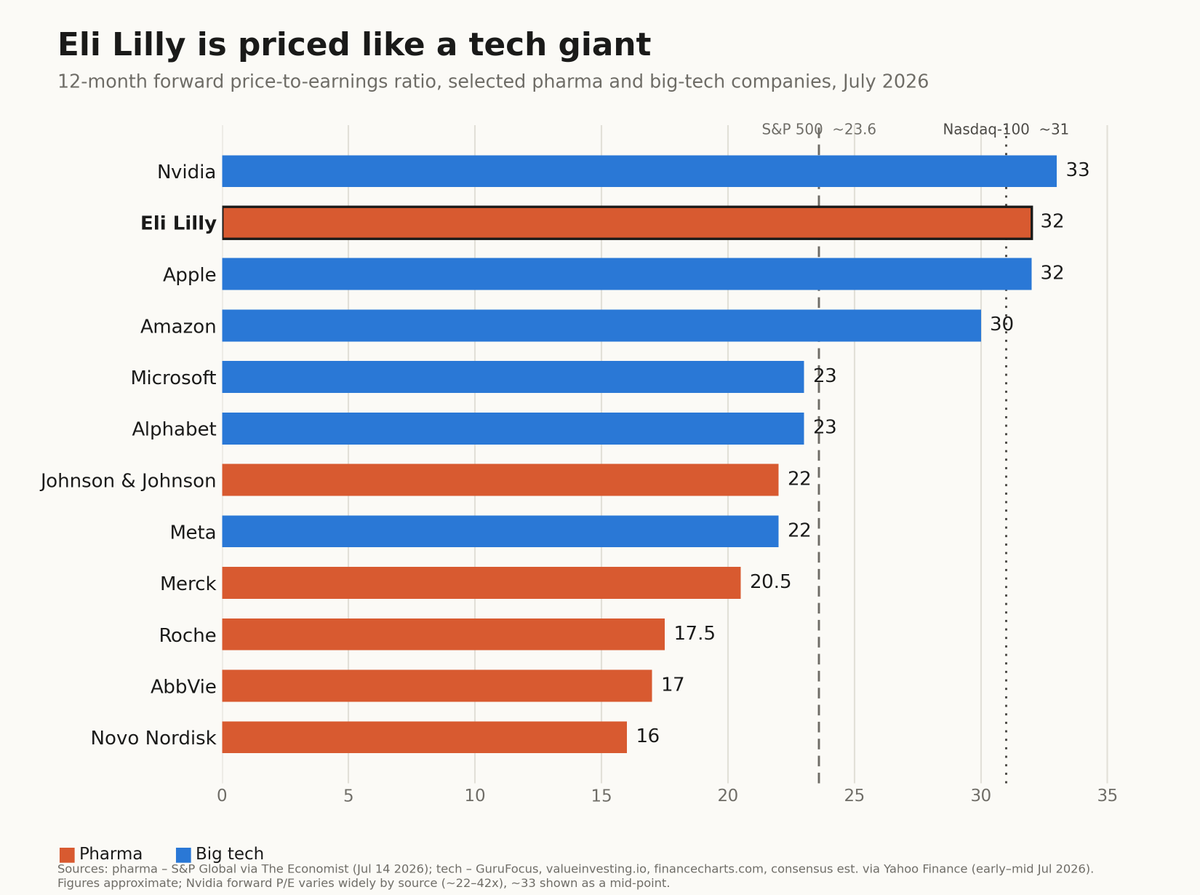
There is one caveat to highlight that the pharma and tech figures come from different sources on different dates. We should read this as directional with an understanding that it is not a strict apples to apples comparison; but a close one.
Earlier today, I was reading a piece on Economist around how Eli Lilly is reinventing the pharma business. The article has an interesting piece of information around price-to- earnings ratio of a few pharma companies. https://t.co/AJURK8GkgV
The striking piece of data is that Eli Lilly is priced like Apple or Nvidia and at roughly double its closest obesity-drug rival: Novo Nordisk. To me, this is an extraordinary place for a pharmaceutical company to sit.
I found the concept simple, yet real and powerful, and I'm still reading through the research, but I wanted to share it with you right away.
https://t.co/6cqS1aVRlO
I really like the concept of "The Last 8% culture" defined by the Institute for Health and Human Potential.
In simple terms, they found that people tend to leave out about 8% of what they want to say during difficult conversations.
If it persists in an organization, it erodes trust, engagement drops, decisions slow down, and risk tolerance shrinks. And, as you can imagine, if you are able to move to the last 8% culture quadrant, you drive innovation, collaboration, speed, and performance.