For the past four years, hundreds of thousand American truckers, many of them involved in the industry for decades, have suffered from the worst economic crisis in history.
There have been tens of thousands motor carriers, often small single truck operators, that have filed for bankruptcy or become insolvent due to the flooding of new entrants into the industry.
They have children and mortgages as well.
It is tone deaf when you only talk about non-compliant immigrants that lost their CDL, but fail to mention the devastation of hard working American families that have suffered from the industry becoming flooded with drivers that cheated the system to get a CDL.
“Nobody is passionate about supply chain optimization.”
Here are some of my friends from Grad school now.
-Director of Logistics
-Director of Transportation
-Chief Supply Chain Officer
-Vice President of Supply Chain
We are just nobodies I guess.
I spent 4 hours yesterday updating my resume to apply for a mid-level PM role.
The listing said they wanted someone with 10 years of experience in a software that was invented 4 years ago.
I clicked apply and was immediately redirected to a third-party portal that asked me to upload my resume, which I did.
Then it asked me to manually type in every single detail of the resume I had just uploaded.
Why did I upload it if I have to type it again?
Is the uploaded PDF just a ceremonial offering to the HR gods?
I spent 40 minutes breaking down my career history into tiny mandatory text boxes.
The portal required me to list a start and end date for every job, but the calendar widget wouldn't let me type the year.
I had to click the back arrow month by month to get to 2002.
My wrist started cramping somewhere around 2018.
Then it asked for my high school GPA.
I'm 44 years old.
I don't even remember the name of my high school mascot, let alone my proficiency in AP European History.
After the history lesson, came the behavioral assessment.
It presented me with 75 statements and asked me to rate them from "strongly disagree" to "strongly agree."
One statement was "I prefer to work alone but also thrive in team environments."
That is a paradox.
I'm being asked to evaluate a philosophical contradiction by a recruiting algorithm.
I just clicked "neutral" for everything out of spite.
The final step was a mandatory video cover letter.
I had to record a one-minute pitch explaining why my core values align with a B2B SaaS company that sells inventory management software.
My core value is being able to afford groceries and paying my internet bill on time.
I put on a dress shirt over my sweatpants, stared into my webcam, and lied for 60 seconds.
I said I've always been profoundly passionate about supply chain optimization.
Nobody is passionate about supply chain optimization.
I clicked submit and immediately received an automated rejection email.
The timestamp said it was sent zero seconds after I applied.
I was evaluated and deemed unworthy by a line of code at the speed of light.
Next time I'm just going to wrap my resume around a brick and throw it through their office window.
We are about to see a freight market in which 27,000 freight brokerages are competing for 78,000 of the 'safest' carriers.
Only 22% of active for-hire FTL carriers have OOS scores below the national average, ISS scores in the 'low risk' zone, and all BASIC % scores below the median.
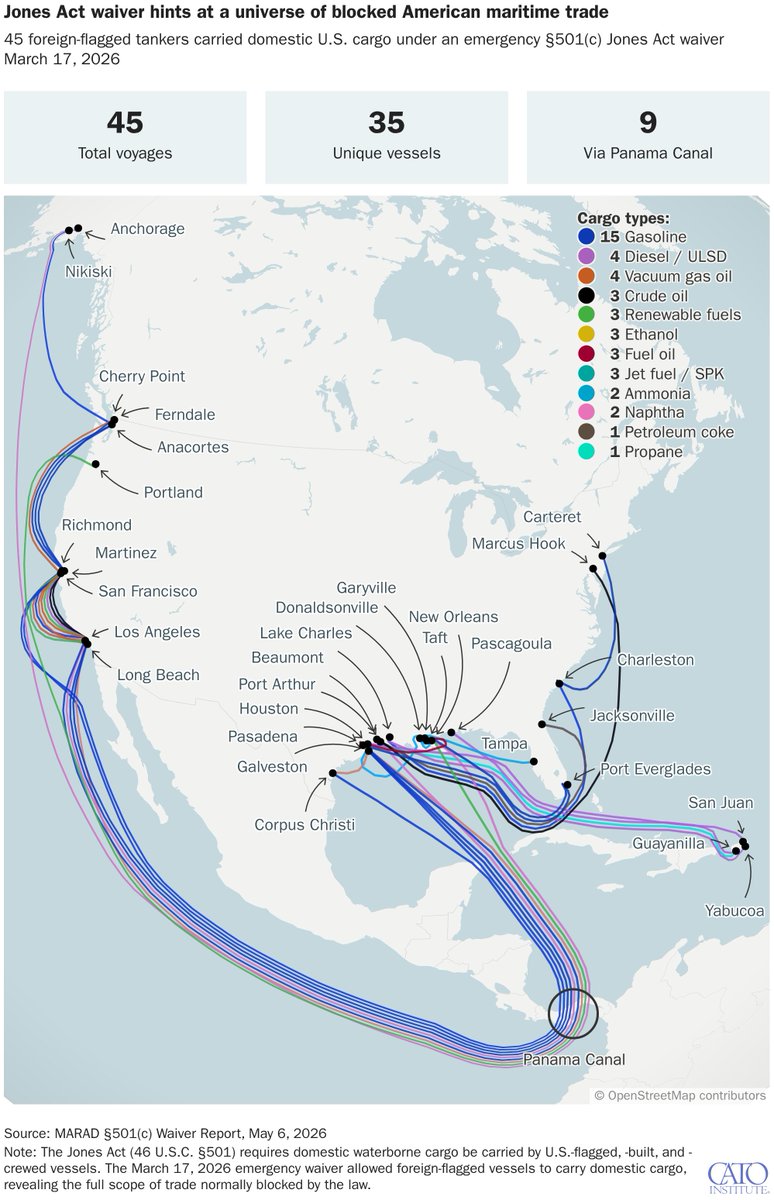
Look at all the 🇺🇸 trade that's now happening without the Jones Act in effect.
And the Jones Act fleet is still fully booked. This is all extra shipping, from Americans to Americans, that's happening just because government got out of the way.
This is the correct assessment.
Brokers aren’t going to go away.
They just aren’t immune from the consequences of their decisions.
If they act in a reasonable and proper manner to hire compliant carriers there is no issue.
Carriers directly operate the equipment and employ drivers. Brokers do not.
So plaintiffs still have to establish:
negligent selection,
failure of REASONABLE vetting,
ignoring red flags,
or some breakdown in process.
This is NOT automatic pass-through liability.
That distinction matters enormously.
🚨 7,757 Lives Lost: FedEx Express, UPS, J.B. Hunt Lead Fatal Truck Crashes
We just analyzed 258,631 commercial vehicle crashes based on current FMCSA crash data spanning the last 24 months:
- 6,850 fatal crashes (2.65% of total crashes)
- 7,757 lives lost
- 5,546 distinct carriers had a single fatal crash
The industry giants dominate fatal crash stats.
Top 10 Carriers by Fatal Crashes (FMCSA Data):
FedEx Express (MC66562) - 76 fatal crashes
UPS (MC115495) - 48
J.B. Hunt (MC135797) - 45
Walmart Transportation (MC311233) - 35
Swift Transportation (MC136818) - 28
FedEx Freight (MC121805) - 22
Old Dominion (MC107478) - 21
Prime Inc. (MC140665) - 19
R+L Carriers (MC99074) - 18
Tyson Foods (MC145655) - 16
Top 10 alone represent 328 fatal crashes (nearly 5% of ALL fatal incidents).
The data shows carriers with the largests fleets have the biggest absolute exposure.
Safety isn't optional when lives are on the line.
We've been involved in many "negligent selection" lawsuits filed against some of our broker customers that hired carriers involved in fatal accidents. They've always been mega brokers.
CHR used to be one of my biggest brokers and freight forwarders.
They have been on a downward trajectory for years. Replacing skilled individuals with mindless drones.
We no longer have a relationship with their US operations.
STATEMENT ON FREIGHT SAFETY AND MISLEADING MEDIA COVERAGE:
Our deepest sympathies go out to all the families affected by roadway tragedies. Safety matters deeply to us and is foundational to how we operate and the decisions we make every day.
This trucking company reported 9,545,354 miles last year. They also report having 9 trucks.
That's 1,060,595 miles per truck.
At 1,060,595 miles, each truck would need to average:
> 2,906 miles per day
> 121 mph for 24 hours straight
> 365 days per year
The math ain't mathin'
My valued carrier base who canceled contracted rates whenever spot was significantly above contract in 2020…..
Freight is cyclical. Carriers do X when they have power. Shippers do Y when the tables turn.
There is nothing new here….
A panel of shippers was just asked, "How have you supported your valued carrier base over the last three years as operational costs rose but rates didn't follow?"