Preorder is now live for Reformation, Not Revolution: Why God’s Law Matters for Society by David A. Forsythe.
Releasing June 23, this new Ezra Press title calls Christians to reject retreat, resist revolutionary politics, and recover a biblical vision for cultural reformation under Christ.
Preorder here: https://t.co/8tiZvtLXWO
Canada is in a recession.
Mark Carney, the self-styled “great economist,” took office 14 months ago.
He increased the industrial carbon tax, maintained anti-development laws, and doubled Justin Trudeau’s deficit.
This is the consequence.
Companies say they're cutting back on temporary foreign workers.
What they're lobbying for behind closed doors? Different story entirely.
Canadian families pay the taxes — they should get first crack at the jobs.
https://t.co/3GwFzgbQID
These are not minor tweaks or unfortunate timing. They reflect a worldview that trusts government direction, spending programs, and “transformation” agendas more than it trusts letting Canadians and businesses keep more of what they earn and build. @MarkJCarney 's agenda and "values" are “right out of the socialist playbook", and they never work, never. When @PierrePoilievre states the plain fact that Canada is the only G7 country in this position despite shared tariff headwinds, some in the media treat it as scandalous partisanship rather than legitimate opposition scrutiny. This is not neutral analysis. It is protective circling around a political figure whose brand was supposed to deliver competence. The cognitive dissonance is glaring. Carney was sold (and sold himself) as the adult in the room, the economist who understood markets and global finance. When the economy contracts on his watch after 10 years of weak per-capita performance, the same voices that once praised his gravitas now demand we ignore the data or blame everything on external forces and the previous prime minister. Carney has been in office long enough for his policies (an extension of Trudeau's) to matter. Pretending otherwise requires impressive mental gymnastics. Canada does not need more lectures about “sacrifices” for grand transformations or the defending of policies that correlate 100% with declining investment and contraction. It needs the opposite: aggressive deregulation, fiscal restraint, faster project approvals, and an environment where businesses want to invest here rather than elsewhere. In other words, free markets! Until that shift happens, expect more of the same disappointing results and managed decline of our economy. The recession is real. The policy failures are obvious. The refusal to confront them is the real scandal. Statistics Canada confirmed on May 29, 2026, that real GDP contracted 0.1% annualized in Q1 2026, following a revised 1.0% drop in Q4. Two consecutive quarters of contraction meet the textbook definition of a recession. Business capital investment has now fallen for five straight quarters. Unemployment has climbed toward 6.9%, with job losses mounting. Food bank usage and mortgage delinquencies are rising. These are not abstract statistics, they are the lived reality for Canadians. Pierre Poilievre correctly called it out.
A doctor met a guy at a coffee shop, assessed him for MAID, then drove him to the spot where he'd be put down. Horrors beyond comprehension happening just to our north. There's a much better moral argument for invading Canada and deposing its regime than invading or bombing any country 10 thousand miles away. Industrial scale eugenics and mass murder happening right next door.
(1/2) All G7, Five Eye partners and most EU countries have lawful access frameworks that include technical obligations for electronic service providers.
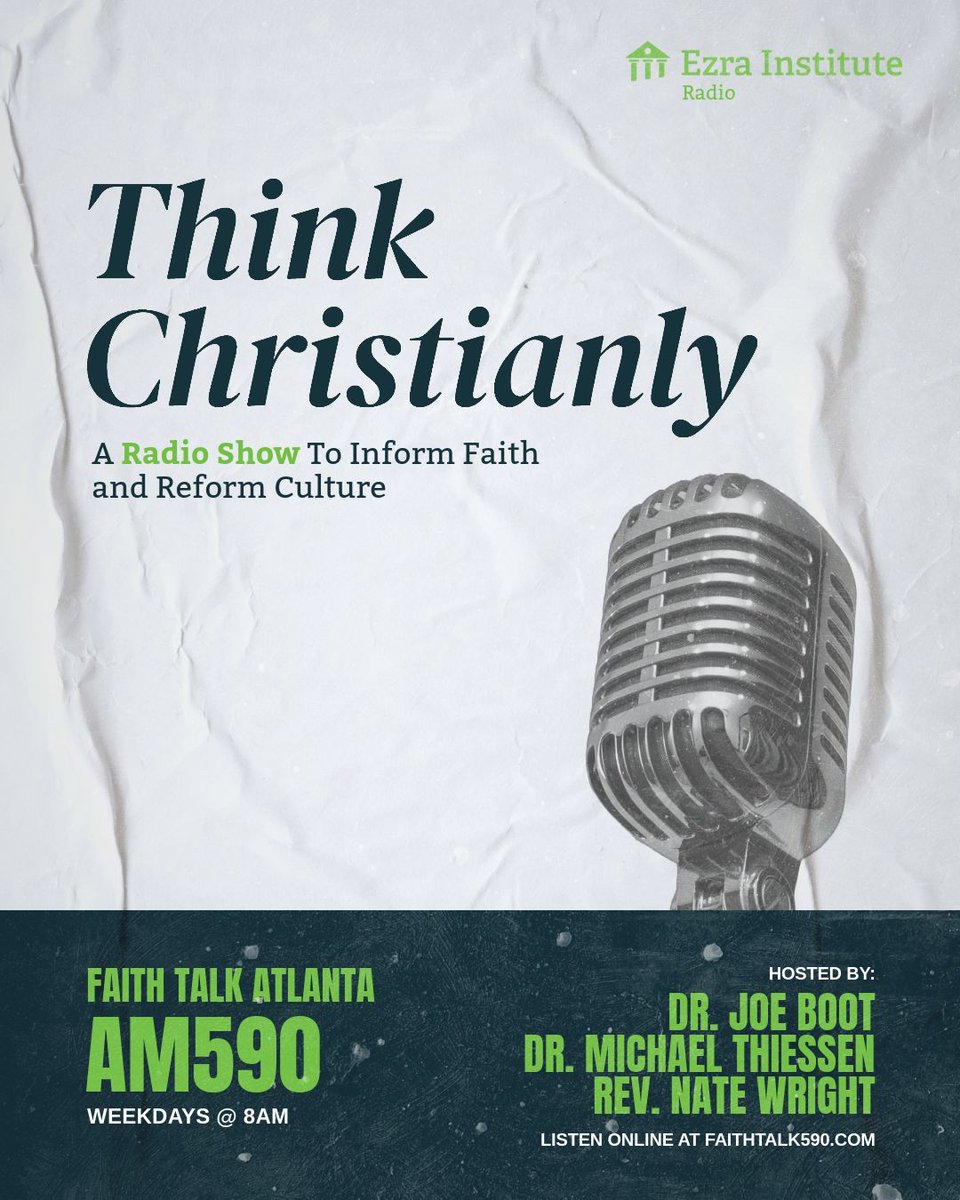
Have you tuned in yet?
Think Christianly is now airing every weekday from 8:00–8:30 AM ET on FaithTalk 590.
You don’t have to be in Atlanta to listen. Tune in live at https://t.co/kQmx246Rrr.
Start your morning with 30 minutes of biblical worldview teaching that sets your mind on Christ for the day.
Here’s a simple way to get unstuck when you’re worried, overwhelmed, or overthinking a decision.
Ask yourself one question:
What kind of thing am I dealing with?
Most issues fall into one of three categories.
1. Settled Things
These are things that have already been decided.
Your birth family.
Your nation of origin.
Your height.
Your past decisions.
Your upbringing.
Things you did.
Things done to you.
Some of these things were decided by your own past actions. Others were decided by God’s providence. As Paul says in Acts 17:26, God determined our appointed times and the boundaries of our dwelling place.
You can’t go back and change these things.
So the question is not, “How do I undo this?”
The question is, “Does this have any bearing on what I should do now?”
If not, leave it alone. Don’t spend your life fighting settled things.
2. Action Things
These are things you have some real control over.
Your diet.
Your exercise.
Your spending.
Your work ethic.
Your attitude.
Your friendships.
Your theological knowledge.
Your presentability.
Your habits.
Your skills.
These are your controllables.
You may not control everything about your health, finances, relationships, or future. But you usually control more than you think.
So if the issue falls here, don’t overthink it.
Take direct action.
Start small if you have to. Make the call. Go on the walk. Open the Bible. Apologize. Apply for the job. Pay the bill. Clean the room. Do the next faithful thing.
3. Prayer Things
These are things outside your direct control, but not outside God’s control.
The economy.
The weather.
The housing market.
The availability of a suitable spouse.
Other people’s choices.
Timing.
Open doors.
Closed doors.
You can’t force these things. You can’t grab the steering wheel of providence.
But God can act.
So you take indirect action through prayer. You ask. You wait. You prepare. You remain faithful. You do what you can do and trust God with what only He can do.
So ask yourself:
Is this settled?
Then accept it and learn from it.
Is this actionable?
Then do something.
Is this outside my control?
Then pray and trust God.
This is a simple framework, and yes, it’s a little reductionistic. But that’s the point. The goal is not to explain every complexity of life. The goal is to get you unstuck.
Most people waste too much energy trying to change the past, control what belongs to God, or pray about things they simply need to obey.
So categorize the issue.
Then act accordingly.
Accept what is settled.
Act on what is yours.
Pray over what belongs to God.