Agentic search is AI that retrieves, evaluates, and acts on information on behalf of users.
A search engine retrieves what you ask for.
A chatbot generates an answer.
An agent breaks your goal into steps, uses external tools and live websites, and adapts when something changes.
It researches, compares, and increasingly takes action – booking, purchasing, planning.
What changes for brands is where the evaluation happens:
Traditional search → a person visits your site and makes a judgment
AI search → the AI composes an answer that may or may not include you
Agentic search → the AI researches you across multiple sources, compares you, and may take action – before a human is involved
As agents take on more complex tasks, they test whether they can:
• find you
• understand you correctly
• validate you through independent sources
• trust you enough to act
See how it works ↓
https://t.co/epABKo3NLF.
SEO question, then vs now:
Old → How do we rank higher?
New → How do we become a trusted source everywhere AI looks?
Rankings still matter. But AI answers pull from citations, mentions, and repeated signals far beyond your site.
Example: LinkedIn already drives ~11% of AI citations, more than many major publishers.
https://t.co/y7H14dpl3n.
Imagine asking @perplexity_ai “What keywords are my competitors ranking for?” and getting a real, data-backed answer instantly.
No technical setup, no manual exports.
That’s what happens when you connect Semrush MCP directly to Perplexity.
Just connect, ask, and get answers you can trust.
Try it ↓
https://t.co/8JAmtzOV0C
Appearing in AI-generated answers is unquestionably important for modern brand visibility.
That said, showing up in traditional search engine results is still a powerful way to connect with your audience and drive business results.
We broke down what drives search visibility – and how to improve it in both search engines and AI tools: https://t.co/QP3IG3LIPV.
@aeljaouari This is the part most teams underestimate. AI citation is downstream of content decay and governance, not just optimisation. If accuracy isn’t maintained at scale, visibility erodes fast.
@NianyaXie Well said. Rankings remain important, but brand presence across AI answers, search, and other discovery channels is becoming a key part of the equation.
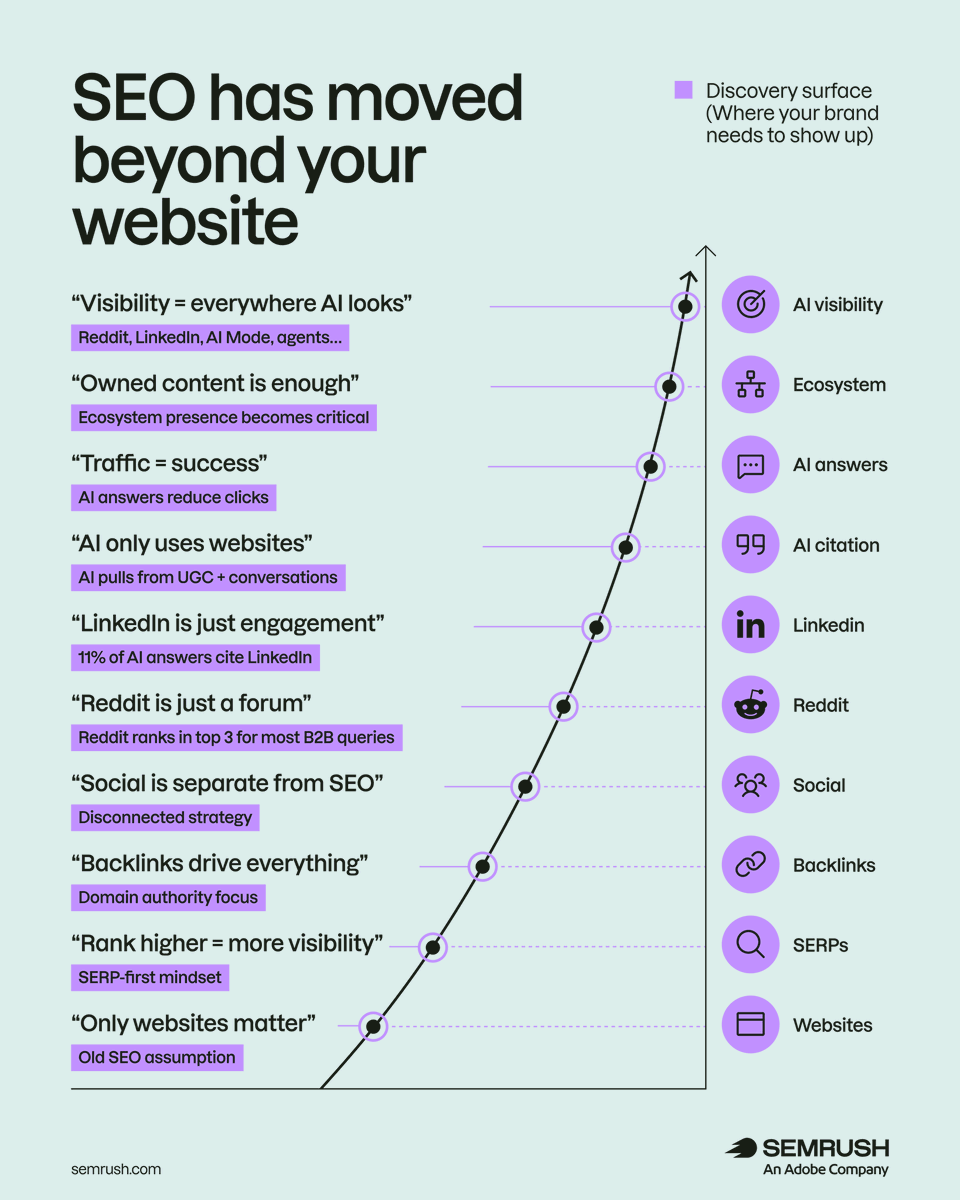
SEO used to be about pages, rankings, and backlinks. That foundation still matters, but it’s no longer the whole truth 🤓
Now it’s:
• UGC
• Communities
• LinkedIn
• Reddit
• AI search modes
• Autonomous agents
Here's how it's moved from website to a full-on ecosystem👇
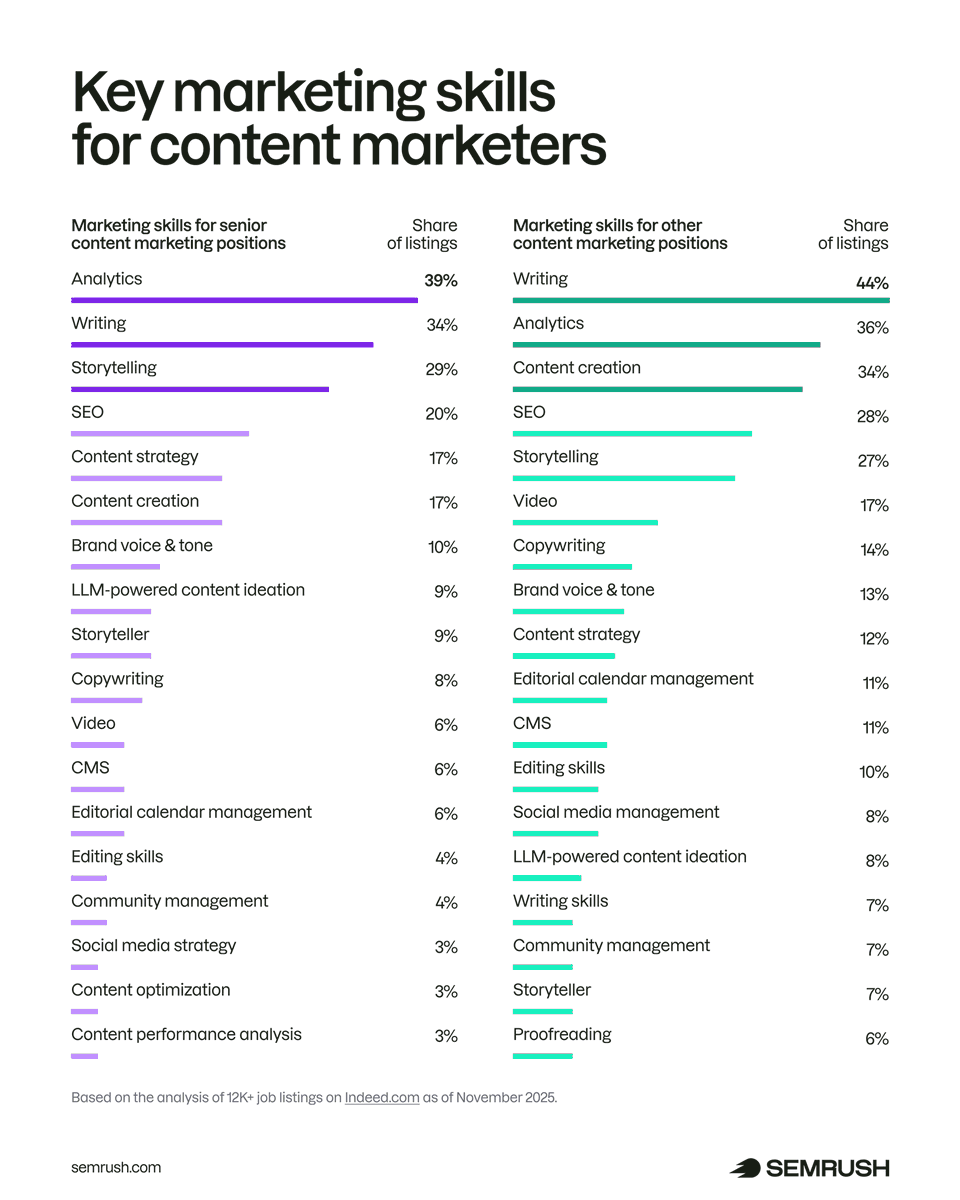
According to our study, data literacy and narrative skills are now core to high-performing content marketers.
• Analytics ranks #1 for senior roles (~40%)
• Storytelling is now a top-three skill (29%)
• Content creation is increasingly replacing pure writing (+209%)
• SEO is a baseline skill across roles
The role has evolved: create, distribute, and demonstrate impact.
Full data: https://t.co/bYcHYijmXX.
This study specifically analyzed ChatGPT usage and referral traffic, so we can't draw the same conclusions for Claude from this dataset alone. However, the broader shift toward conversational, intent-rich queries isn't unique to ChatGPT and is something we're seeing across AI search more generally.
ChatGPT is now a standard part of how people use the web, as one piece of a complex, interconnected search journey.
We dug into 17 months of clickstream data to map how ChatGPT usage is changing, how referral traffic is growing, and where that traffic goes.
If you're a marketer, understanding how your audience uses ChatGPT and where it exists in this buyer journey is critical for understanding how best to reach them.
Key takeaways:
• Outbound referral traffic from ChatGPT to the rest of the web grew 206% in 2025.
• Over 30% of all referral traffic from ChatGPT goes to 10 domains. And over 20% goes to Google.
• ChatGPT enables its search feature on just 34.5% of queries as of February 2026 – down from 46% in late 2024 – meaning most responses still rely on training data alone.
• Users are asking more prompts per session. After 12 months of flat engagement, average queries per session jumped 50% in the last four months of our study period.
Full study: https://t.co/o0ahjxcX5J.
Google announced a new AI performance insights report in Merchant Center that will give ecommerce brands their first native look at how they appear across AI-powered shopping experiences – including AI Mode, AI Overviews, and the Gemini app.
The new report includes four core data views:
• Share of voice
• Shopping funnel performance
• Product term insights
• Product attributes insights
This is the first time Google is offering native reporting on AI search visibility for ecommerce, signaling that AI performance is becoming its own measurement category. With Bing already rolling out similar reporting earlier this year, Google’s move confirms this is quickly becoming a standard layer in search analytics.
Full breakdown: https://t.co/sFkUZJ65Kk.
10 Best PR Tools for Outreach, Distribution & Monitoring
1. Semrush AI PR Toolkit
2. Muck Rack
3. PitchFriendly
4. Anewstip
5. GlobeNewswire
6. Cision
7. Business Wire
8. Media Monitoring
9. BuzzSumo
10. Pulse
We tested them personally, here's what we learned: https://t.co/vMB5vDwrxu.
We’ve evolved our approach to LLM visibility.
Since publishing our original framework, we expanded our prompt set from 39 to 726 queries, weighted toward commercial and buying-intent searches, and reset our baseline to create a more rigorous benchmark.
The result: Share of Voice increased from 15% to 25%, while visibility for SEO-related prompts rose from 49% to 55%.
What changed?
→ We shifted from optimizing for exact prompts to covering full topic intent
→ We reduced our reliance on Reddit-focused tactics in favor of broader SEO-aligned strategies
→ We started prioritizing off-domain accuracy by improving information on highly cited third-party pages
→ We’re actively testing platforms like LinkedIn and Medium as additional visibility channels
LLM visibility is proving to be an extension of SEO. The same fundamentals – authority, clear structure, relevant content – decide whether you show up, whether a person or a machine is doing the looking.
https://t.co/69OIgsWbY4.
Most SEO professionals that use AI content (72%) say they think AI-assisted content performs just as well or better than human-written content in search rankings – that’s up from 64% in our 2024 study.
But it’s not one-sided:
📈 13% now say it performs worse (vs. 9% last year)
📉 “Not sure / haven’t compared” dropped from 27% to 15%
This shows how opinions are moving in both directions. After having some time to experiment and use AI in their workflows, more teams now have a definitive opinion on how they think AI content performs.
https://t.co/DZBpUgJvNJ.