We are pleased to welcome @RepGinaCurry to the Women's Health Caucus leadership! 🎉
As a new Co-Chair of the WHC, Rep. Curry is committed to addressing issues facing Pennsylvanians like maternity care deserts and systemic inequities in the health care system.
@HIRH That's the median pay for child care workers in PA -- many of whom have degrees (and debt) with few other benefits. No wonder there aren't enough child care slots.
You can watch an excellent press conference on the need for PA state investments in early care & education teaching staff. Without it, the child care sector is "on life support." #fixchildcare https://t.co/btSFBuJ0uC
.@SenJudySchwank - co-chair of the Early Childhood Education Caucus - speaks about the need to fund early childhood education.
It’s critical that every child has access to the high quality education all Pennsylvanians deserve.
@katibrillhart Good girl! We also waited patiently. Finally, a short Q&A that begged more questioning...pretty much the same as yesterday. One particular solution helps many, but will not float all boats.
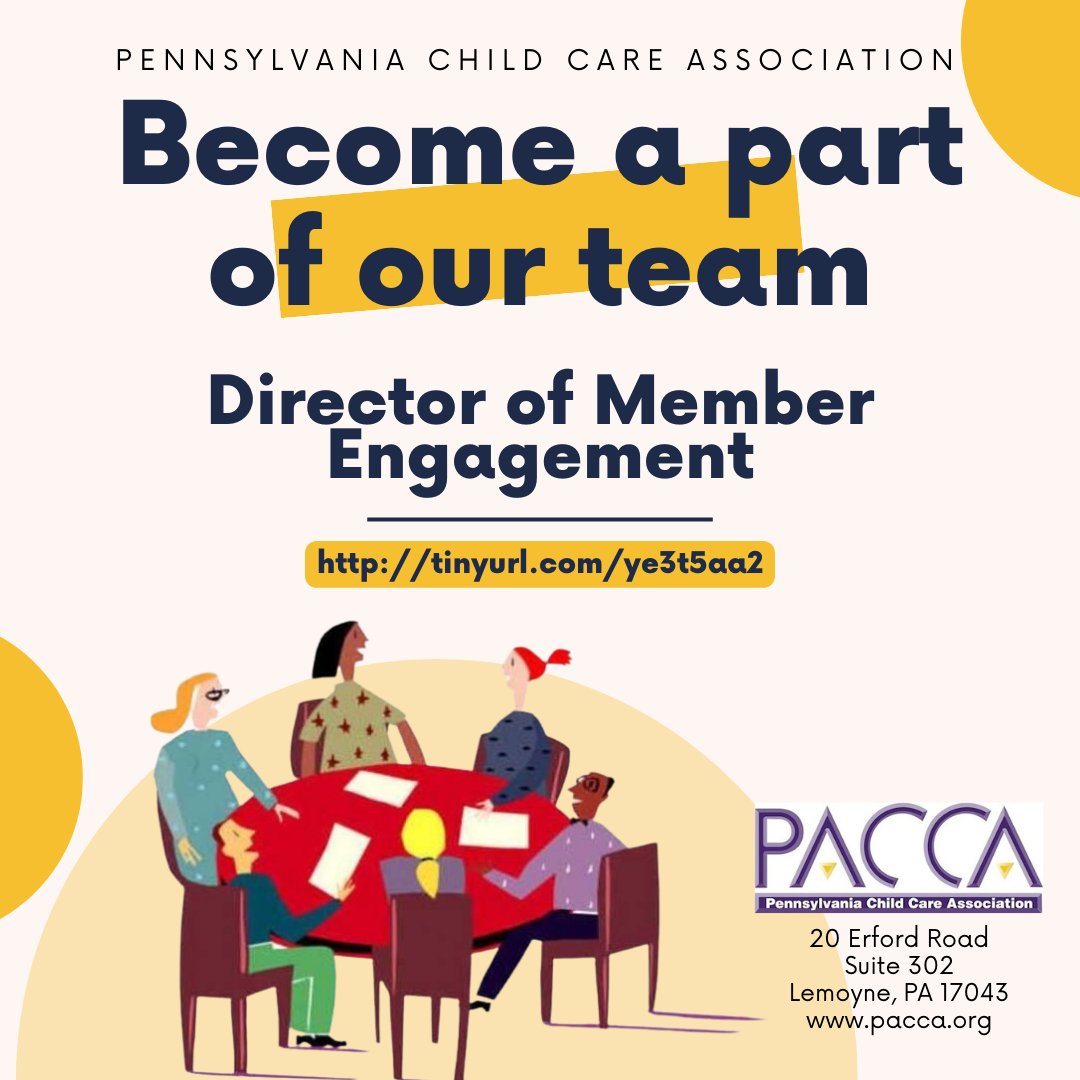
𝐂𝐀𝐑𝐄𝐄𝐑 𝐎𝐏𝐏𝐎𝐑𝐓𝐔𝐍𝐈𝐓𝐘
PACCA is seeking a dynamic and results-oriented Director of Member Engagement. For a full description of the position and how to apply please visit: https://t.co/sfMbrKC0Y4
In just the past four months, Google, General Mills, and nearly a half-dozen hospital systems have shut down their on-site child care centers. Why, then, are states rushing to use taxpayer dollars to incentivize employer-linked child care benefits?
https://t.co/WceEgIRcvC
@RepDonnaBullock @GovernorShapiro FYI, Rep. Bullock we know you are a champion. But the child care community is very disappointed that the Governor's budget is not dealing with the root causes of the staffing crisis -- the "supply side." Many children are shut out because there aren't enough slots. @StartStrongPA
@PAHouseGOP That's why we should invest in quality child care -- proven in study after study to have a high return on investment for kids, families, communities, school districts and the state. #solvechildcare@Startstrongpa@PACCAorg
In the “zone!”
As young children grow and develop, almost all of their skills and abilities begin in a shared space with someone more knowledgeable.
The Russian psychologist Lev Vygotsky called this space the “zone of proximal development.”
It’s a fancy term, but worth unpacking because it has so many interesting implications for parents and teachers.
You can visualize the idea like a continuum broken into three parts.
On one side are the things your child knows and can do independently. They don’t need instruction here, because they’ve already got these skills locked down.
On the opposite side are things that are simply beyond their current abilities. Here, children can’t really benefit from instruction, because the skill is just too hard.
And right in the middle is the zone of proximal development - which is home to those things your child is ready to conquer with just a little help.
As both parents and teachers this is where we’re wisest to focus - because it’s where all new learning occurs. In that space just beyond what we can do on our own.
And what a lovely example we have here.
Watch as this amazing big brother, helps his little sister to deal with her strong emotions - coaching her to pause and breathe.
What they are doing together today is something little sister will soon be doing all by herself - internalizing all the tools he and others have shared.
I’m particularly fond of this video because it models something else important: the instructor in this situation isn’t always an adult.
Indeed, this little guy isn’t significantly older than his sister. But look at the skills he’s internalized from Mom and Dad. And now he’s become a teacher in his own right.
Last week I posted a video and made reference to what I called “The Goldilocks Strategy” - which (like The Three Bears story) involved identifying activities that are “just right” for your child.
It applies here as well.
As you approach this week, look for activities just beyond your child’s independent functioning and face them together, with your help and guidance.
You’ll be amazed by the results.
——
This video via therealdougefresh on IG.
In the “zone!”
As young children grow and develop, almost all of their skills and abilities begin in a shared space with someone more knowledgeable.
The Russian psychologist Lev Vygotsky called this space the “zone of proximal development.”
It’s a fancy term, but worth unpacking because it has so many interesting implications for parents and teachers.
You can visualize the idea like a continuum broken into three parts.
On one side are the things your child knows and can do independently. They don’t need instruction here, because they’ve already got these skills locked down.
On the opposite side are things that are simply beyond their current abilities. Here, children can’t really benefit from instruction, because the skill is just too hard.
And right in the middle is the zone of proximal development - which is home to those things your child is ready to conquer with just a little help.
As both parents and teachers this is where we’re wisest to focus - because it’s where all new learning occurs. In that space just beyond what we can do on our own.
And what a lovely example we have here.
Watch as this amazing big brother, helps his little sister to deal with her strong emotions - coaching her to pause and breathe.
What they are doing together today is something little sister will soon be doing all by herself - internalizing all the tools he and others have shared.
I’m particularly fond of this video because it models something else important: the instructor in this situation isn’t always an adult.
Indeed, this little guy isn’t significantly older than his sister. But look at the skills he’s internalized from Mom and Dad. And now he’s become a teacher in his own right.
Last week I posted a video and made reference to what I called “The Goldilocks Strategy” - which (like The Three Bears story) involved identifying activities that are “just right” for your child.
It applies here as well.
As you approach this week, look for activities just beyond your child’s independent functioning and face them together, with your help and guidance.
You’ll be amazed by the results.
——
This video via therealdougefresh on IG.
A message for @senbobcasey: Federal funding is critical to the child care and early learning programs that help parents go to work and provide for their families. Please protect and prioritize these funds - families in our district are counting on you! @StartStrongPA@SEPECC
A message for @repdean: Federal funding is critical to the child care and early learning programs that help parents go to work and provide for their families. Please protect and prioritize these funds - families in our district are counting on you! @StartStrongPA@FirstUpEarlyEd
A message for @senfettermanpa: Federal funding is critical to the child care and early learning programs that help parents go to work and provide for their families. Please protect and prioritize these funds - families in our district are counting on you! @StartStrongPA@SEPECC
@Rue_Landau Congratulations, Rue! The early childhood community wishes you the best. We'll be relying on you to help fix our broken child care system. More later -- for now, celebrate!