$PLTR
PALANTIR Q2 2026 EARNINGS:
- Revenue of $1.94B, +93% YoY
- U.S. Revenue of $1.573B, +115% YoY
- GAAP net income of $1.062B, +324% YoY
- Rule of 40 at 155%
- GAAP Net Income of +$1.062B, 55% margin
- Adjusted Free Cash Flow +$1.220B, 63% margin
- $9.2B in cash
- Raised FY guide to $8.15B, +82% YoY
This was, once again, the best quarter in Palantir's history.
These numbers are not just mind blowing, the execution to achieve these results is fundamentally separating Palantir from every single other company on Planet Earth.
The market wants to know AI will change the world, not just pump tokens for the sake of it.
Palantir is the company bridging the gap between the value that AI promises and the infrastructure needed to unlock it and these results highlight how seriously Palantir embraces the burden of value creation.
Congrats to all investors who have been on the journey and a big thank you to all the employees who have worked so hard to deliver the results needed to make AI meaningful in the real world.
$RDDT Reddit reported Q2 revenue of $805M, beating the $730M estimate by 10%, with ad revenue up 64% year over year to $762M and EPS of $1.25 beating the $0.95 consensus. Adjusted EBITDA of $343M beat estimates by 15%, gross margin hit 91.3%, and FCF more than doubled to $261M. Weekly active users crossed 500 million for the first time. Q3 guidance of $860 to $870M also clears the $829M estimate. The stock fell 7% after hours.
The disconnect between numbers and price action comes down to one unresolved question: the Google AI data licensing deal. In late July, reports emerged that Reddit was reconsidering whether to renew its AI content licensing agreement with Google, sending the stock down 8% on July 23. That deal represents a meaningful chunk of Reddit's "other revenue" and AI monetization story. If it lapses, the market is repricing what the revenue base actually looks like without it.
There is also an ARPU problem hiding inside the user growth story. Weekly active users grew 24% year over year, but international ARPU sits at $2.02 against US ARPU of $9.63. As international growth outpaces domestic, the blended monetization rate dilutes. Reddit has beaten estimates eight consecutive quarters, yet the stock is down 22% year to date. The business is executing. The market is waiting for clarity on the Google deal and a more credible path to monetizing the half-billion users outside the US.
Markets have a funny way of making people question a thesis JUST before it starts working again.
Every major investing cycle comes with a moment where fear becomes louder than facts.
This AI pullback is pure narrative exhaustion and not business deterioration.
The winners won’t be the people who predict the bottom.
They’ll be the ones who stay invested long enough to see everyone else lose conviction.
Woah.
Nvidia $NVDA just created a new line of business for themselves.
So, all those neoclouds like $CRWV $NBIS $IREN $APLD $SPCX that have been getting deals with hyperscalers worth billions?
It’s because demand for compute, according to Jensen, is growing at a level that is beyond imagination. So, companies need to secure more compute.
But, many of these neoclouds are struggling to finance large GPU deployments, even after securing long-term compute demand.
So…Nvidia is going to help them out and share in the upside.
“This new model enables AI clouds to procure NVIDIA infrastructure for AI-native, enterprise and ISV customers through economic alignment with a revenue-sharing and credit-support model. Through the partnership, AI clouds will sell NVIDIA-powered cloud services, with NVIDIA earning both standard product revenue and a share of the cloud revenue on the supported capacity. This structure accelerates adoption of NVIDIA platforms among the high-growth, high-conviction AI native sector, and provides NVIDIA with a recurring, usage-linked earnings stream.”
Looks like Nvidia is going to make sure the best neoclouds don’t fail and this also shifts from a one-time GPU sale to a recurring, usage-based revenue stream…which just creates many more longer-term monetization opportunities.
$PLTR has been getting punched in the face lately because the market has convinced itself that OpenAI and Anthropic are coming for Palantir.
I think that is moronic.
Saying LLMs are eating Palantir is like saying paint brush manufacturers are putting painters out of business…
OpenAI and Anthropic are building the brains. Palantir is building the nervous system that actually connects the brain to the body.
Big difference.
The model can tell you what it thinks. Palantir helps a company decide whether that answer is using the right data, whether it fits the right workflow, whether the right human signed off, and whether the action actually gets pushed into the real system where money, logistics, defense, fraud, supply chains, hospitals, or governments operate.
That is the part people keep missing.
LLMs are insanely valuable, but as the major models keep improving, they are also starting to look more similar. GPT, Claude, Gemini, Grok, all of them are getting better. The gap between them is no longer the whole story.
For enterprises, the real question is not just, “Which model gives me the smartest answer?”
The real question is:
Can I trust this answer?
Can I trace where it came from?
Can I control who approves it?
Can I plug it into my existing systems?
Can I use it without blowing up compliance, security, privacy, or operations?
That is where Palantir lives.
OpenAI and Anthropic are trying to build intelligence. Palantir is trying to turn intelligence into operational outcomes.
Those are not the same business.
One is the engine. The other is the factory floor, the dashboard, the permission layer, the audit trail, the operator, and the process that turns the engine into actual production.
So when people say, “What if OpenAI replaces Palantir?” my answer is simple:
That is like saying Ferrari replaces roads because Ferrari makes a great engine.
Good luck driving that thing through a hospital procurement system, a defense agency, or a Fortune 500 compliance department.
That is why I have been doubling down on Palantir recently.
Not because Palantir has no risk. It absolutely does. Valuation risk is real. Execution risk is real. Expectations are sky high.
But the competition fear is misunderstood.
The market is treating Palantir like it is competing with the model companies.
I think Palantir is the company enterprises call when they want to actually use the models without setting the building on fire.
We are seeing historic growth in tokenized stock trading volumes:
Across all chains, monthly tokenized stock trading volume hit a record $5.3 billion last month, up 44% MoM.
On Solana, total transfer volume of tokenized stocks is now officially above $10 billion for the first time in history.
Over the last month alone, tokenized equity volumes have surged +180% on Solana, driven primarily by growing demand for tokenized RWA products which can be traded 24/7.
On Jupiter, the most popular venue for trading these assets, 33% of tokenized asset traders are now trading over the weekend.
Tokenization has created 24/7 markets.
This bull cycle will last far longer than Wall Street expects.
There is no bubble. AI infrastructure and semiconductor demand are still in the early stages, supporting S&P 500 earnings growth toward $650 by 2031.
Inflation is not the issue many claim; a supply shock simply changes relative prices. Why does everyone forget their undergraduate economics?
Warsh is not a hawk.
We are also heading toward a constructive Iran deal that restores risk-on momentum.
Ignore the doomers. This cycle has substantial room to run.
I've been bearish on L1 / L2 tokens for a long time.
But the only one I could see potentially justifying the valuation and coming back from here is $SOL.
Figured, I'd share my POV given I have the unique vantage point of someone who spent ~5 years as part of the @solana team and now manages a liquid fund that holds no $SOL atm.
My best guess at what the triggers for the @solana / $SOL comeback story are laid out below. No guarantees the triggers happen, but if they do, I think $SOL could [for a third time] run it back turbo.
---------------
1/ Solana facilitates many of the apps and tokens with strong price action in 2026.
--- @Collector_Crypt and $CARDS is already one and I suspect the run will continue. Crazy business
--- I have a strong hunch for what the next breakout will be, but not going to say more atm. Let's just say, the memecoin casino brought the retail energy back to Solana in 2023/2024. I think we will see history rhyme and that casinos of various flavors could bring retail back to Solana
2/ Solana continues to take share from CEXs as the best place for spot trading
--- What's been happening with @sunrise and stuff like:
https://t.co/rXMVYZxZZU is underrated atm
--- Solana is increasingly a great spot venue for tokens of all kinds and if the network can continue growing RWA volumes as well, even better
--- @MetaDAOProject and ownership coins are also a very interesting spot asset ecosystem (of seed stage startups)
3/ One or more perps platform on Solana also gain relevance
--- Whether it's @PhoenixTrade or some other platform I am not sure, but some platform has to make Solana relevant in the most important line of business in crypto
--- I think this is the most uncertain of my triggers
4/ 1+2+3 above also translate into increases in network fees / REV
--- it's not good enough for Solana to be home for financial activity. The network also needs to prove it can monetize that activity.
I am highly confident in 1 and 2 happening. Medium confidence in 4. Least confidence in 3
---------------
If we see the above happening, I think the narrative will turn. Solana will be once again be seen as the L1 with a credible shot at the biggest vision of "house of finance" because it is also making progress in payments and various institutional efforts.
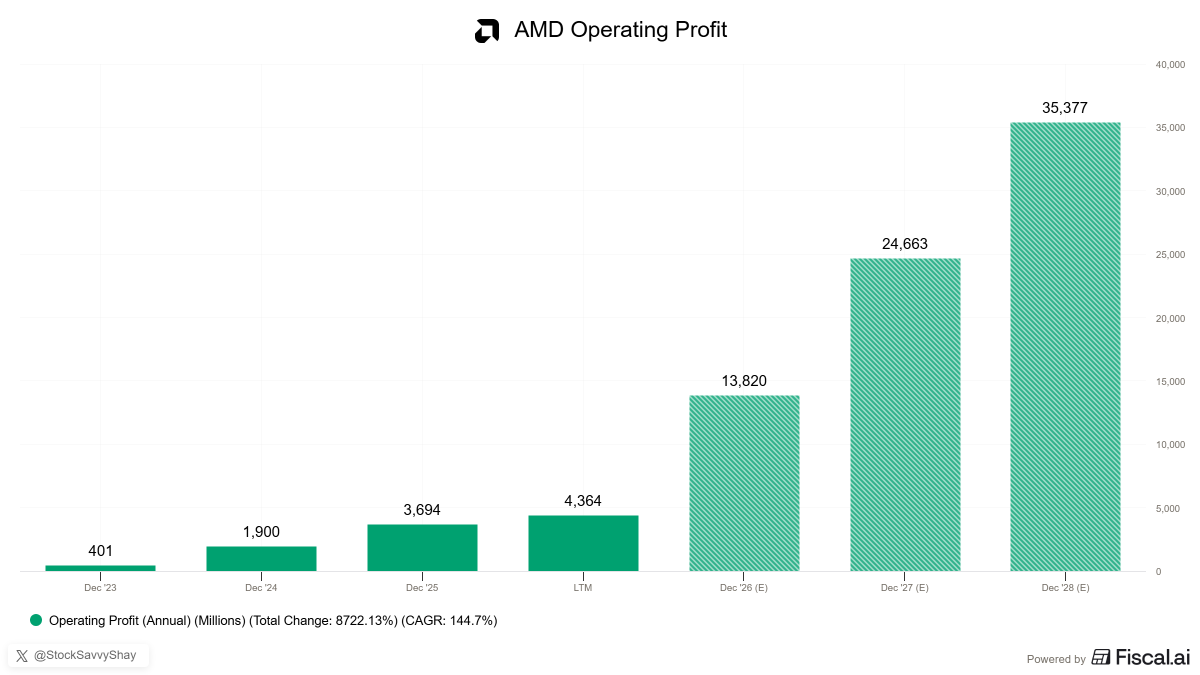
$AMD is on pace to generate over $75B in profit over the next three years:
• 2026: $13.8B (+274% YoY)
• 2027: $24.7B (+78% YoY)
• 2028: $35.4B (+43% YoY)
AMD is the only credible challenger gaining share across both the CPU and GPU layers of the AI economy at the same time.
We are seeing a historic earnings boom.
The current year-over-year blended earnings growth rate for the S&P 500 is a whopping +27.1%, more than DOUBLE the +13.1% expected.
With ~63% of S&P 500 companies reporting Q1 earnings thus far, we are on track for the highest earnings growth rate since Q4 2021.
Meanwhile, Magnificent 7 companies alone are now guiding over $700 BILLION in CapEx spend for 2026 alone.
There has never been a more historic time to own assets than now.
Asset owners are winning.
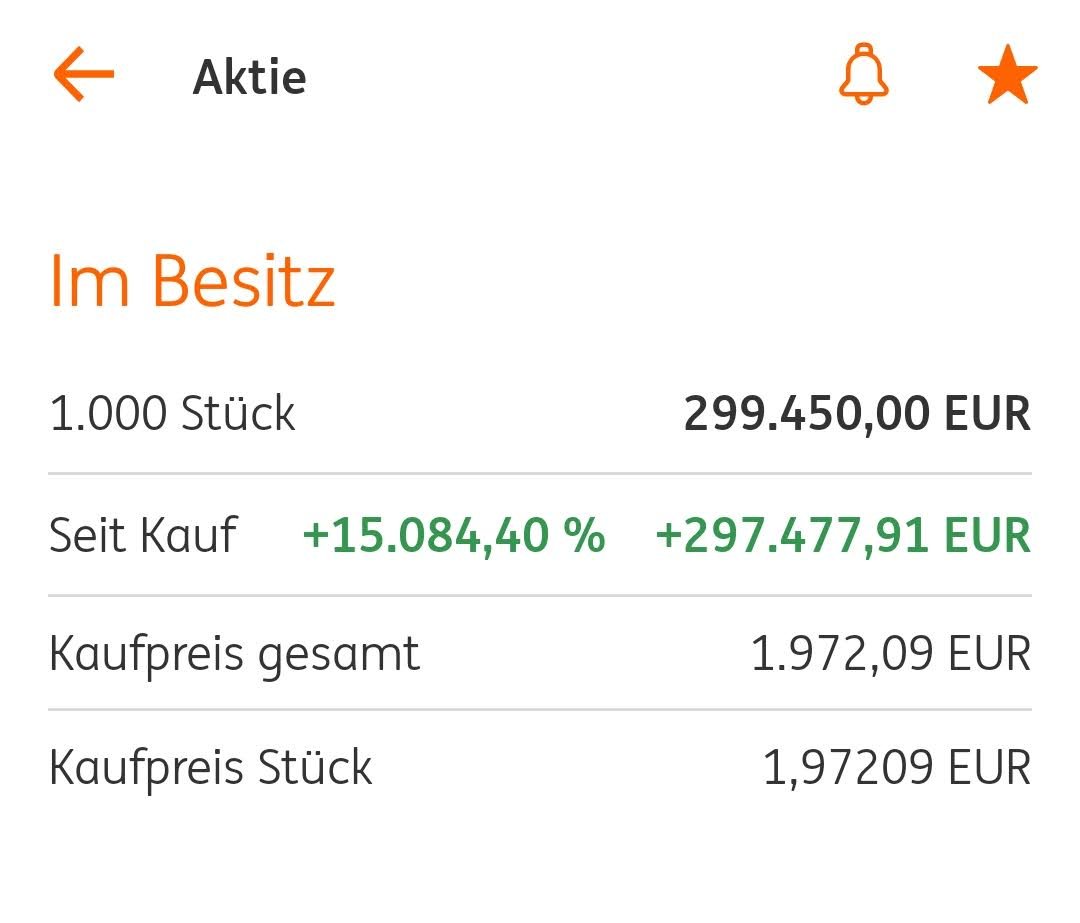
AMD ist bei mir nun 150-Bagger und 36% meines Portfolios. Keine Angst vor Klumpenrisiken. Anfänger verkaufen ihre Gewinner, nennen es Rebalancing und kriegen so nie auch nur einen 10-Bagger. Dann kommen sie zu mir und erklären mir, ich hätte nur Glück gehabt 😂.
AMD ist diese Woche auf ein neues Allzeithoch gestiegen, weil der Markt erkannte, dass man für KI neben Grafikchips und Speicher auch Prozessoren / CPUs im Rechenzentrum braucht. +27% in einer Woche.
Ich war damals Gamer und habe die Produkte gekannt und wusste, dass AMD nur eine gute Prozessorarchitektur brauchte um als Zwerg im Duopol mit Intel zu ballern. Die kam nicht mit Bulldozer aber dann später mit Zen. Ich war nicht sofort im Plus, sondern etwa fünf Jahre (2011-2016) im Minus. Ich hatte nie verkauft, sondern drei Mal nachgekauft, weil ich an das Potenzial glaubte. Nun sind die Produkte besser als Intels und werden zusätzlich in Spielekonsolen, Autos, Raumfahrt, Datenzentren und für AI verwendet. AMD war meine allererste Aktie im Februar 2011.
Ich hatte AMD gekauft in
2011: 6,63€
2012: 1,70€
2014: 1,93€
2015: 1,97€
Aktueller Kurs: ca. 300€
Von meinen insgesamt 2.500 AMD-Aktien halte ich noch 1.000. Diese haben nun einen Gesamtwert von fast 200.000€. Ich halte weiter.
Ich hatte ständig Videos von YouTubern geguckt, die Leaks aus der Industrie hatten. Daher wusste ich einiges über zukünftige vielversprechende AMD-Produkte. Das gab mir die Sicherheit zu halten. Zu erwähnen sind "Moores Law is dead" sowie "Coreteks".
Da Anthropic, OpenAI und andere weiter Geld einsammeln und ggf. auch an die Börse gehen, fließt mehr Geld in den Sektor, so dass AMD, Intel und Nvidia weiter steigen werden dieses Jahr, denke ich.
Cybersecurity as we know it is dead.
What killed it?
AI acceleration.
The cybersecurity we once knew, built for humans, cannot survive a time when AI speed is exponentially surpassing human speed.
Now, cybersecurity is at an inflection point.
The old game of prevention and detection is no longer applicable.
The new game is resilience - at AI speed.
Businesses that want to survive in this new era: focus on resilience for the future.
It’s the dawn of a new cybersecurity. Time to wake up to it.
@0xSchnitzel@Ruediger_Krause Die Höhe der Gebühr ist ein anderes Thema - ich wollte nur klarstellen, dass es nicht ohne Grund passiert. Eventuell den Betreuer kontaktieren und ihn bitten, das nächste Mal vorher darauf hinzuweisen - die Möglichkeit sollte bestehen, es vorher auszugleichen.
5 Mio. Views in 24h.
Und der Grund ist unbequem.
Der Originalbeitrag von Citrini Research ist kein normaler Research.
Er ist ein Gedankenexperiment… das sich zu real anfühlt, um es zu ignorieren.
Wir sprechen seit Monaten über den AI-Boom.
Produktivität. Effizienz. Margen.
Aber was, wenn genau das… das Problem ist?
Die zentrale These:
AI macht Unternehmen effizienter.
Aber zerstört gleichzeitig die Nachfrage.
Nicht sofort.
Sondern schleichend… und dann plötzlich.
Warum?
Weil unsere Wirtschaft auf einem simplen Kreislauf basiert:
Menschen arbeiten → verdienen Geld → konsumieren → treiben Wachstum.
Jetzt kommt AI ins Spiel.
Maschinen arbeiten → Unternehmen sparen Kosten → Menschen verlieren Einkommen → Konsum sinkt.
Und genau hier beginnt das Problem.
Citrini nennt das: „Ghost GDP“
Auf dem Papier wächst alles:
Produktivität steigt. Gewinne steigen. Börsen steigen.
Aber unter der Oberfläche passiert das Gegenteil:
Weniger Löhne.
Weniger Konsum.
Weniger reale Nachfrage.
Wachstum… das nie beim Menschen ankommt.
Der gefährlichste Teil ist der Feedback-Loop:
AI wird besser → Unternehmen entlassen Mitarbeiter
→ Margen steigen → mehr AI-Investments
→ weniger Konsum → weniger Nachfrage
→ mehr Druck → noch mehr Automatisierung
Ein Kreislauf ohne natürliche Bremse.
Und jetzt wird es kritisch:
70% der US-Wirtschaft basieren auf Konsum.
Ein Großteil davon kommt von White-Collar-Jobs (geistige Tätigkeiten).
Genau diese Jobs sind am stärksten durch AI bedroht.
Das ist kein Randthema.
Das ist der Kern der Wirtschaft.
Was viele unterschätzen:
Das ist keine klassische Krise.
2008: Schlechte Kredite.
2020: Externer Schock.
Dieses Szenario?
Strukturell.
Die Regeln selbst ändern sich.
Aber (und das ist wichtig):
Das Szenario ist extrem (Es wird ein Crash in 2028 prognositiert).
Zu schnell.
Zu linear gedacht.
Technologie braucht Zeit.
Politik reagiert.
Neue Jobs entstehen.
Die Richtung kann stimmen.
Der Zeitrahmen wahrscheinlich nicht.
Trotzdem bleibt eine unbequeme Frage:
Was passiert…
wenn Intelligenz plötzlich kein knappes Gut mehr ist?
Für mich die eigentliche Erkenntnis:
Wir stehen nicht vor einer normalen Disruption.
Wir stehen vor der möglichen Entkopplung von
→ Wertschöpfung
und
→ menschlichem Einkommen
Und wenn das passiert,
muss sich das gesamte System neu erfinden.
Was denkst du?
Ist das übertriebenes Doomsday-Szenario
oder ein realistischer Blick in unsere Zukunft?
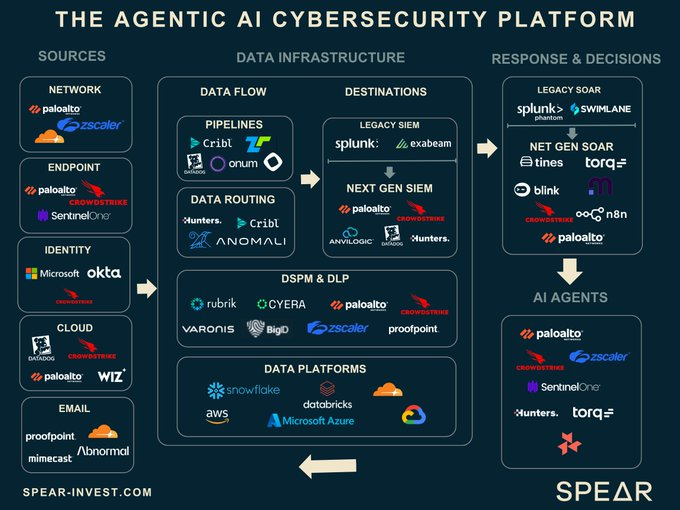
THE AGENTIC AI SECURITY CHEAT SHEET
The selloff in cybersecurity after Anthropic announced Claude Code Security is a perfect example of the market reacting to a headline instead of the actual product.
This is what the real security stack looks like:
Identity & Access (who/what is allowed to act in production)
• $ZS controls agent access & traffic across apps + networks
• $OKTA manages identity & access for humans + machine agents
Endpoint & Workload Security (what runs on machines)
• $S protects the machines & workloads agents run on
• $CRWD is the interactive response layer for agents across endpoints & cloud workloads
Data Protection & Recovery (what must be protected after compromise)
• $RBRK is the “undo button” for AI agents when things go wrong
Network & Edge Security (how attacks move through systems)
• $NET gatekeeper of agentic AI traffic on the modern internet
• $FTNT secures AI traffic moving inside enterprise networks
• $PANW coordinates security across network, cloud & SecOps
• $AKAM protects applications & APIs at the edge where traffic hits first
Cloud Runtime & Vulnerability Exposure (what is exploitable in production)
• $RPD protects cloud workloads at runtime as deployments scale
• $TENB maps & prioritizes exploitable vulnerabilities across live assets & cloud
Security Operations & Observability (how incidents are detected & acted on)
• $DDOG provides real-time visibility into the infrastructure agents run on
• $DT provides deep runtime visibility into applications & APIs agents interact with
Claude Code Security sits at the application security layer scanning code for vulnerabilities and suggesting patches for human review. It's a useful feature but represents a VERY small slice of one layer of the broader security stack.
AI doesn’t replace cybersecurity but will actually expand the attack surface.
Serious question for the $PLTR bears….
Let’s be serious, we all know Palantir will eventually be a $500+ stock long term. (Low end estimate FYI)
My question is this:
Why would it matter if you bought today at $140? Sure, let’s say it did go down to $50, I’d just buy more.
If the company continues to excecute, which they will, that “expensive” valuation you keep harping on slowly goes away and, before you know it, you just missed out on a generational company (again) because the P/E was too high.
$NVDA had a P/E of 114 in 2023
$TSLA had a P/E of 1,300 in 2021
$NFLX had a P/E 408 in 2015
$AMZN had a P/E of 529 on 2015
My point brining any of this up is that if you invested $10,000 in these companies at this exact time frames you’d now roughly have:
$NVDA: $110,000
$TSLA: $21,250
$NFLX: $76,110
$AMZN: $110,101
P/E isn’t everything bears
I’d hate for you to miss out on yet ANOTHER generational company but, if you insist, I’ll happily buy your shares here.
LONG $PLTR