“Retributive Philanthropy” is now published in the Journal of Marketing Research (@ama_journals)! (w/ @KJKristofferson & Miranda Goode).
Some consumers use donations to *punish* others. These two actions don’t usually align. Why are consumers doing this?
Thread & link below 👇
@NinjaZoo666 So you end up with people in rent controlled units paying low rent but the units are super low quality, AND the tenant feels like they can’t leave because the “true” market rate is so much higher elsewhere.
One of the most surreal arguments I’ve had IRL is with friends who are otherwise “believe science” people who forget that economics is also a science when it comes to rent freezes
@NinjaZoo666 1) If rents are frozen and maintenance costs rise, property owners end up being able to afford basic maintenance, so property quality decreases
2) it reduces mobility of current tenants (if you have a kid and want a bigger place you don’t want to sacrifice a rent control unit)
It’s such a great policy for politicians insofar as the costs are very diffuse, impact mostly unobservable people, and have some concentrated benefits among a few people who won’t experience negative impacts until years down the line (once the politician is out of office)
@andre_quentin imo this is just a really unfortunate pattern with Zucman more generally. The really weird analytic choices he makes when considering income inequality (e.g., not including benefits and post-tax transfers as income) are also systematically wrong and in one direction
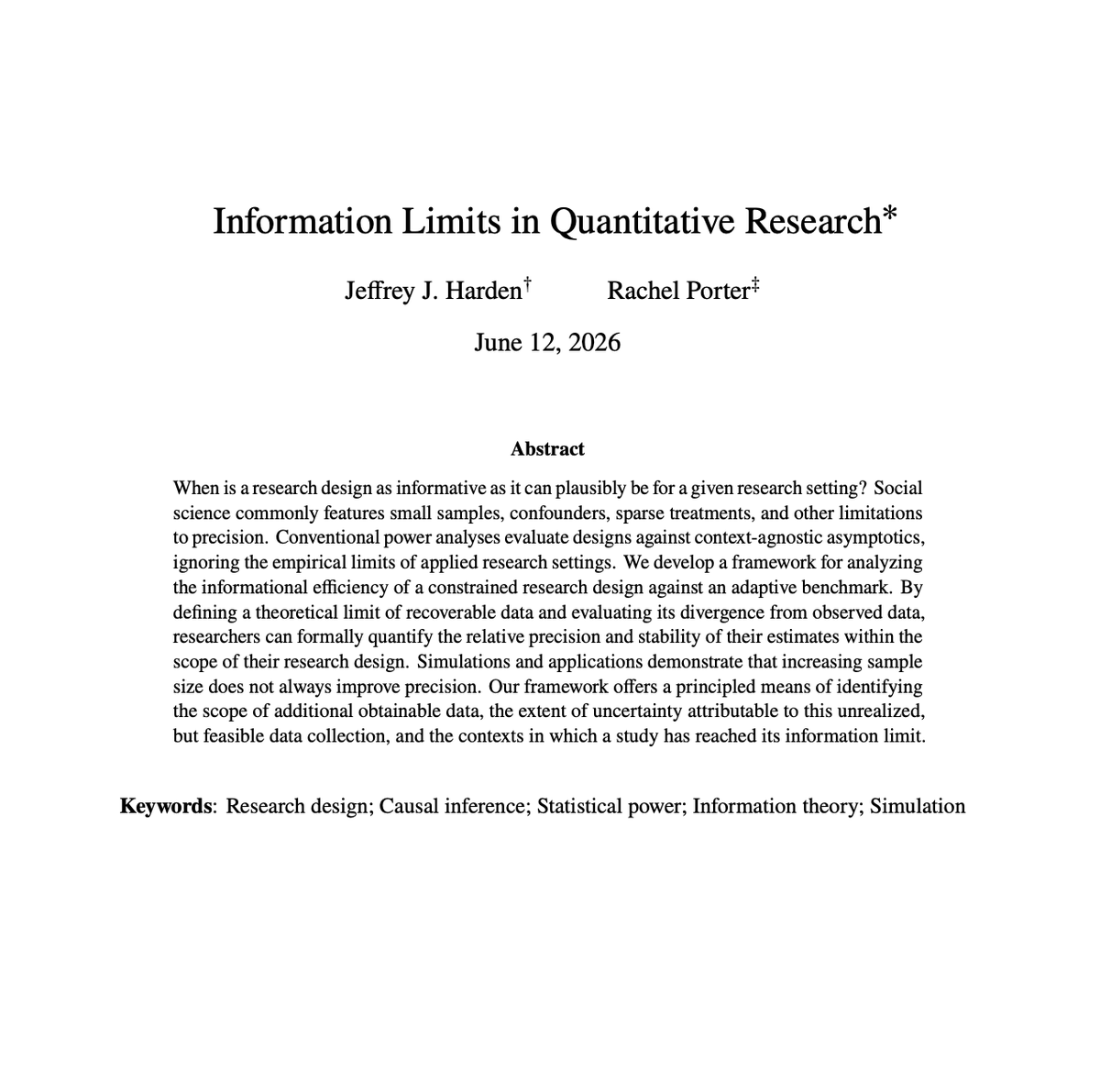
“Just collect more data” is one of the most common responses to uncertainty in quantitative research.
But in a lot of social science, that advice is impossible—or even misleading. Our new working paper asks: when has a study reached its information limit?
I distinctly remember one case of a paper suggesting that “neoliberalism” (&figures like Hayek) entails rejection of all government intervention. (See e.g., https://t.co/CVFtCUgqH2 for why this is a wild claim)
Very much this:
If a historian on the right abused evidence in this way, they'd face career ruination.
When Boston University's Quinn Slobodian does it, he gets a Guggenheim fellowship, book awards, and a Hewlett Foundation grant.
Academia's rot runs far deeper than a simple crisis of rigor.
@venkmurthy If it is the case that there is declining trust in science, then hiring a journalist with the aim of investigating *why* that is the case seems 100% fine
Excellent news! Nature is expanding Registered Reports to all the fields in which they publish! A great result by all those proposing this strong solution to publication bias and selective reporting (and getting expert feedback before data collection)! https://t.co/lVrQcNDVJT
I ate one almond the other day. Then I felt bad about the water usage, so I thought to myself - well I just won’t make the next 15,000 AI queries I was planning on making
An Econ PhD student at the 20th ranked program who is working on stuff they are passionate about will have a better job market than one at MIT who's been doing nothing but phd-app-maxxing since undergrad.
People get confused by this because they don't observe *how* successful people came about their insane knowledge bases. It wasn't by relentlessly grinding away at stuff because they had to.
They look at Scott Kominers and say "if i grind and learn as much math as he did, i will be successful." You can't! *You* can't learn as much math as Kominers because he gets energized by configuration results for type ii lattices. You will burn out if you try to do it this way.
You cannot, through grind alone, learn more about the economics of cities than Glaeser, or about how to maximize a value function than Acemoglu.
Research careers are long. Most people give up and stop working on research (graph is share of elite PhD graduates with at least one publication in year X after graduation).
If you're starting a PhD, you're presumably doing it to have a successful 40-year research career. The number one factor in whether that happens is not which program you get into, it's whether you find a research angle that energizes you enough to push through the endless barriers an academic career throws in your path.
This is why a lot of the received wisdom around PhD applications is wrong. If you're 100% consumed by the predoc rat race already, it's going to be a long, hard road ahead.
Obv you still have to do admissions, you should study a lot for the GRE, sigh it seems like taking real analysis is probably worth it.
But spending time on the things that energize you about economics is a no-brainer, whether it's policy, or blogging, or whatever, you gotta do the things that light your fire and make you want to be on this road.
@ryancbriggs At a conference right now but will reach out later — we’re working with marketing / consumer behavior journals which might be a bit easier to extract than PoliSci, but maybe there’s something transferable :)
@ryancbriggs Does your data have full text of articles? I’m working on a paper where we extract all statistical tests for papers across a set of journals to assess changes in distributions of significance over time (using local models to meet publisher guidelines)
Next in "you can just do things" with Claude/Codex: I've spent tens of hours fiddling with powerpoint to make PROCESS/mediation figures
Pointed Claude Code at the Hayes PROCESS R script and now I can run mediation models & generate nice .svg images with standardized aesthetics
@cgaunerd@JeremiahDJohns I might not be up to date on some other posts, but seems like the direct reply chain traces back to here, which is distinctly not about newcomers, but simply income required to live in NYC
@cgaunerd@JeremiahDJohns I did a double take at the stat too, but the median rent paid for an apartment != the median asking rent for apartments currently unoccupied.
The search you did seems to exclude every apartment currently being rented.