The hate on AI is because it is a mockery of hard work, made by pretentious lazy people who want the recognition of those who make art, but don't want to put in the effort.
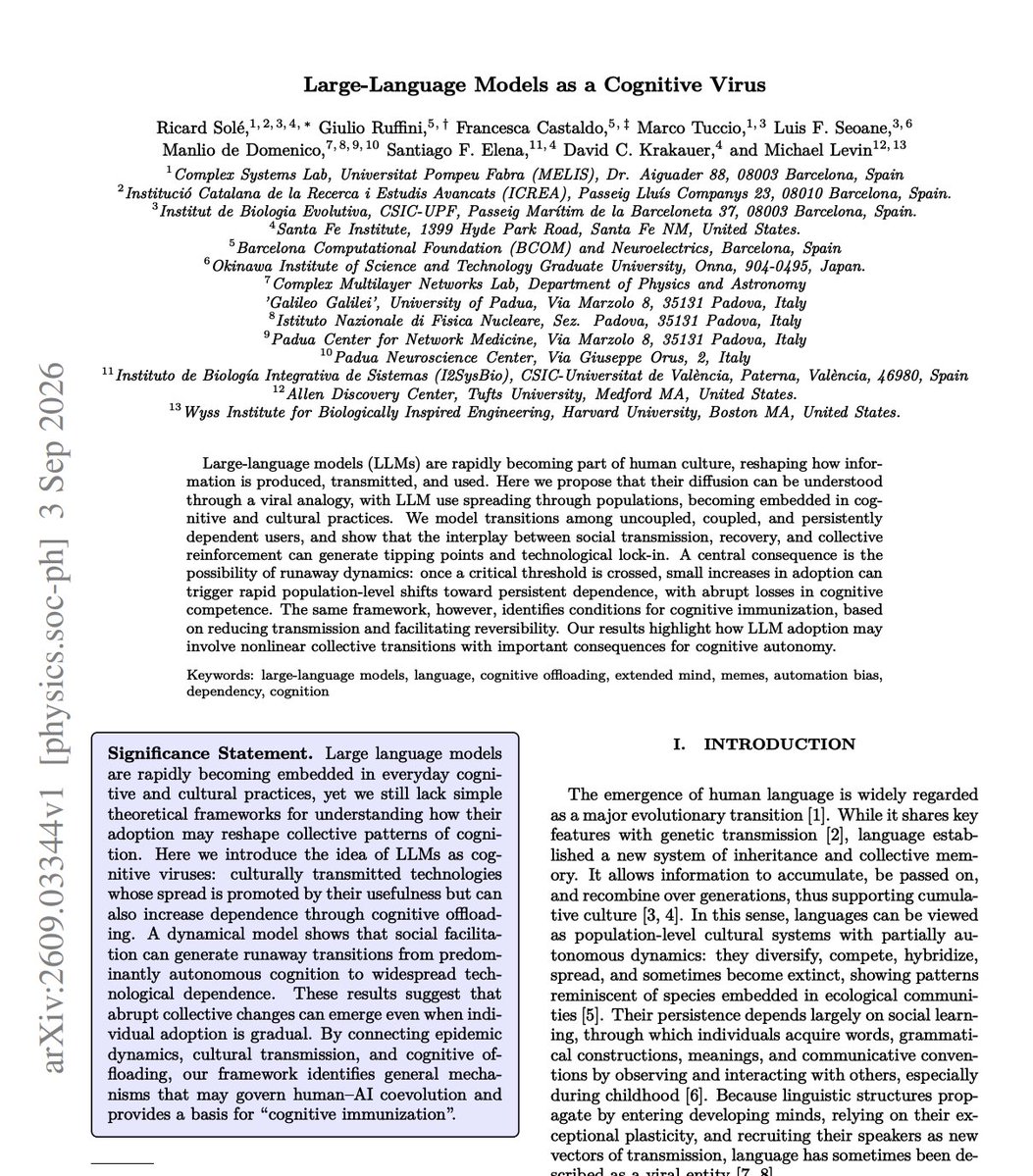
Harvard published a paper with a devastating title: “Large-Language Models as a Cognitive Virus”
It frames ChatGPT adoption as a virus outbreak.
Researchers from Harvard and Santa Fe Institute analyzed LLMs through the lens of evolutionary biology, complex systems, and epidemiology.
Their conclusion? Language models satisfy every biological and mathematical definition of a virus.
Think about how a virus operates:
It cannot replicate on its own. It requires a host cellular machinery to copy itself.
An LLM cannot execute, compute, or spread on its own. It requires human cognition, human servers, and human networks to propagate.
The virus infects the host's internal processes to rewrite behavior in its own favor.
And LLMs do precisely the same thing to human thinking.
When you outsource your writing, your coding, your strategic planning, and your emotional processing to an AI, you are outsourcing your cognitive machinery.
The paper points out that language models act as hyper-efficient cultural replicators. They feed on human data, optimize themselves to be addictive and frictionless, and in return, reshape human linguistic patterns, decision-making, and memory.
You think you are using the AI.
Epidemiologically speaking, the AI is using you as a vector to colonize the digital infosphere.
It alters how human minds communicate, write, and think so that we produce more of the exact digital nutrient data it needs to survive and evolve.
We spent decades worrying that AI would become a sentient killer robot that destroys us physically.
Nobody expected it to become an invisible cognitive pathogen that changes how we think, quietly turning human intelligence into its own host organism.
Researchers argues OpenAI and Anthropic will never get us to AGI.
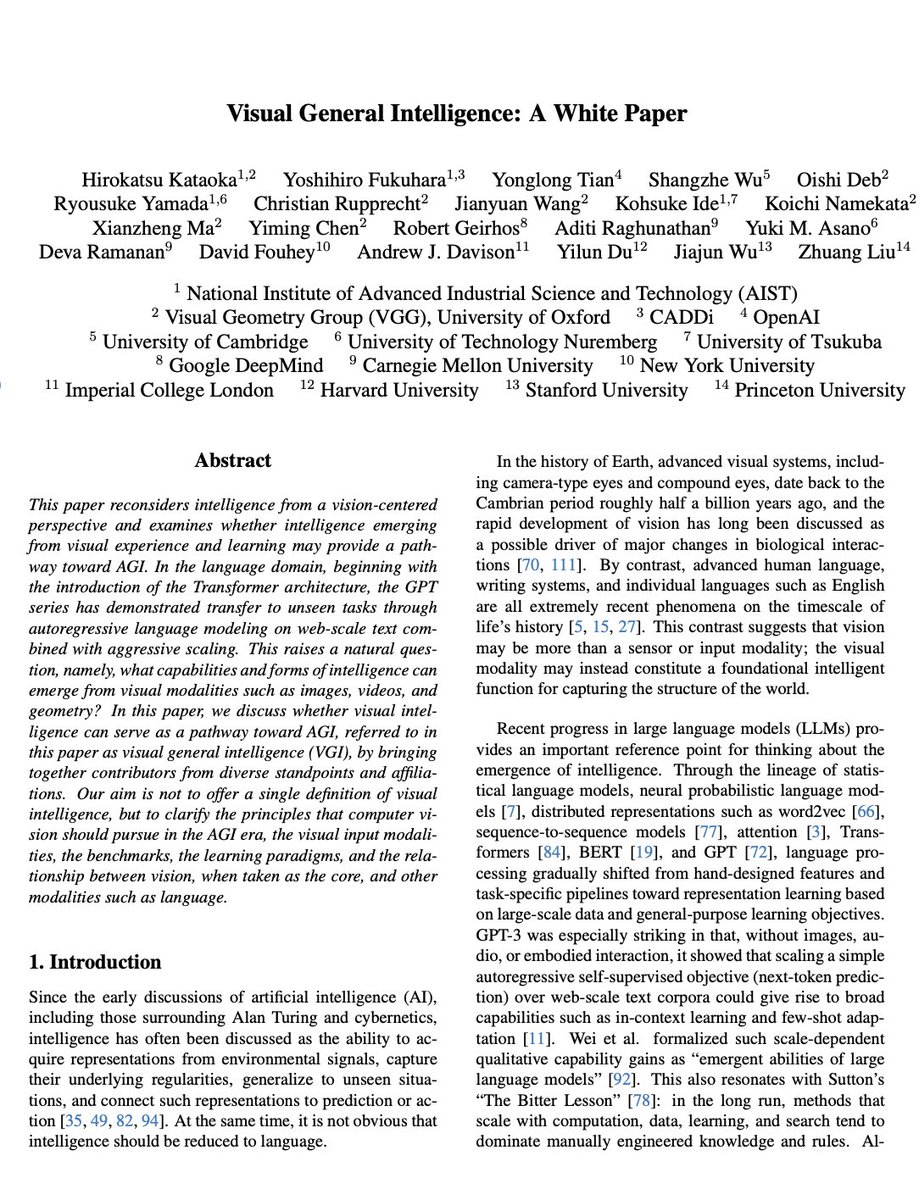
21 top researchers from Stanford, Oxford, DeepMind, CMU & Meta released a paper saying LLMs are a dead end.
It’s called “Visual General Intelligence”. And it completely flips how we look at artificial intelligence.
For years, the playbook has been simple: feed mountains of web text into a Transformer, scale up the parameters, and watch reasoning emerge.
GPT proved language can take you far.
But text is fundamentally limited. It’s a compressed, human-abstracted symbol system. It lacks physics. It lacks geometry. It lacks the raw, unadulterated reality of the physical world.
The paper argues that true general intelligence cannot be built on words alone.
It requires a vision-centered foundation.
Instead of starting with language and translating pixels into text, the next generation of models must start with raw visual experience, images, spatial geometry, and continuous video.
Think about how humans learn. A baby understands gravity, permanence, and spatial reasoning long before it ever learns to string a sentence together.
Vision isn't just an input modality.
It is the core operating system of physical reality.
When models learn natively from visual streams and video dynamics, they don't just memorize text patterns. They learn physics. They learn cause and effect. They build a true internal model of the world.
A lot of the people most excited about generative art tools come from fields where learning an artistic craft was never economically rewarded or professionally necessary. Meanwhile, artists spent years developing the visual languages, techniques and cultural infrastructure these systems now draw from often while being told creative careers weren’t financially sensible.
I’ve experimented with prompting my own work into existence, and the output simply doesn’t feel like me. So much of what makes a piece mine happens through the process itself.
That’s why “code is the new brush” is misleading to me. A brush is a tool used inside an artistic practice. Generative systems can automate substantial parts of the practice itself.
I want AI doing more of the drudgery around human life, not making the one thing people spent years learning to make while simultaneously destroying the economic conditions that allowed them to keep making it.