The hate against India was not created recently. It has been cultivated and spread for centuries by Western powers.
Many Western people are still brainwashed against India.
Must watch👇
High dose vitamin D supplementation might be doing more harm than good.
Stephanie Seneff, MIT researcher:
Vitamin D is a signalling molecule, not a nutrient to megadose.
It mobilizes calcium — but doesn't control where calcium goes.
High dose vitamin D drives calcium into the arteries, leaching it from bones.
A 3-year study comparing 400 IU/day, 4,000 IU/day and 10,000 IU/day found the highest dose group had statistically significantly worse bone mineral density.
A 2006 study found that calcitriol supplementation (the active form of vitamin D) in young adults with kidney disease increased artery calcification — because calcitriol is taken up directly by cells in the artery wall.
Artery calcification is one of the strongest risk factors for cardiovascular disease.
An Indian study compared vitamin D supplementation to 20 minutes of daily sunlight in 100 men with severe deficiency.
Remarkably — the supplement group had a larger increase in serum vitamin D than the sunlight group.
Yet opposite effects on cholesterol:
Sunlight group — cholesterol dropped. Supplement group — cholesterol increased.
Why?
Sunlight and vitamin D supplements take completely different routes through your body.
Vitamin D supplements are fat-soluble. The liver has to synthesize cholesterol and release LDL particles just to transport them through the blood.
Sunlight stimulates cholesterol sulfate synthesis directly in the skin. The sulfate component makes the molecule water-soluble — transported freely in the blood without being packaged inside an LDL particle.
Because cholesterol sulfate is both water-soluble and fat-soluble, it can transfer from skin cell membranes to HDL particles or red blood cells and deliver cholesterol directly to tissues that need it.
No LDL carrier required.
When you get vitamin D from a supplement instead of the sun, you don't get the simultaneous increase in cholesterol sulfate.
The pill doesn't just fail to replicate sunlight.
It uses a completely different biological pathway.
Seneff: "Vitamin D wants to be subtle. Get out in the sun."
"People answer: oh yeah I know, vitamin D is important."
"No. Not vitamin D. The sun.”
Vitamin D is a proxy for sunlight exposure.
The proxy isn't the mechanism.
Introducing: PlayerZero
The world's first Engineering World Model that puts debugging, fixing, and testing your code on autopilot.
We've raised $20M from Foundation Capital, @matei_zaharia (Databricks), @pbailis (Workday), @rauchg (Vercel), @zoink (Figma), @drewhouston (Dropbox), and more
PlayerZero frees up 30% of your engineering bandwidth by:
1. Finding the root cause for bugs & incidents in minutes that engineering teams take days to identify.
2. Predicting in minutes, edge case issues that a 300-person QA team would take weeks to find.
------
Here's why this matters:
No one in your org has a complete picture of how your production software actually behaves.
Support sees tickets. SRE sees infra. Dev sees code. Each team builds their own fragmented view - and none of these systems talk to each other. When something breaks, everyone scrambles to stitch the picture together by hand.
PlayerZero connects all of it into a single context graph -
→ The Slack thread where your lead said "we went with X because Y fell apart in prod last time"
→ The PR review where an engineer explained the tradeoff
→ The lifetime history of your CI/CD pipeline, observability stack, incidents, and support tickets
So you can trace any problem to its root cause across every silo.
And it compounds. Every incident diagnosed teaches the model something new. The longer it runs, the deeper it understands - which code paths are high-risk, which configurations are fragile, which changes tend to break which customer flows.
So when you sit down to debug a live issue, you have your entire org's collective reasoning and production memory behind you - instantly.
------
Zuora, Georgia-Pacific, and Nylas have reduced resolution time by 90% and caught 95% of breaking changes and freeing an average of $30M in engineering bandwidth.
------
Our guarantee:
If we can't increase your engineering bandwidth by at least 20% within one week, we'll donate $10,000 to an open-source project of your choice.
Book a demo - https://t.co/dH1dulIwSS
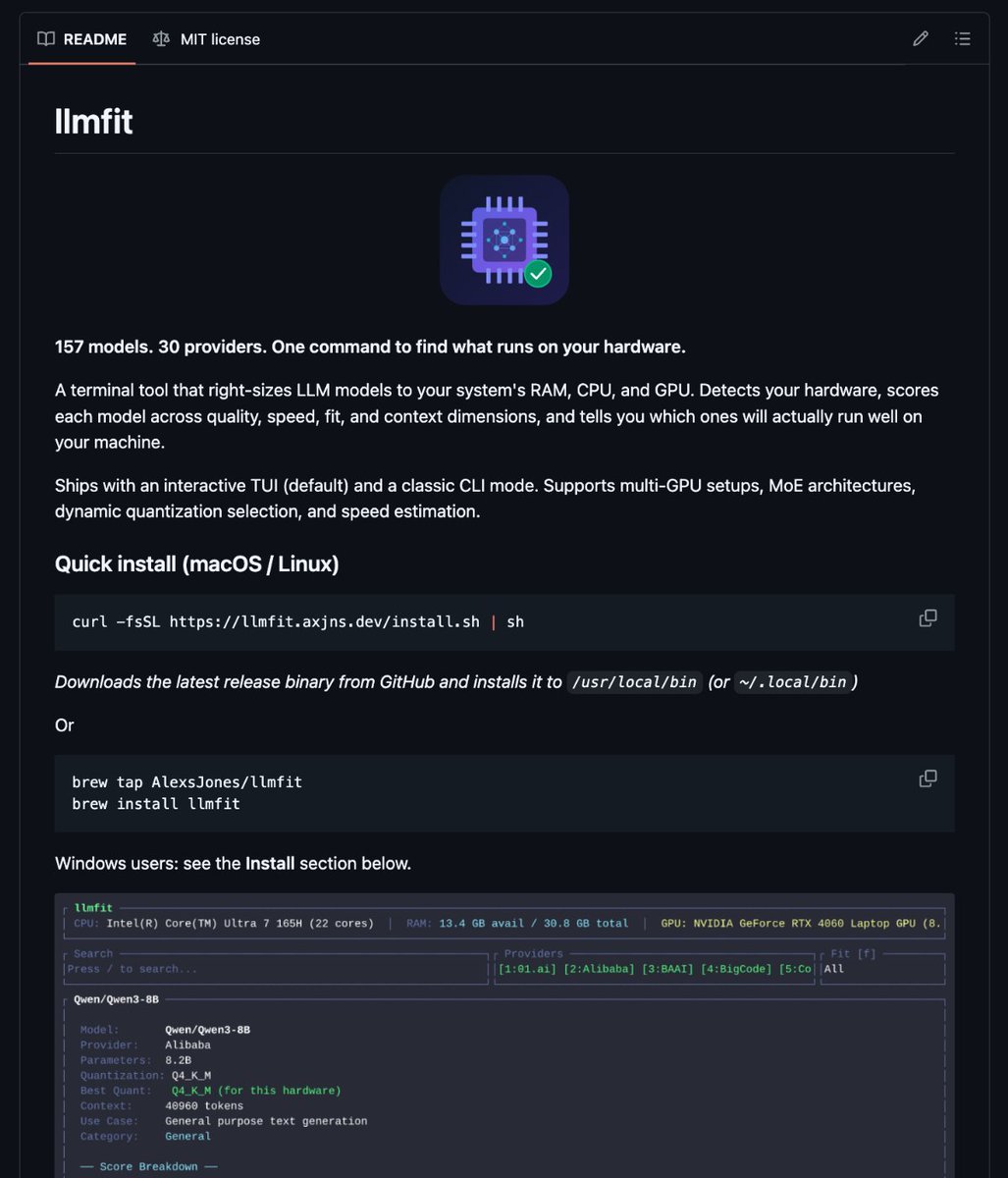
🚨BREAKING: Someone just solved the #1 problem with local AI.
It's called llmfit and it tells you exactly which LLMs will run on YOUR hardware before you waste hours downloading the wrong model.
No guessing. No trial and error. No "out of memory" crashes.
Here's how it works:
One command scans your full setup
→ Detects your RAM, CPU, GPU, and VRAM
→ Scores every model on quality, speed, fit, and context
→ Picks the best quantization automatically
→ Ranks what's perfect, good, or marginal for your machine
Here's the wildest part:
It handles MoE architectures properly.
Mixtral 8x7B has 46.7B total parameters but only activates 12.9B per token.
llmfit accounts for that. Most tools don't.
94 models. 30 providers. One command.
100% Opensource.
Link in the first comment.
This got almost a million views. I am introducing myself.
Hi 👋 I’m Rohan Anil. I do research at Anthropic.
I left Google DeepMind in January 2025, where I led work on the Gemini models (leaving as a Distinguished Engineer for contributions to Gemini pretraining).
Before that, I worked at Google Brain on foundational research in training algorithms as well as infrastructure—for example, the first Transformers inference at Google, and the first large-scale TPU training and inference ex shipping models for core services (including early large-scale neural network models in Search like RankBrain and DeepRank, as well as Ads and Translate). Before Brain, I was on the Sibyl team doing large-scale machine learning. Earlier in my career, I worked on low-level performance engineering for Google’s core servers (including a memory allocator that is part of nearly every Google server call).
I had the opportunity to work with amazing engineers and researchers at Brain, including @geoffreyhinton , @JeffDean, @GuptaVineetG, @GeorgeEDahl Manfred Warmut, Yonghui Wu, Claire Cui, Sanjiv Kumar, Tal Shaked and many others.
On X, I’m known for the Shampoo algorithm and Gemini Flash because I care a lot about efficiency and have talked about it obsessively. For Shampoo, I felt the community didn’t give it its due (and ICLR AC acting irresponsibly) until a few years ago.
Back to the tweet, when I say this can compress six years of work into a few months, I mean it especially on the engineering side: performance work, and cobbling together distributed systems under real constraints. And I can be honest with myself: I didn’t work on truly novel insights until I moved into neural network research, and even then it was standing on the shoulders of giants.
This got almost a million views. I am introducing myself.
Hi 👋 I’m Rohan Anil. I do research at Anthropic.
I left Google DeepMind in January 2025, where I led work on the Gemini models (leaving as a Distinguished Engineer for contributions to Gemini pretraining).
Before that, I worked at Google Brain on foundational research in training algorithms as well as infrastructure—for example, the first Transformers inference at Google, and the first large-scale TPU training and inference ex shipping models for core services (including early large-scale neural network models in Search like RankBrain and DeepRank, as well as Ads and Translate). Before Brain, I was on the Sibyl team doing large-scale machine learning. Earlier in my career, I worked on low-level performance engineering for Google’s core servers (including a memory allocator that is part of nearly every Google server call).
I had the opportunity to work with amazing engineers and researchers at Brain, including @geoffreyhinton , @JeffDean, @GuptaVineetG, @GeorgeEDahl Manfred Warmut, Yonghui Wu, Claire Cui, Sanjiv Kumar, Tal Shaked and many others.
On X, I’m known for the Shampoo algorithm and Gemini Flash because I care a lot about efficiency and have talked about it obsessively. For Shampoo, I felt the community didn’t give it its due (and ICLR AC acting irresponsibly) until a few years ago.
Back to the tweet, when I say this can compress six years of work into a few months, I mean it especially on the engineering side: performance work, and cobbling together distributed systems under real constraints. And I can be honest with myself: I didn’t work on truly novel insights until I moved into neural network research, and even then it was standing on the shoulders of giants.
I'm Boris and I created Claude Code. Lots of people have asked how I use Claude Code, so I wanted to show off my setup a bit.
My setup might be surprisingly vanilla! Claude Code works great out of the box, so I personally don't customize it much. There is no one correct way to use Claude Code: we intentionally build it in a way that you can use it, customize it, and hack it however you like. Each person on the Claude Code team uses it very differently.
So, here goes.