'“Prohibition does not end nicotine use. It hands the market to criminal operators, weakens consumer protections, and leaves adults with fewer legal options to move away from smoking.” - @caphraorg
H/T @PVapes
https://t.co/V7YHze55O4
Yesterday Pauline put forward the "Acknowledging Biological Reality Bill" in the Senate. This Bill would have protected women and safeguarded female only spaces. Sadly, the Bill was voted down by Labor and Green Senators. It's extremely rare that Bills are voted down at such an early stage in the Senate. It shows that Labor and Green Senators are not even prepared to debate their extreme views on gender identity.
One Nation stand for biological reality and common sense on issues relating to gender identity and in protecting female only spaces.
Enjoy the #bloodmoney@DailyMail. I'm sure #bigtabacoo loves writing you checks
Fear-based headlines are not a substitute for science. If you're going to make public health claims that could influence millions of smokers and vapers, you'd better have solid evidence—not sensationalism.
Misinformation has consequences. If misleading health claims discourage smokers from switching to less harmful alternatives, the people spreading them should be held accountable. Public health deserves facts, not fear.
#HarmReduction #Vaping #PublicHealth #TobaccoHarmReduction #ScienceMatters #TruthMatters #QuitSmoking
It’s wild that the people in Australia doing the tobacco enforcement, don’t even think Australia is doing a good job.
“ There will be no legal market in the next two years”
Campaign for Tobacco-Free Kids @TobaccoFreeKids has $159,381,326 million reasons not to see harm reduction work 🤔
Campaign for Tobacco-Free Kids (CTFK) itself (not the affiliated Action Fund), its IRS filings show that the organization relies heavily on a relatively small number of very large philanthropic foundations.
Breakdown of Major Contributions (IRS Form 990 for FY 2023)
ContributorContribution
1. Bloomberg Family Foundation$151,477,691
2. Bill & Melinda Gates Foundation$14,200,000
3. Robert Wood Johnson Foundation$6,483,635
These three foundations accounted for the overwhelming majority of the organization's largest disclosed contributions for that filing year.
#TobaccoFreeKids #Vaping #HarmReduction #PublicHealth #FollowTheMoney #Transparency #BigPhilanthropy #Bloomberg #PublicPolicy #AdultSmokers #TobaccoControl #Nicotine #FDA #HealthPolicy #FactCheck #KnowTheFacts #SmokingCessation #OpenDebate #TaxpayerTransparency #XPost
Simon Chapman’s latest polemic is not an essay it’s a sprawling ideological screed that conflates nearly every public safety regulation ever enacted with prohibition, in an attempt to defend Australia’s failed nicotine policies.
150 Regulations Are Not an Argument Against Prohibition Failure. His latest essay attempts to ridicule the phrase “prohibition doesn’t work” by presenting a list of 150 public health laws and regulations that have improved safety and quality of life in Australia.
The problem is that most of his examples aren’t prohibitions at all.
Seat belt laws are not prohibition.
Swimming pool fences are not prohibition.
Food safety standards are not prohibition.
Building regulations are not prohibition.
Professional licensing is not prohibition.
These are examples of regulation, standards and risk management. Almost nobody disputes their value.
Critics of Australia’s vaping and illicit tobacco policies are making a very different argument. They are pointing to situations where governments attempt to severely restrict or prohibit access to products that remain in demand, creating opportunities for black markets and organised crime.
History shows this can happen.
US alcohol prohibition generated illicit supply networks.
The war on drugs has fuelled global criminal enterprises.
Australia’s illicit tobacco market has generated billions of dollars for organised crime and has been linked to hundreds of firebombings.
You can believe these policies had good intentions while still recognising that they produced unintended consequences.
Chapman’s article avoids this distinction by creating a straw man. He implies that anyone questioning prohibition must also oppose seat belts, clean water, pool fencing and food standards.
That simply isn’t the argument being made.
There is also an irony here. Chapman himself now openly acknowledges that cheap illicit cigarettes threaten decades of tobacco control progress. In other words, he accepts that when a prohibited or highly restricted market emerges, people adapt their behaviour in ways policymakers didn’t anticipate.
That is precisely the concern critics have been raising.
The question isn’t whether all regulations work.
Of course it does.
The question is whether certain forms of prohibition, under certain conditions, can create harms that outweigh their intended benefits.
On that question, Australia’s experience with illicit tobacco and vapes suggests the answer is at least sometimes yes.
Public health should be willing to learn from unintended consequences, not dismiss them by equating pool fences with prohibition.
New peer-reviewed research in Nicotine & Tobacco Research analysed a decade of U.S. data on vaping and found no gateway effect to smoking, minimal dual use, and a steady shift from combustible cigarettes to e-cigarettes
Researcher Arielle Selya, PhD breaks down the findings here: https://t.co/2taNlsnkzB
We compared Ireland and New Zealand to get to the bottom of what works and what doesn’t in achieving a smoke-free Europe!
Here are the results. The way forward for Ireland is:
1️⃣Adopt a #HarmReduction policy.
and
2️⃣ Actively promote it to the public!
Read more in our report 👇 https://t.co/YLesyCUXcl
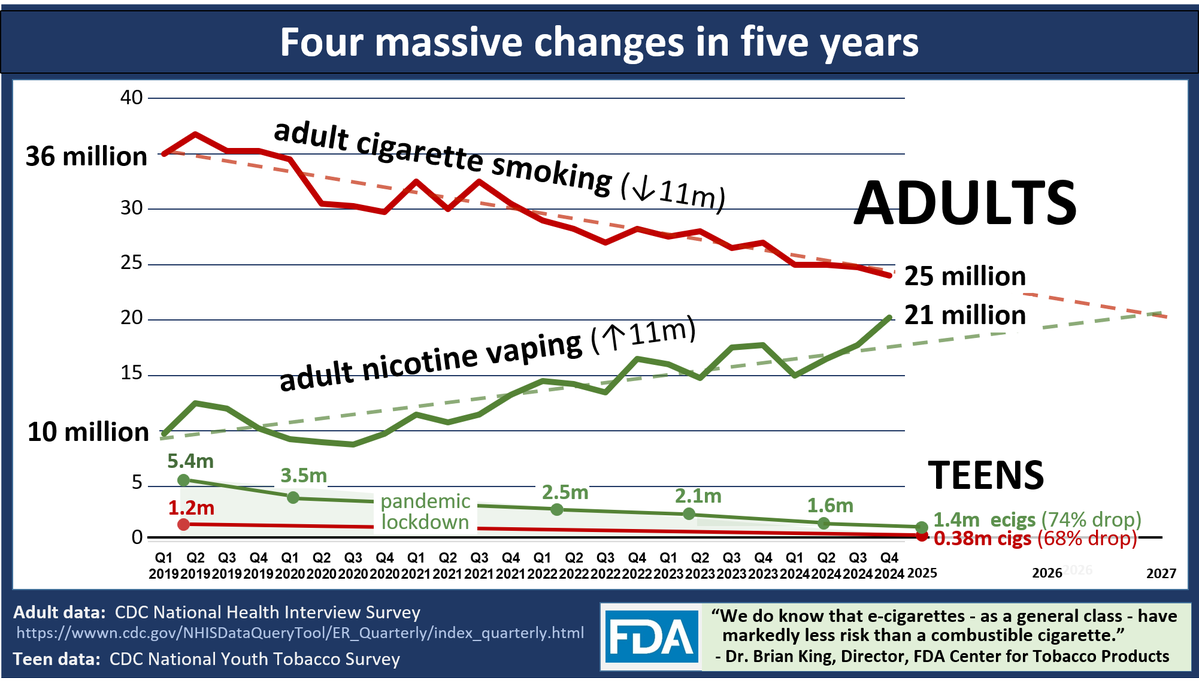
5.2% of teens vaping nicotine "at least one time in the past 30 days." 74% lower that 6 years ago.
Daily use is 1.4%. Daily users buy products routinely.
3.8% of THEM buy online = 0.05% (1 in 2,000).
State AGs are convinced teen vaping is a "crisis." Shopify's decision will 21 million adults by reducing access to #SaferNicotine alternatives. It will have zero effect on teen use.
#FactCheck
Adult current use (daily or some days)
Nicotine vaping: Q1 2019: 3.9%; Q4 2024: 8.1%
Cigarette use: Q1 2019: 14%; Q4 2024: 9.6%
(260m adults, so 21m adults now vape; 25m smoke)
https://t.co/a41PBpkLzy
Middle & high school “current use” (≥once/month)
2019: 4.5% smoked; 20% vaped nicotine (3.7% daily) https://t.co/6LfoX9OQfq
2025: 1.4% smoke; 5.2% vape nicotine (1.4% daily)
(27m teens, so 1.4 million teens now vape)
https://t.co/Qp0htjMQwb
https://t.co/bPAXw80aPV
Beware the bad science on vaping. A valuable innovation is buried under a pike of debunked research The Rest of the Story: Tobacco and Alcohol News Analysis and Commentary: Another Sham E-Cigarette Study is Retracted; Can We Trust Any of this Literature? https://t.co/IFgg9VR92A
Jennifer Cofer of @UTMDAnderson fails to realize that her own lies and gaslighting is exactly what gives credibility to the overreaching claims about nicotine she dislikes.
https://t.co/khWwLH47YK
'Flavors' hook kids? As a Member of Congress, you can ask CDC and FDA to confirm these numbers (which are based on CDC/FDA survey reports). "Flavors hook kids" is, literally a crazy conspiracy theory. It is NOT what is happening.
#FactCheck
Adult current use (daily or some days)
Nicotine vaping: Q1 2019: 3.9%; Q4 2024: 8.1%
Cigarette use: Q1 2019: 14%; Q4 2024: 9.6%
(260m adults, so 21m adults now vape; 25m smoke)
https://t.co/a41PBpkLzy
Middle & high school “current use” (≥once/month)
2019: 4.5% smoked; 20% vaped nicotine (3.7% daily) https://t.co/6LfoX9OQfq
2025: 1.4% smoke; 5.2% vape nicotine (1.4% daily)
(27m teens, so 1.4 million teens now vape)
https://t.co/Qp0htjMQwb
https://t.co/bPAXw80aPV
@ILAttyGeneral@Shopify Would you care to list some of the health risks? I mean real risks, not theoretical or imagined. Don't include EVALI, which had nothing to do with nicotine vaping.
Or do you even realize that nicotine vaping is different from THC vaping?
Or do you know anything about vaping?
@ILAttyGeneral@Shopify But tobacco fine… make smoking great again!
Keep those MSA dollars rolling in. Straight up cartel behaviour. This is what @Shopify bent over and grabbed their ankles for:
CC: @tobi
@ILAttyGeneral@Shopify So drive sales of a 95% less harmful product further underground with all the bad things that go with that!!
Ffs...Just look at the aussie example!!
Deppart
@ILAttyGeneral@Shopify How do voters feel about AGs misusing their tax dollars to bully businesses into protecting sales of deadly cigarettes from non-deadly competitors?
The 2025 CDC/FDA NYTS shows 5.2% of teens vape nicotine “at least on time in the past 30 days.”
1.4% vape daily so routinely buy
3.8% of THOSE kids buy online
3.8% of 1.4% = 0.05% (1 in 2,000)
Shopify’s decision harms 21 million ADULTS who use nicotine vapes to avoid deadly cigarettes by further reducing their access to #SaferNicotine vapes. It does not protect youth.