Official account of The University of Texas MD Anderson Cancer Center. Our mission is to #EndCancer through patient care, research, education & prevention.
UT MD Anderson is proud to be named No.1 in the nation for cancer care in @USNews’ “Best Hospitals” ranking.
Read more: https://t.co/5DonXqcvat #BestHospitals#EndCancer
How do tumor boards help shape cancer treatment plans? Dr. Ehab Hanna explains how specialists work together to review cases, consider treatment options and identify clinical trials. For 25% to 30% of our head and neck patients, tumor board review leads to a different treatment plan.
Learn more: https://t.co/h3tgfBk5Rw #EndCancer
After #ESMO26, we’re grateful for the conversations, connections and discoveries shared with the global oncology community. Together, we’re advancing cancer research and care to bring new possibilities to patients.
Missed something? Explore our ESMO coverage: https://t.co/30w9Z5ChhE
#EndCancer
Join UT MD Anderson at ESMO Monday for Meet the Experts at Booth 8006 in Hall 8. Discuss the next generation of immunotherapies, advances in leukemia care and how genomic discoveries are translating into clinical impact. #ESMO26#EndCancer 1/2
Dr. Ferdinandos Skoulidis of UT MD Anderson presents late-breaking results from the Phase 3 KRAScendo 1 trial in the Presidential Symposium at #ESMO26. The findings offer new insights into targeted treatment for patients with previously treated advanced lung cancer with a KRAS G12C mutation.
Learn more: https://t.co/9FCGHiL5Ht @FSkoulidis #EndCancer
A next-generation targeted therapy helped patients with previously treated advanced KRAS G12C-mutated lung cancer live longer and delay disease progression.
Published in @NEJM and presented at #ESMO26, Phase 3 KRAScendo-1 results from Dr. Ferdinandos Skoulidis show divarasib reduced the risk of death by 44% compared with current targeted therapies.
Read more: https://t.co/PqPDqlQDsx @FSkoulidis #EndCancer
From cancer prevention to more precise treatment monitoring, UT MD Anderson researchers presented new findings across cancer types at #ESMO26.
Discover how these approaches could help prevent cancer, track treatment response and improve long-term outcomes: https://t.co/xGgWByzYCt @DrNeilGross@evilarsan #EndCancer
Join UT MD Anderson at ESMO Sunday for Meet the Experts at Booth 8006 in Hall 8.
Explore advances in genitourinary cancers, hereditary cancer, drug discovery and antibody-drug conjugates, plus industry partnerships and precision oncology. #ESMO26#EndCancer 1/2
At #ESMO26, researchers are exploring ways to reduce the risk of melanoma returning. Dr. Hussein Tawbi is leading UT MD Anderson’s participation in a Phase 3 clinical trial testing a personalized cancer vaccine with immunotherapy.
Learn about the research and hear about a patient’s experience on the trial: https://t.co/5J6dLbigti @HTawbi_MDPhD #EndCancer
Phase 3 DUO-E results show that adding durvalumab and olaparib to treatment extended median overall survival by 11.5 months for patients with advanced or recurrent endometrial cancer compared with chemotherapy alone.
Presented by Dr. Shannon Westin at #ESMO26, the findings are especially encouraging for patients with pMMR tumors.
Read more: https://t.co/lSEWdHLgSM @ShannonWestin #EndCancer
Cancer vaccines are being explored not only to help prevent cancer from returning, but also to prevent it from developing.
At #ESMO26, Dr. Eduardo Vilar-Sanchez will present research on a vaccine designed for people with Lynch syndrome, an inherited condition that raises the risk of several cancers.
Read more about the future of cancer vaccine research: https://t.co/SB12HEIjfP @evilarsan #EndCancer
What’s next for treating KRAS G12C-mutated lung cancer? Dr. Ferdinandos Skoulidis will share findings from KRASCENDO-1 at #ESMO26.
Catch his presentation in the Presidential Symposium Sunday at 4:30 p.m. CET. #EndCancer@FSkoulidis
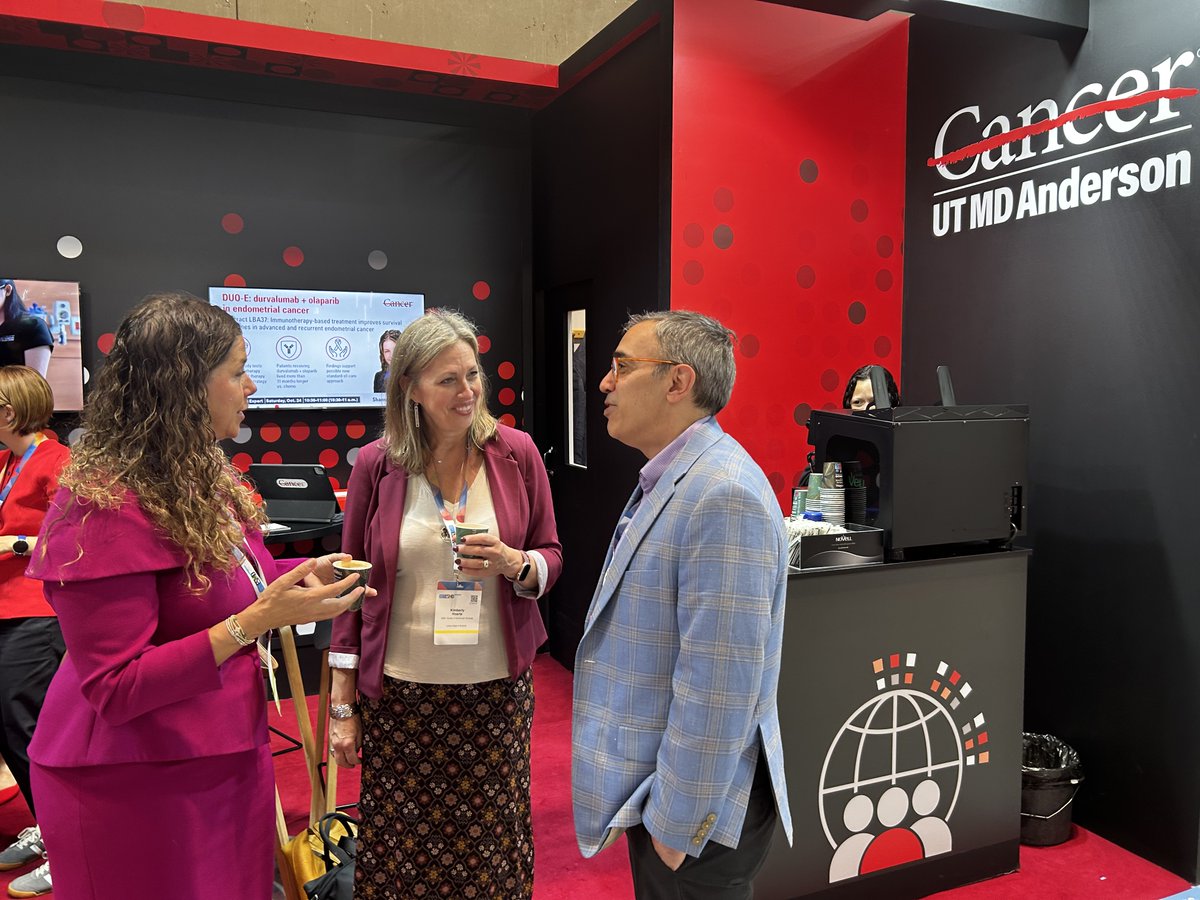
Join UT MD Anderson at ESMO for Saturday’s Meet the Experts sessions at Booth 8006 in Hall 8.
Connect with our experts to discuss advances in gynecologic, head and neck, breast and blood cancers, next-generation immunotherapies, palliative care and clinical trials. 1/2