🔐 Opening up Meta Ads to industries outside of Cleaning
Unlimited Creatives, Backend set up done for you (including GHL set up, Ads Manager, and Launch) 👻
In a constant slack channel with men and my team for questions or adjustments 🧭
Only thing I need from you is that you text/call the leads within 5 minutes 🍽️ 👨🏻💻
The biggest wake-up call for me running a marketing agency this year was realizing there is only so much you can control after the lead comes in.
You can help a business owner get more traffic.
You can get them more phone calls.
You can get them more form submissions.
You can lower their cost per lead.
But you cannot sit inside their office and make sure every call gets answered, every lead gets followed up with and every salesperson actually does their job.
We would have clients asking for more leads while they had missed calls sitting there.
Leads taking hours to get contacted.
Intake forms that barely collected enough information for the sales team.
Nobody really knowing which marketing source produced the lead.
And then the marketing gets blamed when the revenue does not show up.
That is a huge reason we built Stryke.
We did not want to stop at:
“Here are your leads. Good luck.”
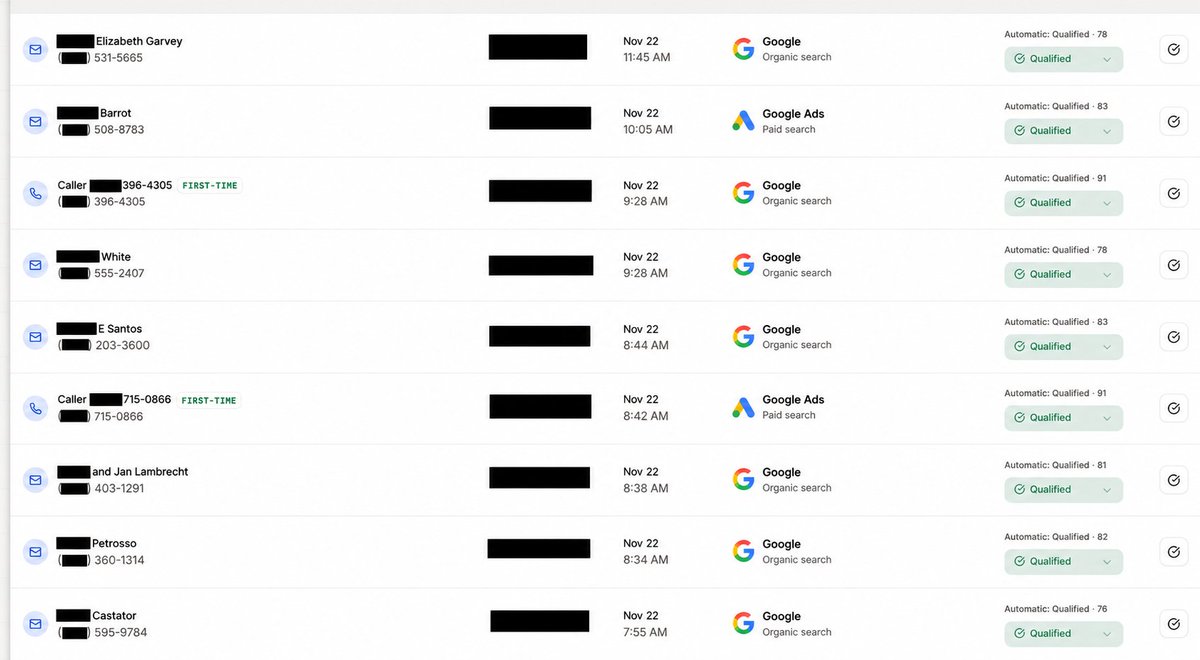
We wanted visibility into what happened AFTER the lead came in.
Which channel generated it.
Whether the phone call was answered.
What happened during the intake process.
Where leads were getting lost.
Which opportunities actually turned into revenue.
Now when we talk to a home service company we can help them on both sides.
How do we generate more opportunities?
AND
What the hell is happening to those opportunities once they enter the business?
Getting more leads is still massively important.
But sometimes the fastest way to grow revenue is finding the leads you are already paying for and figuring out why they are not turning into customers.
A toothpaste company has quietly killed the entire market research industry and nobody is talking about it.
Colgate published a paper showing you can predict real purchase intent by simply asking LLMs to roleplay customers.
And this is beyond insane.
If you ask an AI, "Rate this product from 1 to 5," it gives safe, middle-of-the-road garbage.
So researchers invented a method called Semantic Similarity Rating (SSR).
Instead of asking the AI for a number, they asked it to roleplay.
They gave the LLM a demographic profile. They showed it a product concept. And they asked it to write down its raw, unfiltered thoughts.
Then, they used a semantic model to translate those written thoughts into a numerical score.
The results are staggering.
Tested against 57 real personal care product surveys and 9,300 human responses, the synthetic consumers hit 90% of human test-retest reliability.
They perfectly mirrored how different age brackets and income levels react to price changes.
And they provided detailed, qualitative feedback that was deeper and more critical than what actual humans wrote.
This destroys the economics of traditional market research.
You don't need to wait a month to see if a product will sell.
You can simulate 1,000 hyper-targeted customer interviews overnight.
You can A/B test pricing across every demographic instantly.