$MVIS MicroVision is strengthening its financial foundation and accelerating commercial momentum.
They announced a $3.6M insider-led financing, significant debt reduction, and strategic cost efficiencies - all designed to support long-term growth and shareholder value.
$MVIS 🇺🇸 The Next AI Battleground: Who Builds the Eyes of Autonomous Machines? Far fewer investors are paying attention to LiDAR — the technology enabling autonomous machines to perceive the physical world.
https://t.co/1L65j1sIIh
$MVIS has one concrete optical-connectivity product: a pluggable module holding an external laser, built on the same photonic chip as its Scantinel FMCW LiDAR.
Its Scantinel subsidiary introduced it in September 2026 for co-packaged optics, targeting scale-up networks inside AI data centres. The company says the light source can be serviced separately from the chip package it feeds.
MicroVision also paid $33 million for assets of Luminar's LiDAR sensor business, an acquisition that closed in February 2026.
MicroVision said it was in discussions with potential licensees and development partners, an earlier stage than $AEVA's signed development agreement.
Its two LiDAR technologies use different sensing methods and components, so each would need separate work to meet optical-networking requirements. Our working concern is that MicroVision may need more adaptation and qualification than Aeva, so its time to market is less certain.
Deeper dive available at Convequity.
$MVIS Demand for optical interconnect and high-power external light sources is not affected; what changes is the timing. External laser sources (ELS) remain strategically important even if CPO adoption takes longer than expected. https://t.co/8PW6fPvU6v
Weekly|The Rebound and What Comes Next, NVDA Financing, Cybersecurity, CPO, IFX & AMAT
Last week, we argued that the medium-term questions facing AI could coexist with a near-term rebound after the sharp selloff. In the first half of the week we saw a sharp rebound, which was later interrupted. We would keep the same distinction between time horizons: a recovery in share prices does little to resolve the gap between ambitious infrastructure spending and the revenue needed to support it. Jensen Huang’s departure adds another reason to look more carefully at how that spending gets financed.
As we discuss in this week’s NVDA deep dive, Huang’s role extended well beyond selling GPUs. NVIDIA’s equity investments, capacity backstops and credit support helped Neolabs and Neoclouds raise capital and commit to expansion. A more conservative approach under new leadership could make the medium-term constraints we discussed last week more visible. The first changes may show up in new investments and financing commitments over the next one or two quarters, with consequences for deployment and hardware demand emerging later. Strong near-term GPU demand can coexist with a less supportive funding environment. We think the market needs to scrutinize who is financing the next round of capacity, on what terms, and how much spending depends on continued support from NVIDIA.
This week also brought more evidence of the security and operational risks surrounding increasingly connected software. Fireworks’ security incident exposed data from some Notion workspaces, illustrating how an AI infrastructure vendor’s breach can reach customers of the applications built on it. Separately, the prolonged Microsoft 365 outage disrupted essential business services. Microsoft attributed the outage to a network upgrade issue exposed by a subsequent change, and said it was unrelated to cyberattacks or AI/agents. It does, however, underline how much business activity depends on a small number of shared services.
These developments reinforce our focus on the cost of securing and maintaining the systems that AI increasingly relies on. As AI expands software development and accelerates vulnerability discovery, enterprises face more work in remediation, identity management, third-party oversight and continuous protection. We see a firmer basis for sustained cybersecurity demand, even while the funding and returns on parts of AI infrastructure remain uncertain. The timing still matters: our latest checks point to security-spending growth among covered customers rising from 10–12% in 2026 to 13–15% in 2027, with much of the immediate response funded through existing budgets. Our PANW preview provides an early read on how that demand is reaching established security platforms.
This Week’s Reports
NVDA: Near-term demand meets a more uncertain financing backdrop. Our earnings preview examines the B300 ramp and Rubin shipment timing, while our new deep dive considers how Huang’s departure could change NVIDIA’s support for Neolabs, Neoclouds and its supply chain.
https://t.co/cYLCczBTEO
https://t.co/pC2F4CViNk
CPO: Bonding and testing still limit the ramp. Our equipment and process checks point to large-scale shipments in late 2027–2028, with hybrid-bonding yields and an unresolved test-vendor decision keeping near-term volume expectations in check.
https://t.co/HqSbFq92ik
Cybersecurity & PANW: The budget response is taking shape. Our latest cybersecurity checks point to faster spending growth in 2027, while the PANW preview examines solid customer spending and continued consolidation onto fewer security platforms.
https://t.co/K7YeBIaBTG
https://t.co/qnbQ9WdC4t
Premium Report Snapshot
A portion of our research is reserved for Premium subscribers and is not distributed via Substack. Below is a snapshot of what Premium subscribers received this week beyond the Substack feed.
Deep | DELL: Direct ODM Procurement and Fading Memory Benefits Pressure Margins
Review | AMAT FY26Q4: DRAM Strength Supports Another Year of Expansion
Preview & Review | IFX FY26Q4: Data Center Guidance Reaches the Upper End of Expectations
Column | Adobe: AI Accelerates the Development of Competing Products
Detailed Report
https://t.co/V7Ps1dfuNB
This conference season, Ayar Labs put real manufacturing statistics on its SuperNova ELSFPs. More than 100 laser units were measured at 50 C with -20 dB back reflections to simulate imperfections in fiber connectors and fiber-to-PIC coupling. The notable stats include a mean RIN of -158 dB/Hz and an especially low mean linewidth of 0.16 MHz, comparable to what 400ZR coherent class lasers are specified at; giving a lot of margin for DWDM operation. Importantly, every laser met spec with margin, which matters a lot more in production than one device achieving extraordinary performance.
$MVIS At PIC Summit Europe 2026, experts from Valeo, SICK Sensor Intelligence, MicroVision® and imec explored how photonic integrated circuits could help address these challenges and what it will take to bring LiDAR into more commercial applications.
$MVIS Louisville’s ViaSMART initiative represents a $3 million investment, supported by a $2 million U.S. DOT SMART grant and a $1 million contribution from Louisville Metro Government. @MicroVision#LIDAR
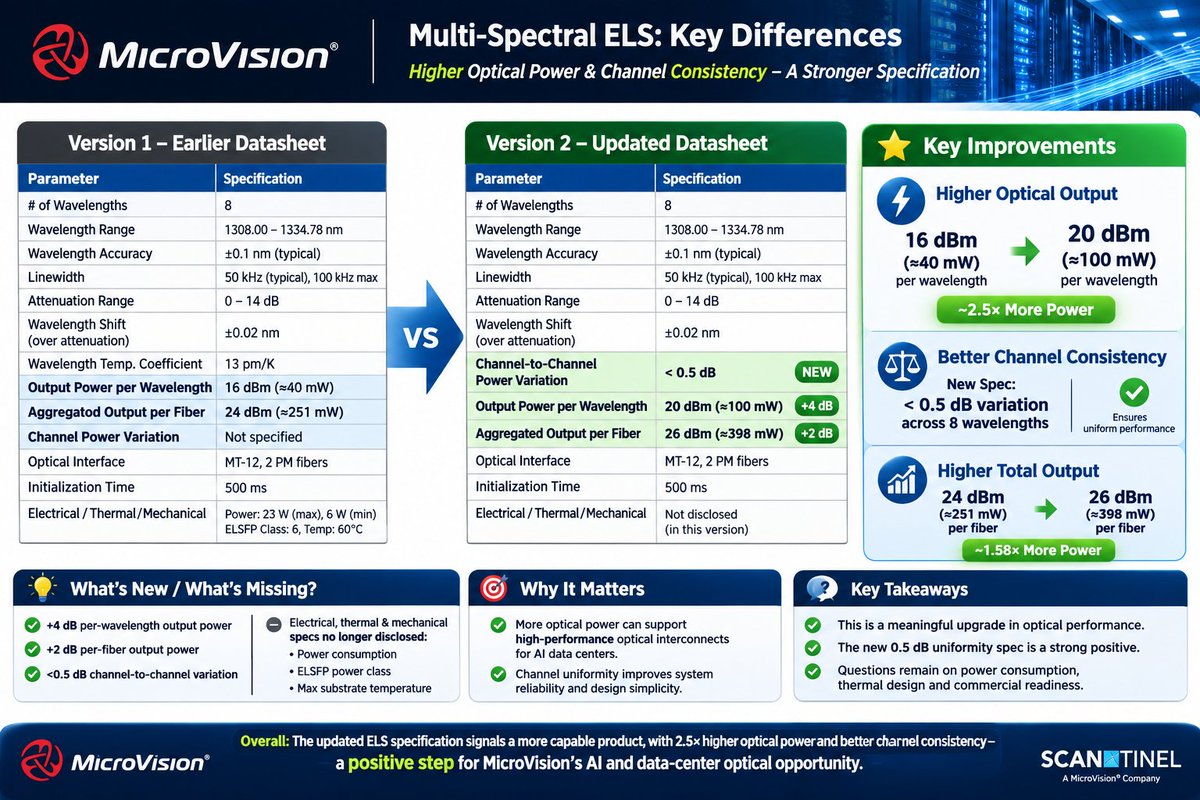
$MVIS Much improved #ELSFP module from Scantinel. Technically more impressive on optical output and channel consistency. Those are meaningful improvements for the #AI#datacenter optical connectivity opportunity.
New : https://t.co/J8Qf1lcfJP
Old : https://t.co/UZ4hqmfMeo
$MVIS Lawmakers are closing in on a deal to ban Chinese cars from the US, according to sources, following last-minute negotiations aimed in part at sparing Mercedes-Benz, which is nearly 20% owned by Chinese entities. What about #LIDAR ? $RIVN 🤔 🤷♂️
https://t.co/VXWX8rEc8G
Rivian's R2 LiDAR appears to be RoboSense's long-range EM4
US customs records show four shipments to Rivian from Singapore-based BotX Innovation SG between Nov. 4 and Nov. 12, the first described as "EM4-RIVIAN LIDAR SENSOR"
The shipments total just over 3,000 kg, enough for 2-3k sensors. Rivian plans to add LiDAR to employee cars this year and customer cars in 2027
BotX was a RoboSense subsidiary as of late August, according to its filings
Rivian has never named its LiDAR supplier. In March, responding to reports tying RoboSense's unnamed-customer descriptions to Rivian, a Rivian spokesperson told EV: "While I don't know what company RoboSense was referring to, it is not Rivian"
In April, Nikkei reported RoboSense would open its first overseas plant in Southeast Asia in response to customer concerns over what its CEO called "U.S.-China geopolitics and tariff issues"
Two weeks later, Rivian CEO RJ Scaringe told Reuters "all the real choices are coming out of China" for LiDAR at the "low hundreds of dollars price point"
In June, the Pentagon added RoboSense to its list of Chinese military companies, which restricts only DoD contracts. That same month, RoboSense committed to selling its Singapore sub-group, most likely BotX
On Oct. 12, all of BotX's shares moved to a Cayman company whose owner isn't disclosed
$RIVN
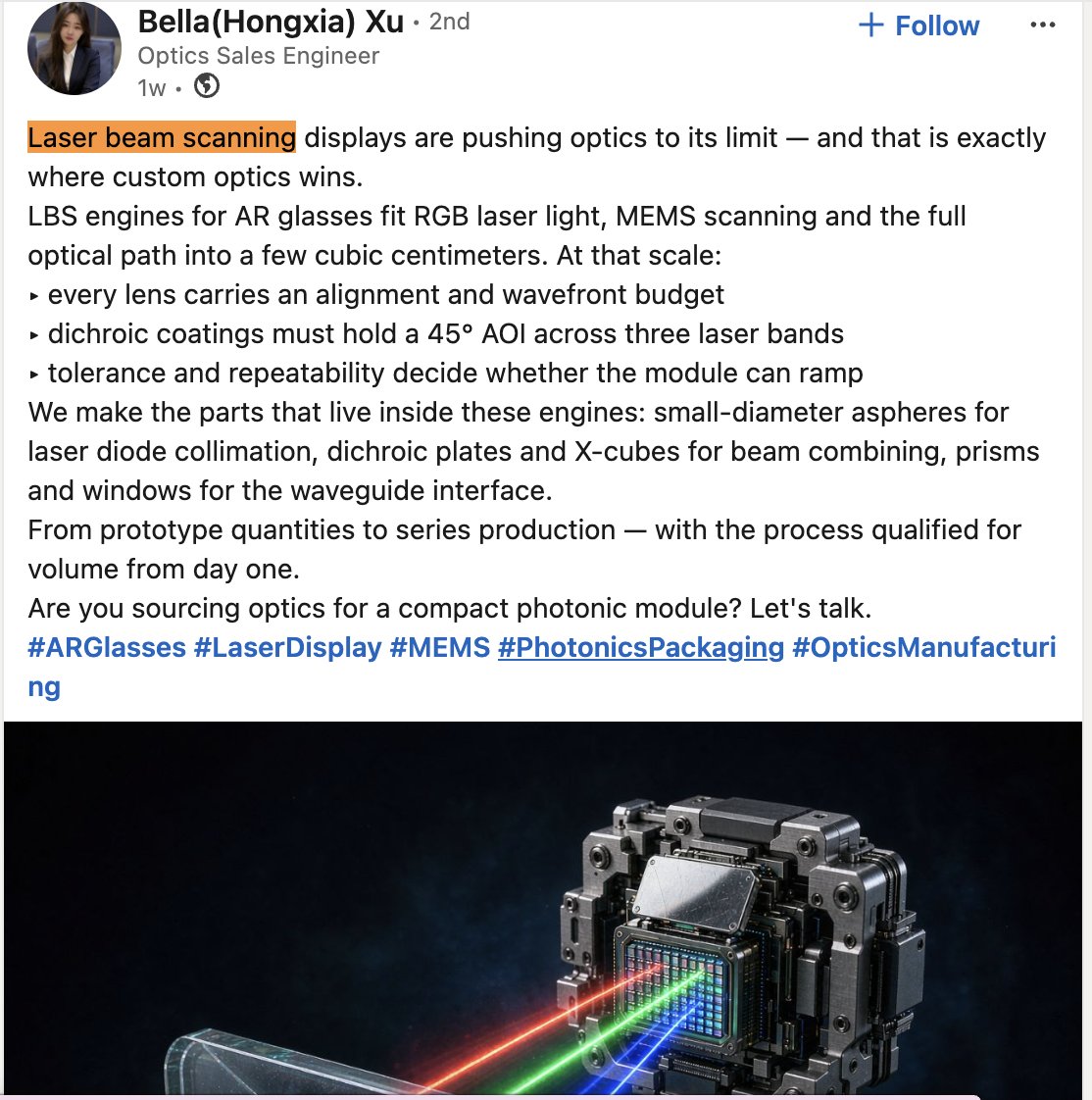
$MVIS So much is happening in laser beam scanning world and yet @MicroVision the pioneer in laser display won't even talk about it. It shelved it. Crazy ... let's see what happens. #LaserDisplay#MEMS
@RetailVolts@DougieFreshPick Most of the partnerships and contracts announced are small in volume. Are there any larger, high-volume commercial deals currently in the pipeline? Also, are there any automotive OEM programs actively under negotiation that we can expect to materialize in the near future?