Physicists have found a way to spontaneously assemble microscopic fractals. Even more amazing, these could form the basis of a new type of quantum computer -- in 1.58 dimensions.
https://t.co/QTGl49AkvO
Don't miss your chance to grab a free ticket to the #FedoraLinux 40 Release Party starting today! Register now and come find us on @matrixdotorg.
https://t.co/q2lCzPyXQR
Our official celebration for #FedoraLinux 40 is happening online this Friday and Saturday. Will you be there?
Register for free now and get the full scoop below:
https://t.co/AtVgbZhRqR
I've spent too much time thinking about how portals could work in the real world. From energy conservation to momentum conservation to moving portals, I have it all sorted out for you. And the cake is not a lie.
https://t.co/93meLX2p3C
I find it interesting that the word "science" in English has acquired a rather narrow meaning, usually referring only to the natural sciences. I have been wondering for some while now if not the shift of the meaning and use of the word "science" has had an impact on how the English-speaking world thinks about knowledge discovery, often dismissing knowledge in any discipline that is not part of what they call "science".
If you look up the German translation of “science”, you will get "Wissenschaft", which means loosely speaking 'dealing with knowledge' (“Wissen” = knowledge). But it’s a poor translation, because “Wissenschaft” is about knowledge discovery in general, not about the natural world in particular.
The origin of the word "science" is the Latin word "scientia" from scire ‘know’. That is, the original meaning also referred to knowledge in general, not to some disciplines in particular.
Consequently, in German, mathematics is -- of course -- a science. We also have "music science" (Musikwissenschaft) and "religion science" (Religionswissenschaft) and "literature science" (Literaturwissenschaft), etc, as they all deal with knowledge in some sense.
These latter examples are part of what in English is called "humanistics". In German they are called "Geisteswissenschaft", which means kind of "science of the mind" (that makes it sound like consciousness research, but I can't think of a better translation).
Philosophy is also a "science of the mind", in the German sense, as it concerns itself with knowledge.
I have talked to some Spanish people who have told me that they use the word 'ciencia' more in the German meaning of the word, not in the English one (not sure this is correct, my Spanish isn’t great).
You may notice this sometimes online, if you have non-native English speakers, some tend to assume eg that mathematics is science, whereas English native speakers find this odd.
One of the consequences of this linguistic shift seems to have been that as the English speaking world became dominant in science, the new “scientists” stopped paying attention to philosophy, as that was no longer part of their “science”.
This is especially obvious in physics, where you can see this happening in the early 20th century. While physicists previously had valued philosophical discourse, they later discarded it as supposedly useless.
Personally I think it’s a big problem and the major reason why the foundations of physics have stagnated. The new ‘scientists’ in this discipline seem to think that ‘theories’ are ‘scientific’ just because you can write them in maths. As a consequence, they keep on producing mathematical theories about nothing in particular.
If they stopped to think about what they are doing and why it’s not working and maybe read some philosophers, we’d make more progress.
The blame is partly on philosophers though because they seem to take pride in not being useful to scientists, usually not concerning themselves with any questions that physicists could actually use. Like why aren’t there thousands of philosophers discussing cosmological priors or naturalness or how to find out whether two models are “the same”.
Somewhat disturbingly, I have had several exchanges with so-called philosophers of science who clearly seem to take pride in being useless, and get offended if you ask them to be useful, as they see ‘being useful’ as being the task of scientists, which they are not.
And that returns me to my misgiving about the English use of the word ‘science’.
This was a “short” reply I wrote to Philip’s quote from Dirac…
https://t.co/EH0boOtAQn
@skdh I think the etymology of these words plays a role here. Science and the name of many scientific disciplines originate from Latin. German words for these nouns have a different etymology. My two cents :)
"Vita immaginaria" è il tema della XXXVI edizione del Salone Internazionale del Libro di Torino! ☁️
🎨 L'illustrazione del manifesto è di Sara Colaone
🎟️ La biglietteria è aperta! Fino alle ore 12 del 16/02 c'è la promo 2x1 di San Valentino: https://t.co/g0vGR9vClC
Researchers from the University of Basel and the NCCR SPIN have achieved the first controllable interaction between two hole spin qubits in a conventional silicon transistor.
https://t.co/RJ5ld2PS6u
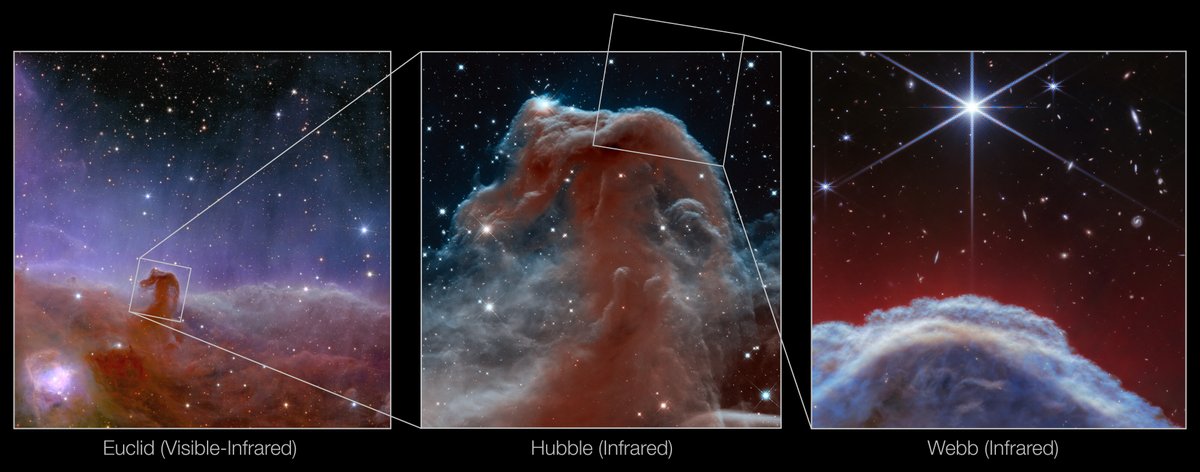
🐴⭐The Horsehead Nebula as seen by three space telescopes! 🤩
From @ESA_Euclid to @HUBBLE_space to @ESA_Webb, delve into the complementary views from these #BFFinSpace! Details 🧵👇
CMS releases #HiggsBoson discovery data to the public
The @CMSExperiment has recently released, in electronic format, the combination of the measurements that contributed to establishing the discovery of the Higgs boson in 2012.
This release coincides with the publication of the Combine software – the statistical analysis tool that CMS developed during the first run of #LHC, to search for the unique particle, which has since been adopted throughout the collaboration.
Find out more: https://t.co/tsHbrEpHam
Modified gravity recently ran into trouble by making a wrong prediction about wide binaries. However, in a new paper, John Moffat showed that at least one version of modified gravity -- called MOG -- fits the data just fine. I had a look.
https://t.co/R8oq1WXnLg
This Hubble image might look like it got marked up with white pen, but it's actually a photobombing asteroid's trail as it moves through Hubble's field-of-view!
These sorts of observations help get a census of the asteroid population in our solar system: https://t.co/to8zOExd1q