@BigWaveChartist It's been a revelation to me to track the indices' health to calibrate exposure and aggressiveness. I think this is not what some investors do (e.g. Minervini), but in my case it's given me clarity and structure.
@BigWaveChartist (Patrick here) Very true. Some strategies work well during a trending market. But many people insist on (ab)using them in every situation.
Negative Expectation Breaker on QQQ Friday closing at the 21ema.
Here are my thoughts on the current market and my current weekly focus list.
🔁 Retweet! 🔁
https://t.co/ajDUyhsQet
Tom Lee made his market open debut today on the show and we discussed a variety of topics including Ethereum & Bitmine:
- Why $ETH could be the biggest macro trade of the next decade
- How $BMNR is growing the NAV & ETH per share at an accelerated pace
- Ethereum end of year targets
Thank you to Tom @fundstrat for taking the time to join the show, we all deeply appreciated it!
$NVDA
TODAY IS A DAY TO REVISIT ONE OF MY FAVORITE OPTION STRATEGIES IN THE STOCK MARKET.
Anyone can do this, it is not “too advanced,” and it is one of the ways to benefit from an underlying equity if it stays flat/goes down.
Will be putting a long explanation below so feel free to bookmark & read later but I’ll be going through an actual example that you see in the screenshot below.
Let’s get into it.
To sell a covered call, you need to own 100 shares of a stock.
100 shares = 1 option contract.
You probably hear about people blowing up their accounts on reddit in options all the time. Those are people that are *buying* options, aka they are betting a stock will move up or down (up is a call, down is a put) and if the stock does NOT move in their direction, they lose all their money that they paid for the option contract.
Well, for every buyer…there is a seller.
If someone is buying the right to own 100 shares of a stock (a call option) YOU could be the seller of that contract. Citadell sells calls, Jane Street sells calls, Goldman sells calls…so could you.
I did not think $NVDA would be $185 by Friday, 8/22. So, I took 100 shares of Nvidia and put them “up for sale,” almost as if I was renting out these shares to someone, by selling a covered call. The call is covered with my 100 shares.
Terms of the contract:
- I get premium upfront as the call seller from the call buyer, in this case $2.37 a share or $237 a contract.
- If $NVDA is above $185 by expiry, I am forced to sell my 100 shares at $185. I still keep the $237 in premium.
- If Nvidia is below $185 by expiry, I keep my 100 shares, the contract goes to zero, the call buyer loses their money, I get to write another covered call again on those 100 shares while pocketing the $237 in premium.
When I learned about this strategy 2 years ago…it genuinely changed my life.
One of the worst case scenarios in this situation is I sell $NVDA at $185. Now my $NVDA average is $122.75, so if I did have to sell at $185…I wouldn’t be crying about it.
You can also roll the contract to avoid selling the shares but we will cover that another day.
So if $NVDA was $190 on Friday, yes I miss out on the extra $5/share, but I got paid $2.37, so I’m technically selling at $187.37.
Now, the odds of Nvidia being exactly above the strike price of $185 simply are more in my favor — you become the CASINO and NOT the gambler when you sell options. The call buyer MUST have the stock over $185. I just need it to be below it.
The other worst case scenario is $NVDA tanks to $160, I keep my covered call premium, but my shares down.
However…my average is $122.75. If I didn’t sell the covered call and Nvidia fell 10%, I’d still feel the pain, but with the covered call I get some benefit as the contracts go to zero and I collect premium on the downside.
Now obviously if you are buying $NVDA today at $178 to sell a $180 call for this week, Nvidia could tank and you are actually underwater on the shares.
But if you have a massive position in a name…that you’d be willing to yield premiums from call buyers who are taking a risk on the volatility to the upside but you are simply selling calls to them with the assumption that their expectations are too high…then you can yield a return from your stock even if it’s flat/down.
The math is:
100 shares at $122.75 avg
$12,275 I paid for the shares
Call premium is $237, so $237/$12,275 = 1.9% ROI
I sold the call on 8/14, today is 8/22, the call is up 87%, so if I were to close the call today…
I’d keep $207 (I’d give back $30 to close the contract, aka buy the contract back to close it) which means $207/$12,275 = a 1.7% return in one week.
There are not many businesses where you can use your capital to generate almost 2% in a week…obviously this can’t happen every week and markets are dynamic but I try to get an extra 1.5-2% a month, not per week, based on my option selling…which has been a game changer for me.
10 baggers aren't sitting at a $500B market cap, they are sitting under $5B with a growth plan still being actively executed.
These companies bring something different to industries begging for innovation.
Here are some of the most interesting businesses today under a $5B market cap:
1/ $ZETA
If you want to invest in a first mover of a space, $ZETA is the company.
They built their AI tech stack marketing platform 7 years ago. While other competitors are currently piecing together their own platforms, $ZETA is pitching a platform that is mature and tuned out.
They will grow by landing large clients (they already have 44% of the Fortune 500), increasing revenue from existing clients (2x'd rev per customer since 2020), and obviously improving the platform.
When the markets get over extended
momentum start to slow down & that makes entering breakouts much harder
so instead of entering on breakouts I look to buy into the key moving averages
specifically the 8 EMA on the daily timeframe
this works on the best stocks, in very strong trends already
BUT you don't just buy it the moment it touches the 8 EMA
look for price to give you a slow pullback to the daily 8 EMA
once the 8 EMA test occurs switch to the 1 hour time frame
From there you are looking for an hourly hammer or bullish engulfing candle with volume
This entry model is one of the most efficient "dip buys" in the market.
@RichardMoglen Oh this was a fantastic idea. Unfortunately this weekend I'm moving and made it impossible to be there. Are you planning to do this regularly o what do you have in mind?
@NickDrendel@Deepvue It actually makes sense to *always* look at the weakest groups as opportunities to hedge during the small pullbacks in an uptrend.
@nextbigtrade You're missing to put all this into context. Apparently JPMorgan just gave a probabilistic outlook based on the facts and if we'd stay the course. Comparing that to Stan Weintein's approach for stock trading is comparing apples and oranges.
The Benefits of Maintaining Fixed % Risk Relative to Equity for Long-Term Trading Success
Discipline and patience are crucial in trading to facilitate the compounding of returns, as supported by the law of large numbers. Compounding can be achieved through a straightforward risk management principle: Maintaining a fixed percentage risk relative to equity.
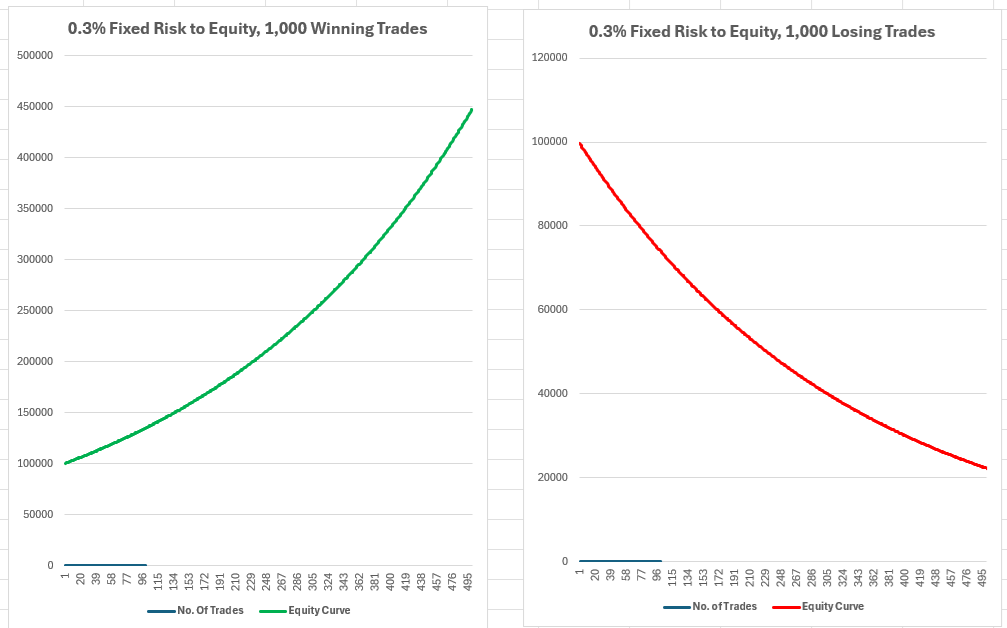
In the two-line chart below, I simulate the outcomes of 1,000 trades, showing consecutive 1R wins and -1R losses based on the simple principle of maintaining a fixed 0.3% risk relative to realized equity. This approach can propel your equity in a parabolic trajectory during a strong winning streak over a large trade sequence, while a losing streak results in a gradual decline as the dollar risk per trade adjusts automatically in line with the %-to-equity principle. Additionally, you get rewarded to increase/reduce risk in an automatic based on your trading performance without discretion. This risk principle carries a minimal risk of ruin at just 0.01%, making it highly valuable for testing strategies without the need to top up your trading account.
Account Start: $100,000
Risk to Equity: 0.3%
Dollar Risk (Start): $300
After 1,000 Trades
Risk to Equity: 0.3%
Dollar Risk (End For Win Graph): $1,337 (+$1037)
Account End: $447,164 (Gain +$347,164)
Dollar Risk (End For Lose Graph): $67 (-$233)
Account End: $22,263 (Loss: -$77,737)
I hope this post serves as a reminder of two key trading principles that are often overlooked in the context of long-term success: 'Treat trading as a business, not just a series of isolated trades,' and 'Focus on the process rather than the outcome of individual trades.'
Do retweet of you find this post helpful.
@TedHZhang@realDonaldTrump Take it as constructive feedback: I think what you are lacking is real world experience to identify the whole tariff issue as one of the most chaotic, less thought-out moves of any US President ever. Actual businesses are seriously hurt and suffering unnecessary pain for no gain.
@TedHZhang@realDonaldTrump I'd agree with you if it wasn't that he's always shown egocentric, erratic behavior. You look like a rational guy, Ted. Would you even give your home's keys to someone that erratic?
@markminervini If I can offer some perspective. The problem is that your post can viewed as partisan during very divisive times. Many replies in support are full of insults, like "liberalism is a mental disorder", etc. Intentional or not, you're also attracting the crazies from the other side.