Great commentary by @singletonion and @amykooz on our recent #psychedelics paper! Totally agree that simultaneous EEG-fMRI can help disentangle neural and neurovascular effects to better understand the neural background of the psychedelic state. More work to be done!
My comment with @amykooz on the recent (and very nice) psilocybin fMRI paper by @SMortaheb & @ADemertzi is now live. TLDR: the global signal debate continues!
https://t.co/eRkkHpMYL9
💡WE ARE HIRING💡
For the “Brain-to-Body MRI” (B2B-MRI) project we have a 2-year MRI physicist postdoc position as part of a local collaboration project to develop/extend 3T and ultra-high field 7T #MRI applications!
All practical details 👉 https://t.co/8uKSBTp9Jx
18/20 Therefore, we suggest considering GS amplitude as a complementary measure to the extracted connectivity profiles as they illuminate their physiological substrate, as we recently showed for the case of mind-blanking https://t.co/n62JtvptKF
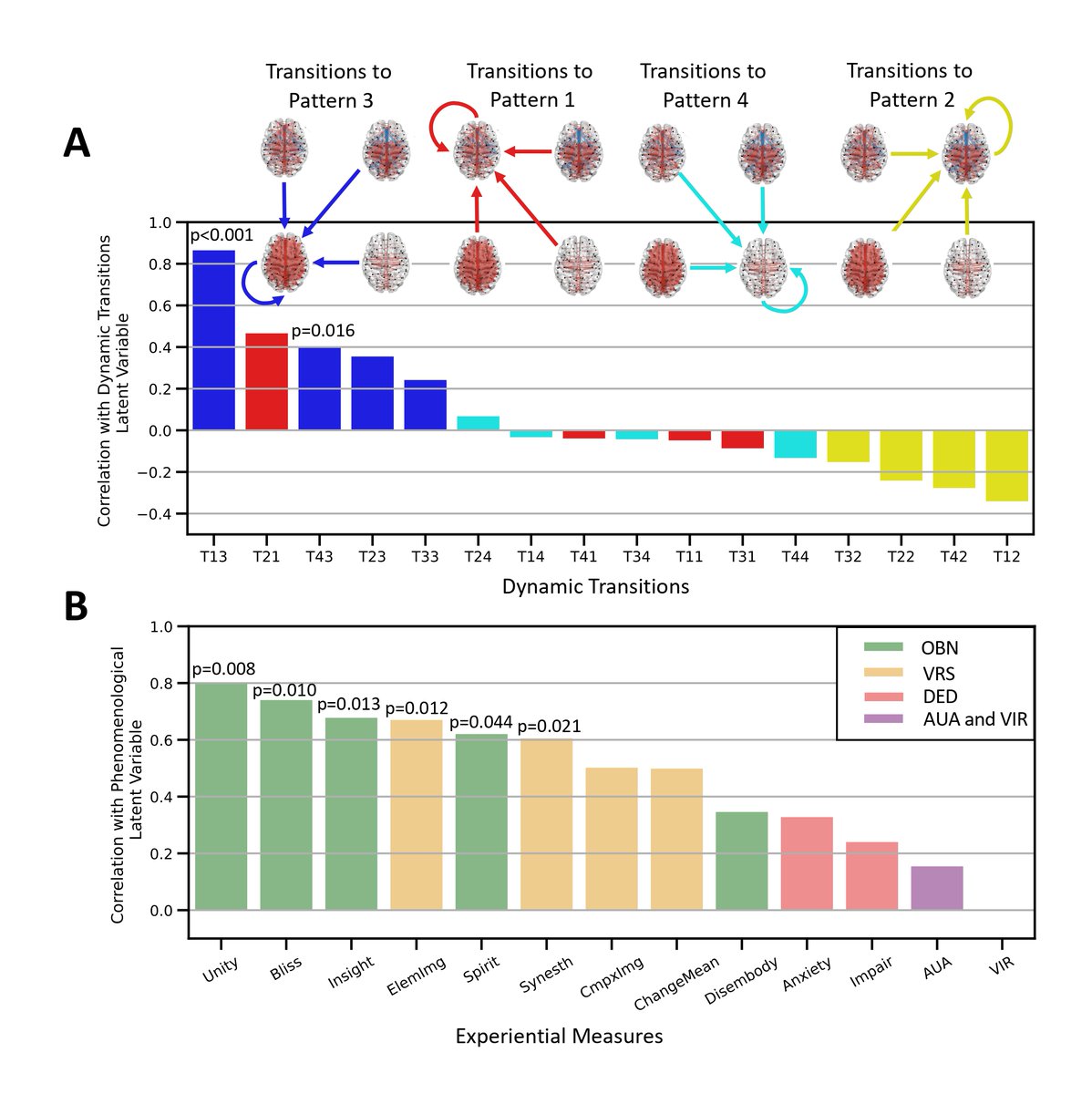
15/20 We found that the transition probabilities to the hyperconnected Pattern 3 and the phenomenological factors related to Oceanic Boundlessness and Visionary Restructuralization showed the highest correlations with the first canonical vector of their associated spaces.
17/20 The decreases in BOLD signal amplitude in the psychedelic state could imply that increased cortical arousal mediates this hyperconnected pattern (e.g. https://t.co/dNlpa761DI).
16/20 In conclusion, we illuminate the intricate interplay between brain dynamics and subjective experience under psilocybin, providing new insights into the neurophenomenology and neurophysiology of the psychedelic state.
14/20 To bridge neural and behavioral data, we performed canonical correlation analysis, by considering between-state transition probabilities as the neural features, and the 11-ASC factors as phenomenological features.
13/20 Also, regressing out the global signal (GS) eliminated the hyperconnectivity pattern in dynamic connectivity states, yielding no significant difference between the Placebo and Psilocybin groups. Therefore, GS is crucial for a more comprehensive analysis.
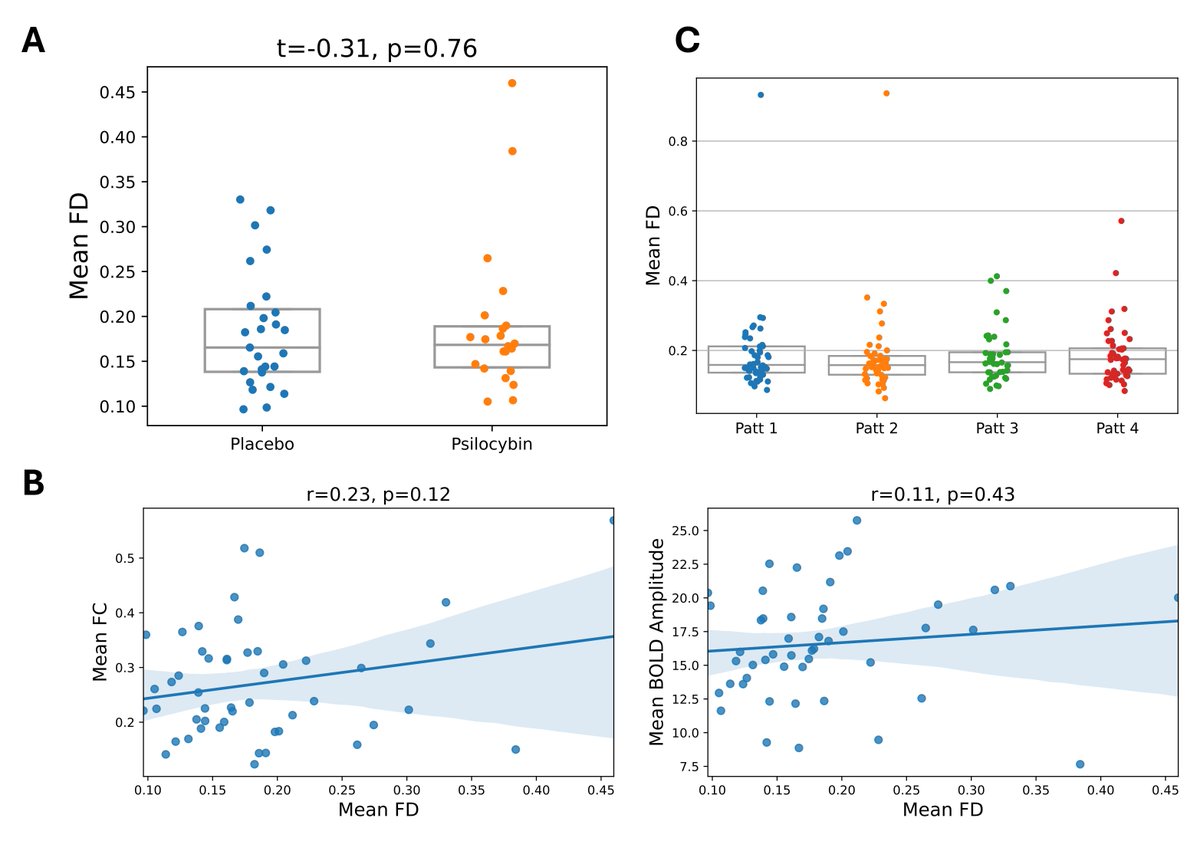
12/20 Motion did not affect the results. Mean framewise displacement (FD) remained consistent across groups and connectivity patterns, showing no significant differences. Moreover, it did not correlate with mean functional connectivity or BOLD amplitude.
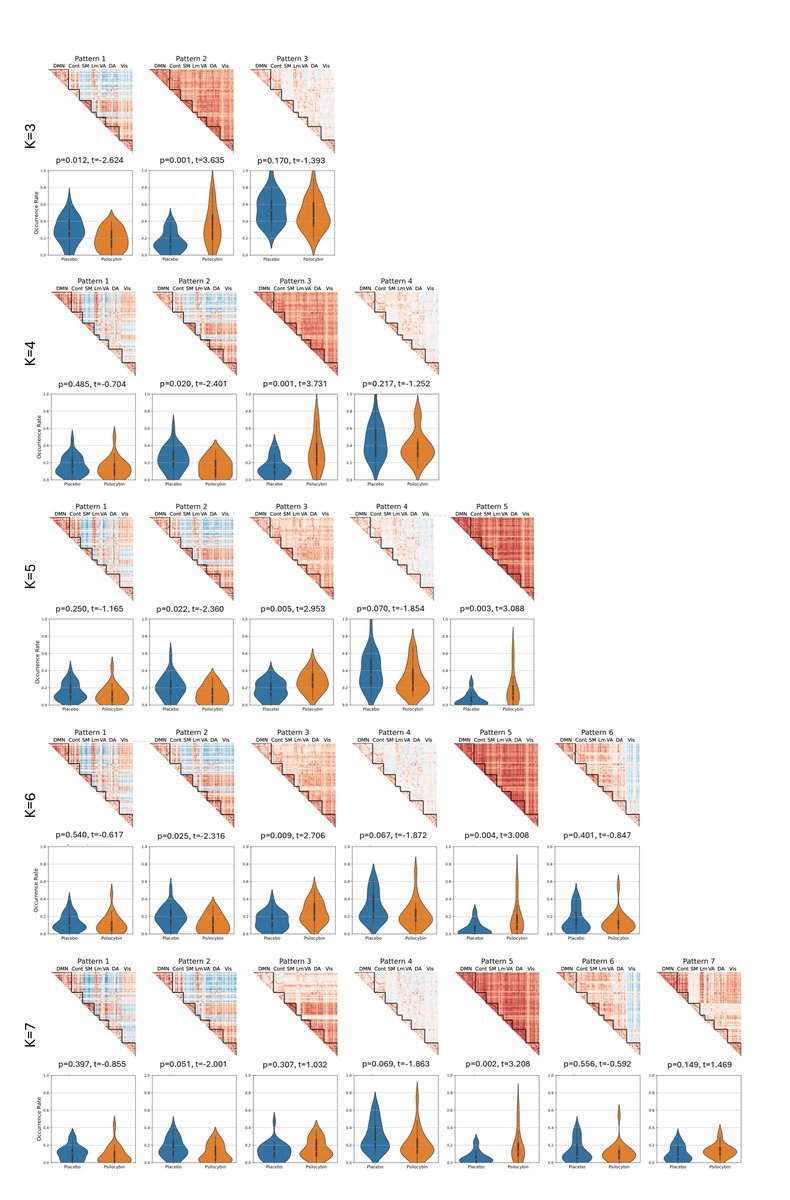
11/20 Changing the number of clusters from 3 to 7 yielded consistent results. Across all conditions, the hyperconnected pattern was notably prevalent in the psilocybin group.
🎉 Our work "Dynamic Functional Hyperconnectivity after Psilocybin Intake is Primarily Associated with Oceanic Boundlessness" is out in Biological Psychiatry: Cognitive Neuroscience and Neuroimaging! 🧠🍄Have a look here https://t.co/hZf7nrx9ms.
A thread below:
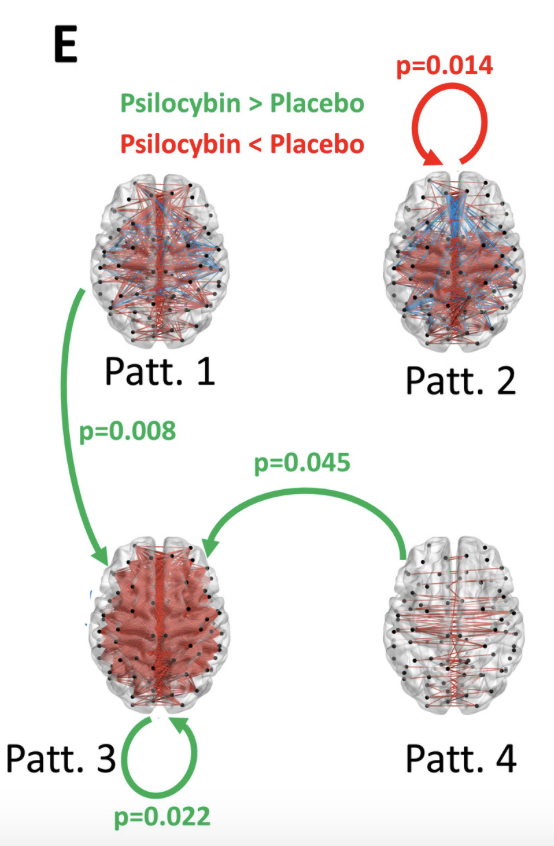
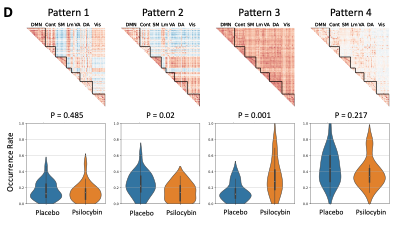
9/20 The patterns concerned both correlations and anti-correlations (P1), anti-correlations of the DMN with other networks (P2), global hyperconnectivity (P3), and low inter-areal connectivity (P4). The hyperconnected Pattern 3 showed the highest occurrence rate after psilocybin.
8/20 To investigate the effect of psilocybin on the dynamics of the whole-brain functional connectome, we estimated phase-based coherence matrices at each scan volume, which were summarized into four connectivity patterns using k-means clustering.