I'm a highly data driven person with a passion for #PPC. #Python is my weapon of choice. I love to write software tools to solve #SEO and PPC problems.
My action plan before Aug 17:
Review budget-capped tCPA campaigns
Compare target CPA vs actual CPA
Lower targets closer to actual CPA where needed
Watch CPC, CPA, and conversion volume after the change
Would you adjust budget, CPA target, or switch bid strategy?
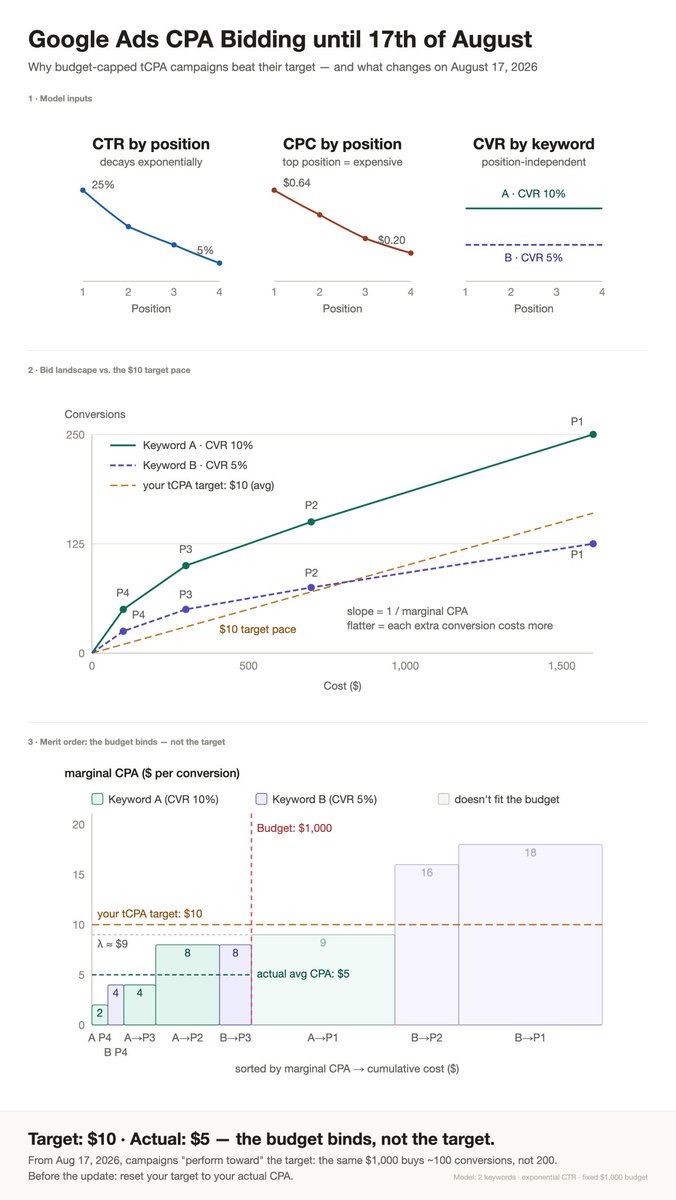
Google Ads tCPA is changing after Aug 17, 2026.
Budget-capped campaigns that currently beat their target may start “pacing toward” the target instead.
Example:
Target CPA: $10
Budget: $1,000
Actual CPA: $5
Today: ~200 conversions
After change: potentially closer to ~100
+++
That is why I struggle to see this as a pure advertiser benefit.
If the target stays at $10 while reality is $5, the system has permission to pay more per conversion.
Maybe volume increases in some cases.
But under a fixed budget, volume can also fall.
+++
PMAX reality check:
Reseller-heavy placements are where bot traffic hides and ad budgets quietly bleed.
We analyzed 3,376 PMAX display placements.
27% have 75–100% reseller chains in ads.txt.
That’s not “programmatic efficiency.”
That’s maximum opacity.
The logic is simple:
++
More resellers:
→ less accountability
→ higher fraud risk
Long reseller chains make it easier for:
• invalid traffic to blend in
• quality issues to spread
• responsibility to disappear
Even without outright fraud, margin leakage and low-quality inventory add up fast.
"Your ad appeared alongside Google because Google determined that competing with you for your own audience was in everyone’s best interest — especially Google’s." #PPC
Anyone else noticing this? Mine started around late July. It’s not even a product Google sells. Thoughts?
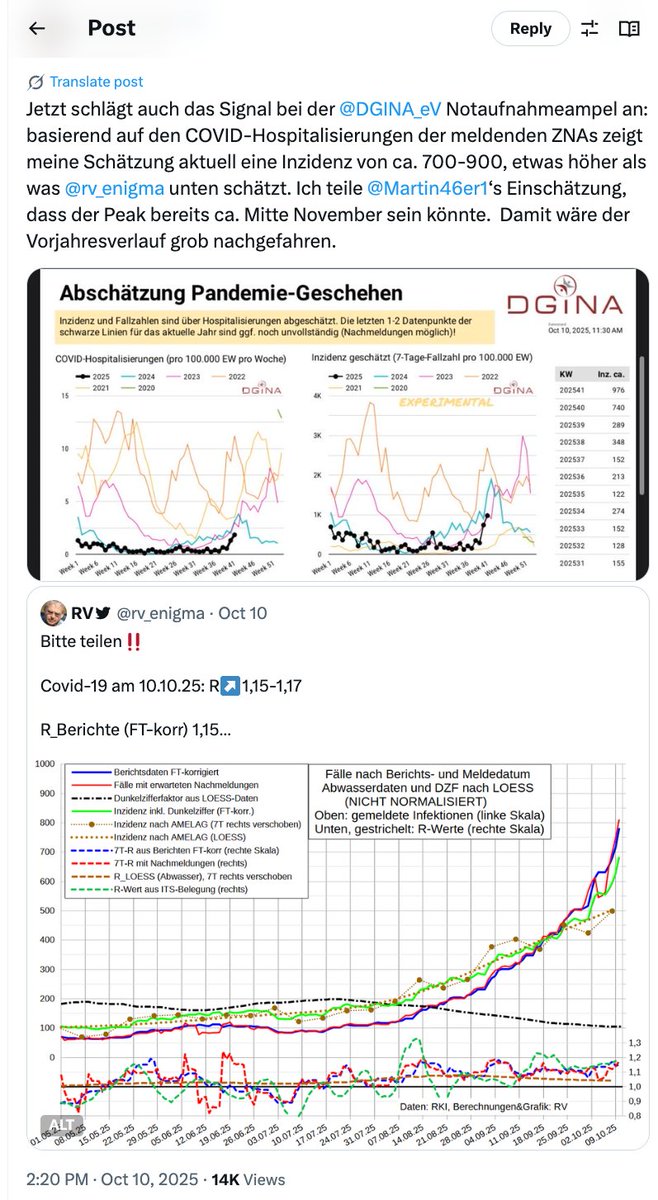
COVID ist nicht weg: In Deutschland sind die nächsten ca. 8 Wochen erhöhte persönliche Infektions-Schutzmaßnahmen empfehlenswert (u.a. Masken in Räumen mit vielen Menschen, gute Belüftung, Testen bei Symptomen, das übliche halt).
Wir sind gerade mitten in der COVID-Herbstwelle 2025. Es ist zu erwarten, dass sich die Fallzahlen bis ca. Mitte November noch einmal verdoppeln (auf über Inzidenz 1000 inkl. Dunkelziffer, also >1 von 100 ansteckend) und dann die Welle ausläuft, ähnlich wie im Vorjahr. Die Zahlen vom RKI muss man aktuell mit Dunkelzifferfaktor 100 multiplizieren.
Bleibt gesund! LongCOVID ist sch**e.
Im Bild: Daten der @DGINA_eV Notaufnahme Ampel, wo wir seit November 2020 tagesaktuelle Daten von Notaufnahmen in ganz Deutschland erfassen, aus denen sich das Infektionsgeschehen abschätzen läßt (ehrenamtlich betrieben von @SNeefischer und mir).
Hey #PPC Network 👋 I wanted to pick your brains about Google’s February 2025 update on landing page navigation quality (https://t.co/wydZrko1gj) and its real-world impact on Landing Page Quality Scores. Specifically, have you noticed 📉 drops for typical B2B/lead‐gen pages +++
BELOW_AVERAGE” for LPQS has climbed, and overall QS is trending downwards.
-Have you observed similar shifts in LPQS for no-navigation or stripped-down lead-gen pages?
-Has anyone tried enhancing navigation (breadcrumbs, menu links, footer, etc.) to see a positive bump in LPQS?++
Unser Paper "Modellierung der COVID-Infektionszahlen in Deutschland (2020–2024)" ist online:
Zusammen mit @rv_enigma, @Martin46er1, @SNeefischer und Prof. H. Dormann haben wir versucht, die tatsächliche Anzahl (also inkl. Dunkelziffer) an COVID Infektionen in DE abzuschätzen.
@JoeMayLI@theJoeShmow We released a free tool that is going for those single words that are outside the known vocabulary: https://t.co/kgpHyXxy4A
You get the highest „red“ coloring when you make use of broad Match heavily 😂