They called them flying coffins. The men who volunteered to fly them knew exactly why.
The Allied gliders of D-Day were made of fabric stretched over a frame of wood and metal tubing. They had no engine. No armor. No weapons. No parachutes for the men inside. They were towed to France at 130 mph on the end of a 300-foot nylon rope attached to a C-47, and when the rope was cut, there was one chance to land.
One. No go-arounds. No second approach. Whatever was below you was where you were going.
What was below them was Normandy at night.
The Germans had spent weeks preparing. Under orders from Field Marshal Rommel, they had driven wooden stakes into every open field in the region, angled to impale gliders on landing. The French called them Rommelspargel. Rommel's asparagus. Thousands of poles, many with mines or artillery shells wired to the tips, packed into every field large enough to land on.
What the glider pilots had not been properly told was the scale of the Norman hedgerows. The bocage. These were not English garden hedges. They were ancient earthen walls, some dating back centuries, topped with dense root systems and trees, rising 50 feet in places, bordering fields barely 200 yards long. A Horsa glider coming in at 100 mph hitting a hedgerow did not survive it. Neither did most people inside.
Some fields were flooded. Some were mined. Many were both.
517 gliders went into Normandy. 97 percent were abandoned in the field by the end of the operation. Most were destroyed.
General Don Pratt, assistant commander of the 101st Airborne, was in the first glider wave. His pilot managed to find a field near Hiesville and brought the glider down. It slid across the wet grass without slowing and hit a hedgerow at speed. The co-pilot died instantly. The pilot, Lieutenant Colonel Mike Murphy, broke both legs. General Pratt suffered a broken neck. He became the first American general to die in the Battle of Normandy. His glider had landed in one piece.
Sergeant Eric Wilson's glider did not. It hit a building at high speed. Both of Wilson's legs were broken. He was trapped inside the wreckage, unable to move, in enemy-held Normandy, for two and a half days before anyone reached him.
Lieutenant Den Brotheridge had come in earlier than anyone, in the first glider to land in France, the silent coup de main assault on Pegasus Bridge just after midnight. His glider stopped 47 yards from its target. He led his men out at a run, reached the bridge, and was shot. He died within minutes, the first Allied soldier killed by enemy fire on D-Day.
The men who survived the landing did not get to stop. Glider pilots were not assigned to combat units. Once down, they were expected to fight as infantry, dig foxholes, guard prisoners, carry ammunition, do whatever was needed. Most of them had trained to fly, not to fight on the ground behind enemy lines in the dark.
They did it anyway.
Of the 517 gliders that went in, 222 were Horsa gliders. Most were destroyed either on landing or by German fire in the hours that followed. The Waco CG-4As fared slightly better but 97 percent of all gliders from the entire operation were eventually abandoned in Norman fields, broken and empty.
The men who flew them were not pilots in the traditional sense. They were soldiers who had been given just enough training to put an unarmed, engineless box of fabric and wood into a dark foreign field at 100 mph, full of men and equipment, with one attempt and no margin for error.
Many of them got it exactly right.
Many of them did not come home.
Today is June 6th.
Remember them too.
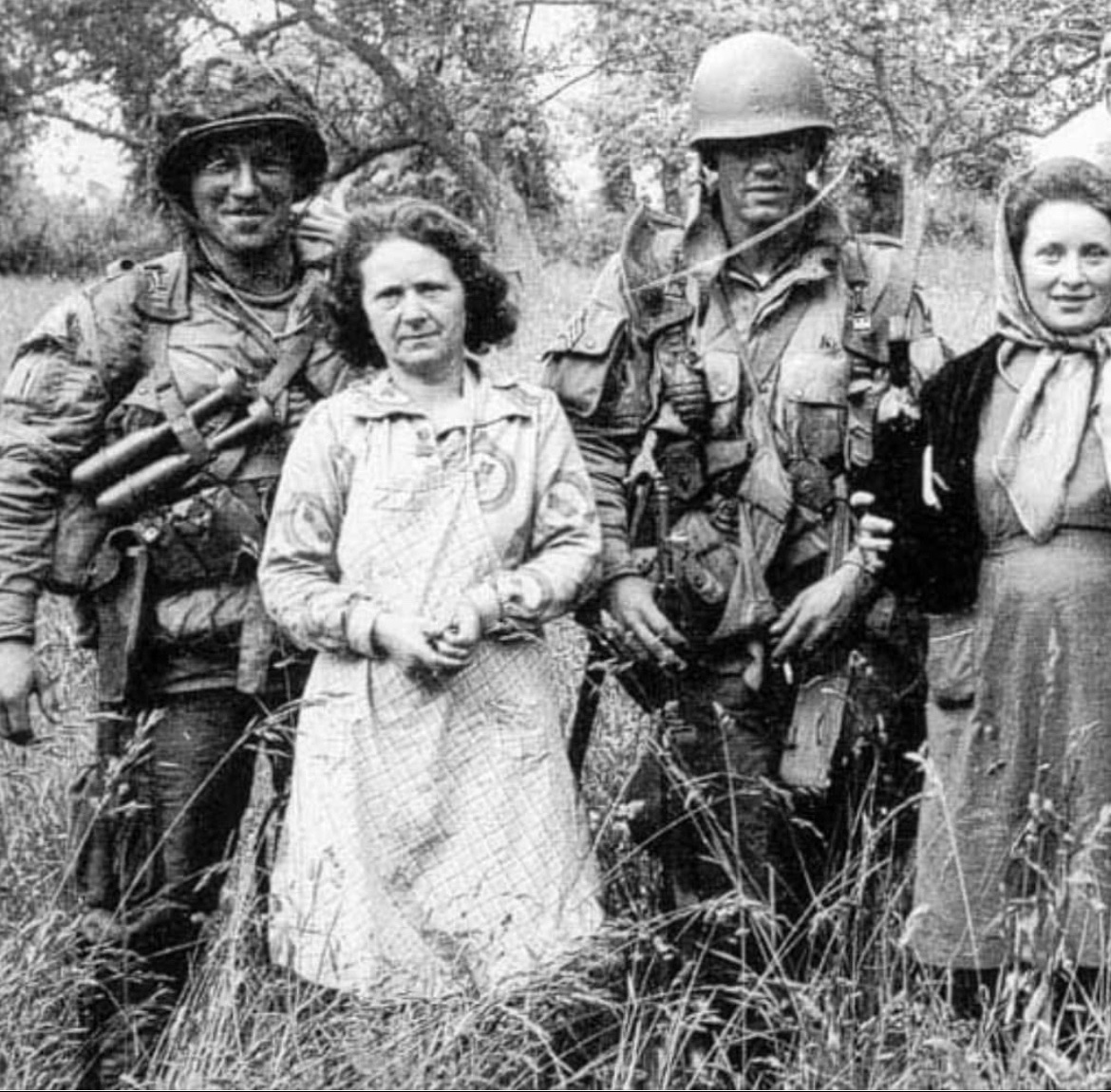
After making their first combat jump 82 years ago today, paratroopers Forrest Guth and Floyd Talbert of Easy Company pose for a photo with some locals in Normandy, France.
June 5, 1944. 3:30am.
Eisenhower woke to howling wind and hard rain. At 4:15am, in a water-soaked tent, his meteorologist James Stagg told him: there's a 24-hour break in the storm coming. One window. Miss it, and the next date is June 19.
He had 5,000 ships and 160,000 men already moving toward France.
He said: "OK. Let's go."
That evening at 8:30pm, he drove to Greenham Common to stand among the paratroopers of the 101st Airborne. He had just been privately briefed they could expect 80% casualties. He didn't show it. He walked through the crowd, shaking hands, asking names, asking where men were from.
One soldier, Lt. Wallace Strobel, said Michigan.
Eisenhower smiled. "Oh, Michigan. I used to fish there. Great fishing in Michigan."
Witnesses said his eyes were wet when he got back in the car.
That night, alone, he wrote four sentences and stuffed the paper in his pocket:
"Our landings have failed to gain a satisfactory foothold and I have withdrawn the troops. My decision to attack at this time and place was based upon the best information available. The troops, the air and the Navy did all that Bravery and devotion to duty could do. If any blame or fault attaches to the attempt it is mine alone."
He misdated it "July 5." His mind was somewhere else.
Meanwhile, across the Channel, Field Marshal Rommel was in his staff car rolling through Germany toward home. His wife Lucie was turning 50 tomorrow. He had brought her a pair of shoes from Paris.
The Germans had no Atlantic weather stations. Their meteorologists had told high command: no invasion is possible in this weather. Rommel genuinely believed they had weeks.
The paratroopers jumped at midnight.
Moment d’émotion quand le vétéran du débarquement 🇺🇸 Arthur Rose,107 ans, relit son courrier et exprime sa gratitude pour l’honneur d’avoir été parmi les héros de 44, et remercié en fin de discours par notre ministre des armées.
#6juin44
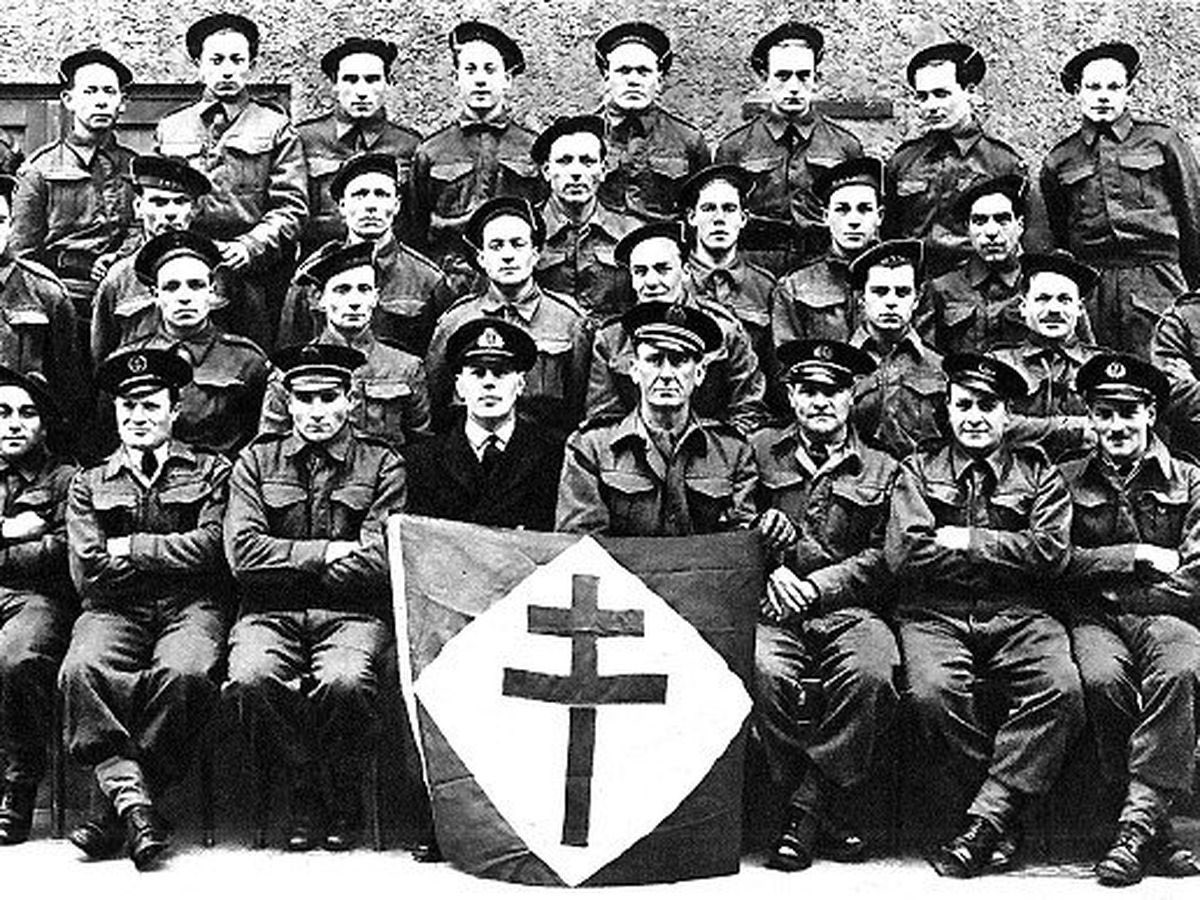
177 Français débarquaient avec les Alliés.
Mais sur la mer, devant les côtes, il y avaient aussi des navires français, et donc des marins participant au plus près à l’appui des soldats sur les plages.
👇
https://t.co/QaUoX2kaQp
6 juin 1944, à l’est du Débarquement : quand les commandos entrent dans l’Histoire
À Sword Beach, la guerre moderne avance au pas calme des hommes sûrs d’eux. La matinée du 6 juin 1944, sur le flanc oriental du débarquement allié, ne se résume ni à une charge désordonnée ni à une mécanique parfaitement huilée. Elle se joue dans un mélange subtil de précision préparée, d’improvisation permanente et de courage brut. Vers 8 h 40, dans le secteur de Sword Beach, à La Brèche, les hommes de la 1re brigade de service spécial approchent la côte normande à bord de petits LCI(S) à faible tirant d’eau. Leur mission est claire, essentielle et dangereuse : pénétrer rapidement à l’intérieur des terres, établir la jonction avec les troupes aéroportées autour des ponts de l’Orne et sécuriser le flanc est de la 2nd Army britannique.
Lorsque les commandos mettent pied à terre, la scène devient instantanément emblématique. À leur tête marche Simon Fraser, brigadier de la brigade, silhouette immédiatement reconnaissable. Il avance dans une eau profonde jusqu’à la taille, béret vert sur la tête, fusil porté avec une décontraction presque provocante. Son allure n’a rien de théâtral. Elle est délibérée. Lovat ne court pas. Il donne le tempo. Il attend que ses hommes suivent sans hésitation, convaincu que le calme est parfois la forme la plus efficace de commandement. À sa droite, tout aussi visible et pourtant totalement incongru dans un tel enfer, se trouve Bill Millin, cornemuse en bandoulière. Malgré les règlements interdisant formellement aux cornemuseurs de débarquer en première vague, Lovat a insisté. Millin joue. Highland Laddie, The Road to the Isles, et d’autres airs écossais s’élèvent au-dessus du fracas des armes. Le son traverse le vacarme des explosions et des tirs, coupant le bruit de la bataille comme un défi lancé à l’ennemi. Ce moment, figé par la photographie, devient l’un des symboles les plus puissants du Jour J.
Sous des tirs sporadiques de mitrailleuses et de mortiers, les commandos progressent à travers Queen Red Beach. Ils contournent les obstacles, dépassent les vestiges d’embarcations détruites et croisent les premières vagues d’infanterie déjà engagées. Leur entraînement intensif, leur discipline collective et leur équipement léger leur permettent de quitter rapidement le sable, là où tant d’unités restent clouées au sol. À La Brèche, ils amorcent sans délai leur poussée vers l’intérieur des terres.
L’objectif ne souffre aucune ambiguïté. Il faut atteindre les troupes aéroportées britanniques et tenir les ponts vitaux sur le canal de Caen et la rivière Orne. Ces points de passage conditionnent la sécurité de tout le flanc est du débarquement. Si les Allemands parviennent à les reprendre, la menace sur les plages devient immédiate.
À midi, la jonction est réalisée. Les commandos de Lovat atteignent les paras comme prévu. Ce succès tactique, souvent éclipsé par les combats plus meurtriers d’autres secteurs, est pourtant décisif. Il garantit la cohérence du dispositif allié et empêche toute contre-attaque allemande majeure sur ce secteur critique. L’image de ces hommes entrant dans le surf, menée par un brigadier imperturbable et un cornemuseur jouant sous le feu, dépasse la simple anecdote. Elle incarne une certaine idée de la guerre commando : avancer vite, frapper juste, et maintenir une maîtrise absolue de soi là où tout incite à la panique.
Selon vous, ce sang-froid presque irréel fut-il avant tout le fruit d’un entraînement d’élite… ou l’expression d’un commandement capable d’imposer le calme au cœur du chaos ?
Il y a 82 ans, ils ont versé leurs sang pour notre liberté.
Ces combattants ont donné leur vie pour que la France soit libre, pour que nous puissions aujourd'hui vivre en paix.
Que leur sacrifice reste à jamais inscrit dans notre mémoire collective.
N’oublions jamais. 🖤
À Londres dès juin 1940,il rêve d'un commando français. Et à 41 ans, sans passé militaire, il est à peu près le seul. Mais le 6 juin 1944 on verra les siens libérer Ouistreham,lui,debout sur un char malgré la mitraille, blessé 2 fois. Son rêve, c'était la France. Philippe Kieffer
This scene from Saving Private Ryan (1998) shows the morning of June 6, 1944 when the Allied forces first arrived at Omaha Beach. It is shocking and tough to watch, but a crucial reminder of the sacrifice here that can never be forgotten. A must-see.